Plagiarism in Pop Culture: Daredevil

Daredevil is, without a doubt, a very unusual superhero.
Blinded as a teenager in an accident involving radioactive material, his other senses compensated for his lack of sight by becoming superhuman to the point of having “radar vision.” He then uses those powers to fight crime becoming one of Marvel Comics’ most popular characters.
However, his alter ego is equally compelling. Matt Murdock is a brilliant lawyer who overcame his blindness to find great success in the legal field with his partner Foggy Nelson. This makes legal drama a major part of the character and the series.
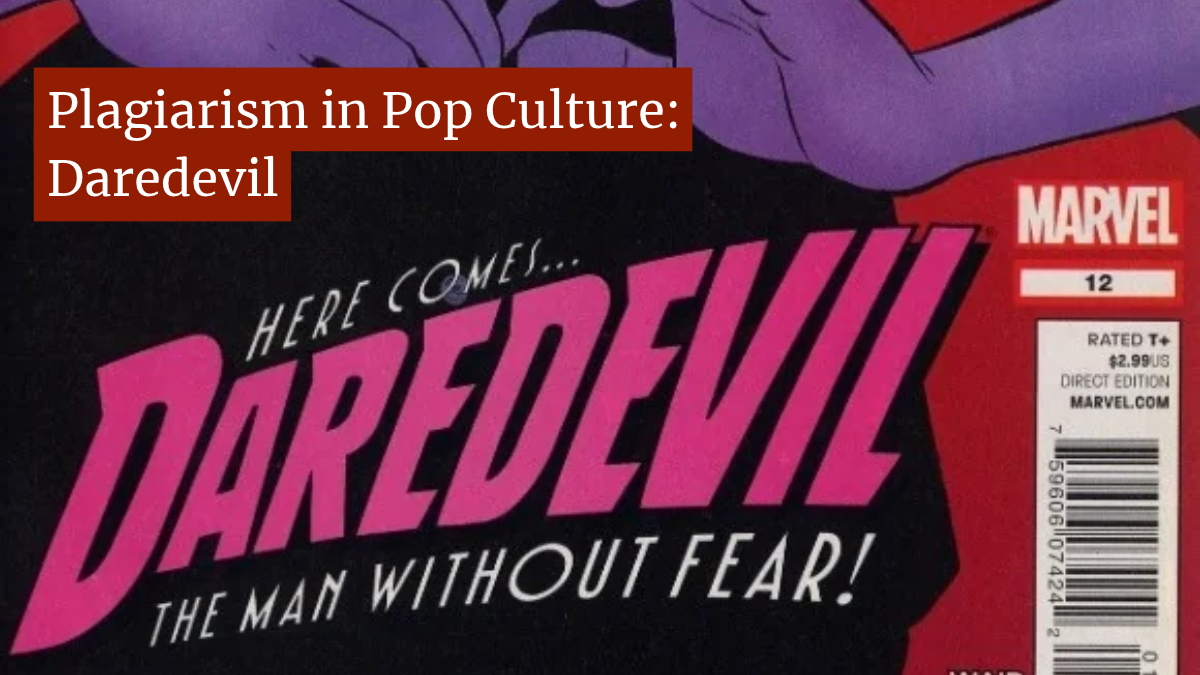
So what happens when Murdock has to fight a plagiarism-related injustice? We find out in issue #12 of Volume 3 of Daredevil, entitled “Battle Buddies.”
But the issue isn’t your usual superhero story. It’s meant to build the characters of Matt Murdock and Foggy Nelson. Still, seeing how the two address the issue not only explains a great deal about them personally, but also how their friendship formed.
The Plot

The story opens with Matt Murdock on a date with assistant D.A. Kirsten McDuffie. Kirsten is convinced that Matt is Daredevil and is faking his blindness. As such, she uses the date as an attempt catch him off guard, something that Matt is always one step ahead of.
During the date, Kirsten asks Matt about Foggy, prompting him to tell her the story of how the two met. That flashback is the plagiarism story we’re focusing on here.
According to Matt, the two met as roommates at Columbia Law School. Initially, Matt despised Foggy, finding him lazy and boorish. The two also share a class with Professor Leopold York, a stroke survivor who has a soft spot for Matt but despises Foggy.
One day, Foggy returns to the room crying. He explains that Professor York expelled him for plagiarism, saying that he had copied a previous student’s work. Matt, listening to Foggy’s heartbeat, determines that he’s telling the truth and promises to help him out.
Matt confronts Professor York, who claims that Foggy copied the work verbatim and must have stolen the paper when he came by his office. However, listening to the Professor’s heartbeat, Matt determines that he is lying and says so to his face.

Professor York threatens Matt, saying that if he pursues the case, he will be expelled as well. Matt is undeterred and begins to investigate the claims.
After gathering evidence, Matt and Foggy walk into Professor York’s class and lock the door. Matt announces that they are holding a trial in the case of “Leopold York v. Foggy Nelson.” Matt makes the class attendees the jury and proceeds to represent Foggy in the mock case.
Matt is able to provide very convincing evidence that Foggy could not have stolen the paper in question. This included tracking when the office was open and where Foggy was at those times. However, Professor York was able to explain that saying that it was possible for Foggy to have obtained the paper on the internet.
Defeated, Matt seems crestfallen. However, it’s Foggy himself who saves the day. He notes that the professor had a stroke ten years ago and had to relearn how to write with his left hand. Her notes that, even though the paper supposedly came from before the stroke, his notes on the paper match his current handwriting.

Professor York doesn’t admit defeat. Instead, he simply says that class is dismissed and that he will see both Matt and Foggy in class next week.
Matt then concludes the story, saying, due to his tenure and position, that Professor York did not face any accountability. However, Matt and Foggy remained friends ever since, with Foggy even using his family money to pay for Matt’s education.
Understanding the Plagiarism
The plagiarism, or rather the fake plagiarism, in this story is relatively straightforward. Professor York, bearing a grudge against Foggy, fabricated evidence of a 12-year-old paper that matched Foggy’s submission verbatim. He then used that evidence to get Foggy expelled from the school.
But there lies the first big problem. There is absolutely no way that Foggy would have been expelled on the word of one professor for a single allegation of plagiarism.
First off, at a major school like Columbia Law School, disciplinary action would have to go through multiple parties, have opportunities for the accused to defend themselves and have at least one appeal. The process would have taken months.
Though Matt and Foggy make some mentions of outside administrators, it’s clear that they glossed over the lengthy process that would have been required to expel Foggy. In fact, Matt would have had an excellent opportunity to present his case at an academic hearing, no in-class shenanigans required.
But even if Foggy had been found to have plagiarized the paper, it’s unlikely that he would have been expelled. For first instances, other punishments such as a zero on the assignment or even an “F” for the class would be more common. According to this story, Columbia Law School skipped over a lot of more reasonable punishments and jumped straight to expulsion.
Then there is the insanity of the professor’s plan. To be clear, we don’t know exactly when this story takes place. Though the issue was published in May 2012, it’s a flashback with an ambiguous date. However, we do know that the internet was at least available to everyone involved.
Falsifying evidence of plagiarism is, in a word, stupid. It could be easily disproven. Furthermore, if Foggy got the paper from the internet, where was it online? When was it posted there? Why was it posted there? This evidence is too easy to disprove.
Professor York’ didn’t have to do anything. All he had to do was grade Foggy’s paper harshly and, assuming that his class is a requirement, Foggy would have been just as screwed. While this would be wildly unethical, it is far less actionable than fabricating evidence of plagiarism.
And that does lead to the final point. If a professor were exposed for fabricating evidence of plagiarism, I can’t imagine that they would not have some repercussions, tenured or not. That would represent an egregious violation of academic integrity and I doubt that any school, let alone Columbia Law School, would just ignore it.
Bottom Line
From a pure realism standpoint, the story could have been improved with one simple change. Move the trial to an academic hearing. Those often function very similarly to a court of law and could have had the same stakes as the in-class mock trial.
I suspect that approach was chosen to make the story more dramatic. It’s much cooler to have Matt lock the doors to the class and force Professor York to face him. While it’s true, I also wouldn’t want anyone to get the wrong idea about how these issues are handled.
In the real world, no one would be expelled based on just one allegation of plagiarism from one professor. Barring an admission and some kind of agreement, the process would likely have taken months. Also, if it’s Foggy’s first offense, he would not have likely been expelled. The school, almost certainly, would have opted for a lesser punishment.
In short, I don’t want students thinking that what happened to Foggy could happen to them. One professor with an axe to grind can end your academic career with a false allegation of plagiarism. That’s simply not how things work.
But all that said, it’s still a superhero comic. Though Matt only wears the Daredevil costume for a single page in the issue, it’s still a superhero comic. It’s going to take liberties to heighten the drama of the story.
So looking for realism in a superhero comic, even a more grounded character-focused one like this issue, is a fool’s errand.
So while the story makes for some good melodrama, it’s important to remember that it’s not how these cases work in real life. Just like how radioactive material will not give you superpowers, no matter how much you expose yourself to it.
More Plagiarism in Pop Culture (In Reverse Order)
Want more Plagiarism in Pop Culture? There Are 48 others to check out!
- Daredevil
- American Dad
- Hallmark’s ‘Twas the Night Before Christmas
- Batman Beyond
- The Simpsons (Part 2)
- The Simpsons (Part 1)
- Bernie Mac
- Assassin’s Creed: Origins
- South Park
- Elsbeth
- Beyond Paradise
- Ferris Bueller
- Randy Feltface
- Bob’s Burgers
- Columbo (Part 2)
- Columbo (Part 1)
- Death in Paradise (Part 2)
- American Auto
- Saturday Night Live
- The Conners
- Death in Paradise (Part 1)
- Lobachevsky
- Back to School
- The Golden Girls
- Young Sheldon
- The Goldbergs (Part 2)
- King of the Hill (Part 2)
- Yesterday
- King of the Hill (Part 1)
- The Kids Are Alright
- Big Fat Liar
- Coco
- Re-Animator
- Elementary
- Instinct
- Fresh Off the Boat
- The Goldbergs (Part 1)
- Lou Grant
- Star Trek: The Original Series
- Arthur
- Criminal Minds
- Mystery Science Theater 3000
- Cheers
- WKRP in Cincinnati
- Boy Meets World
- Law & Order: Criminal Intent (Part 2)
- Law & Order: Criminal Intent (Part 1)
- Jane the Virgin
- The Waltons
- Leave it to Beaver
- The Facts of Life
Want to Reuse or Republish this Content?
If you want to feature this article in your site, classroom or elsewhere, just let us know! We usually grant permission within 24 hours.