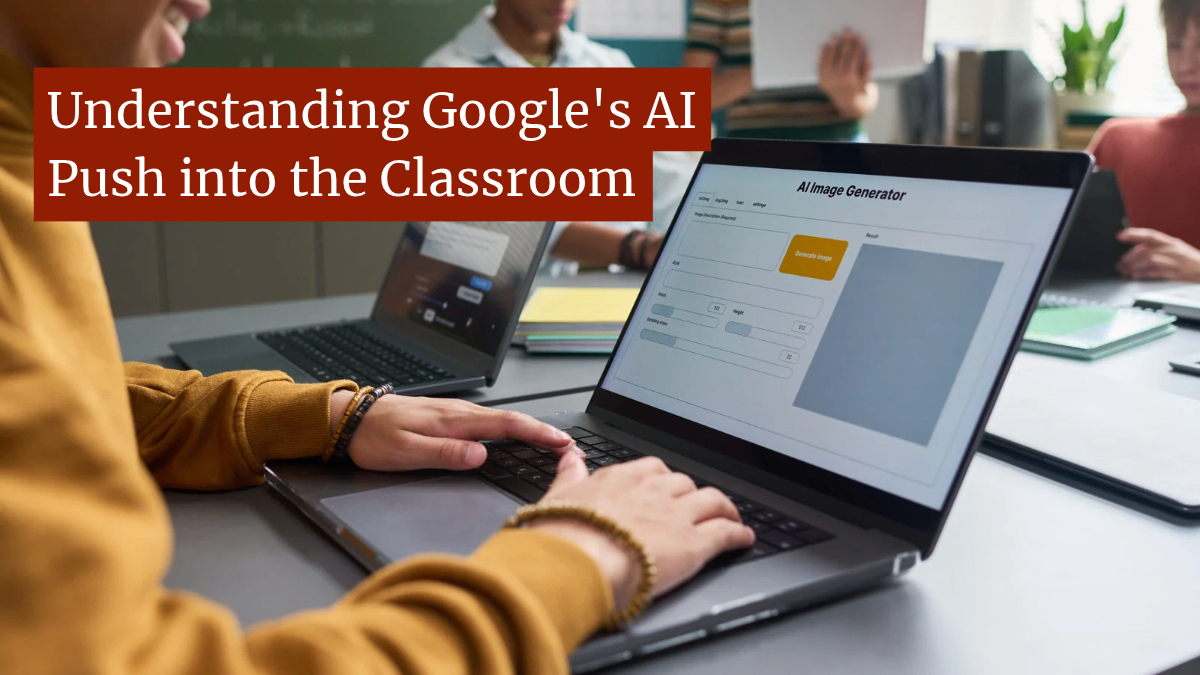
Understanding Google’s AI Push into the Classroom
Yesterday, Google published a blog post entitled “Designing Responsible AI for Learning.”
On the surface, it should have been a mundane announcement. The company announced that it was launching its “Guided Learning” tool to all users of Google Classroom and that it was giving schools more control over the AI tools that are available to students.
However, the headlines that followed the announcement told a different story.
The Associated Press said, “Google will cut off search access for students at schools that reject AI.” NBC News said, “Google to shut off search for schools that opt out of AI.” Finally, the Independent said, “Classrooms face tech nightmare as Google holds basic search hostage over AI backlash.”
Other search engines, including DuckDuckGo, seized the moment to level their own criticism at Google.
So what actually happened? The answer is complicated, but the outcome does not look good for Google and does not bode well for schools all over the world.
What Google Changed
On the surface, Google only changed two things. The first was giving school administrators more control over their students’ access to AI tools. The second was pushing its “Guided Learning” tool to all users of Google Classroom.
Guided Learning is an AI tool first launched in August 2025. The idea is that where a normal AI summary would simply give the answer, Guided Learning is meant to help students work through the process, asking them open-ended questions and guiding them to the solution rather than just giving it to them.
Reviews of Guided Learning have been mixed. A reviewer at Mashable said that while it was useful for some subjects, it was “a mess for reading comprehension” and emphasizes rote learning.
Still, Google is now making it available to all users of Google Classroom. That, by itself, would likely be controversial enough. However, Google is also taking the extra step of having the tool replace Google’s default search engine.
This means that for Google Classroom users, there are only two options.
- Standard Search: Which includes Google’s AI overviews and chat.
- Guided Learning Mode: Which has just been pushed to all users.
Google Standard Search is known for giving students direct answers to questions without requiring any work from the student. Guided Learning Mode, on the other hand, hasn’t been tested nearly as thoroughly, and much of the research about it comes from Google itself.
Unfortunately for administrators, there is no third option. You either enable one of these AI tools, or search is disabled for students. That could be a real problem for schools, as many have grown to rely on Google products.
Schools that don’t want students to use AI now face an impossible choice.
Why It Matters
By most metrics, Google is the largest ed-tech provider in the world. Google’s Chromebook has become the default choice for devices that schools give to students. Currently, it has over 60% of the K-12 device market. Google Classroom is also the largest learning management system, with roughly 10% market share. Google Workspace for Education claims to have more than 170 million students and educators using it.
That, in turn, is the major problem. Many schools all over the world have invested heavily in Google’s educational ecosystem. The new policy means that schools either need to embrace the use of AI or students will lose access to search while within that ecosystem.
Even if there are workarounds, it will take time, energy, and effort to implement them. Those are things that many schools are in short supply of. But even if they are successful, Google is still by far the most popular search engine and the one that is widely considered to be the best.
Schools would be moving students to a different search engine that may or may not meet their needs. It’s easy to see why schools would be reluctant to make such a change, assuming that it is even practical.
In that light, it’s easy to see why people are calling this a hostage situation. Google, for its part, argues that AI is simply now too core to its search product to separate.
But that argument falls flat when you look at both how Google has been developing its search engine and the incentives it has to push AI into the classroom.
Google is Lying
In an article for The New York Times, a Google representative argued that search and AI are “deeply integrated.” But that is objectively untrue. As of the latest data, less than half of all Google search queries have an AI overview. It’s also trivial to remove AI overviews from Google search results through a variety of methods.
Google search functions perfectly fine without AI. In fact, it’s the only way that I use Google search on the rare occasions that I do.
But even if it were true, it would be a conscious choice by Google. Google Search has worked without AI for over a quarter of a century. If search and AI are truly too intertwined to be separated, then that was a choice by Google, not the educators.
So why would Google do that? To that end, several of the articles cited in this piece referenced Josh Golin, the executive director of the advocacy group Fairplay. In his quote, he says that the move isn’t about improving education but “developing lifetime brand loyalty.”
While it would be easy to dismiss that argument, there’s actually a great deal of precedent for it.
To see that, one only has to look at all of the tech companies that offer education discounts on professional products. Apple famously did this in the early 1980s with the Apple II computer. Microsoft, Autodesk, Adobe, and other companies have all done something similar with their products.
Giving an education discount may seem like an act of generosity, but it’s often used to ensure that students are taught to use those particular products and that they will continue to use them as they enter the workforce.
So it is easy to see why many, including Golin, would view this as a play to make Google’s Gemini the default AI in the classroom. Whether this was the primary motivation for this push or not, I feel confident that it was at least part of the calculus in making the decision.
Bottom Line
The broad availability of AI is just under four years old. The education sector is notoriously slow to adopt new technologies and is generally reluctant to adopt them at all until they are proven to be either necessary or beneficial.
So we have an entire education sector that is still trying to figure out what role, if any, AI will play in the classroom.
However, Google is essentially forcing the issue. It is telling schools that they either accept its version of AI or they lose access to search altogether. It is no wonder that at least one senator is calling this “extortion.”
None of this is to say that AI might not have a place in the classroom or that the Guided Learning Mode is a bad product. It may be great, even revolutionary. But educators need to be able to adopt it on their own terms. It needs to be tested, vetted, and have its merit proven before it is shipped to countless schools and students.
Google is exploiting its market dominance in the education sector to force its adoption. It is giving educators an impossible choice.
The only good news is that nothing changes immediately. The implementation will begin in early 2027, meaning that there is still time for Google to backtrack or for something else to change.
But this move has proven that Google is not a reliable long-term partner, especially for education. While they claim to be about giving educators control, this false choice shows that they will remove that choice whenever it suits them.
While this should make just about everyone who uses Google pause and reflect, it should be a full-on wake-up call for educators. Google has made it clear that it is not your friend and that its connection to the education sector is purely transactional.
Unfortunately, it’s a price that many schools will be forced to pay, one way or another.
Want to Reuse or Republish this Content?
If you want to feature this article in your site, classroom or elsewhere, just let us know! We usually grant permission within 24 hours.