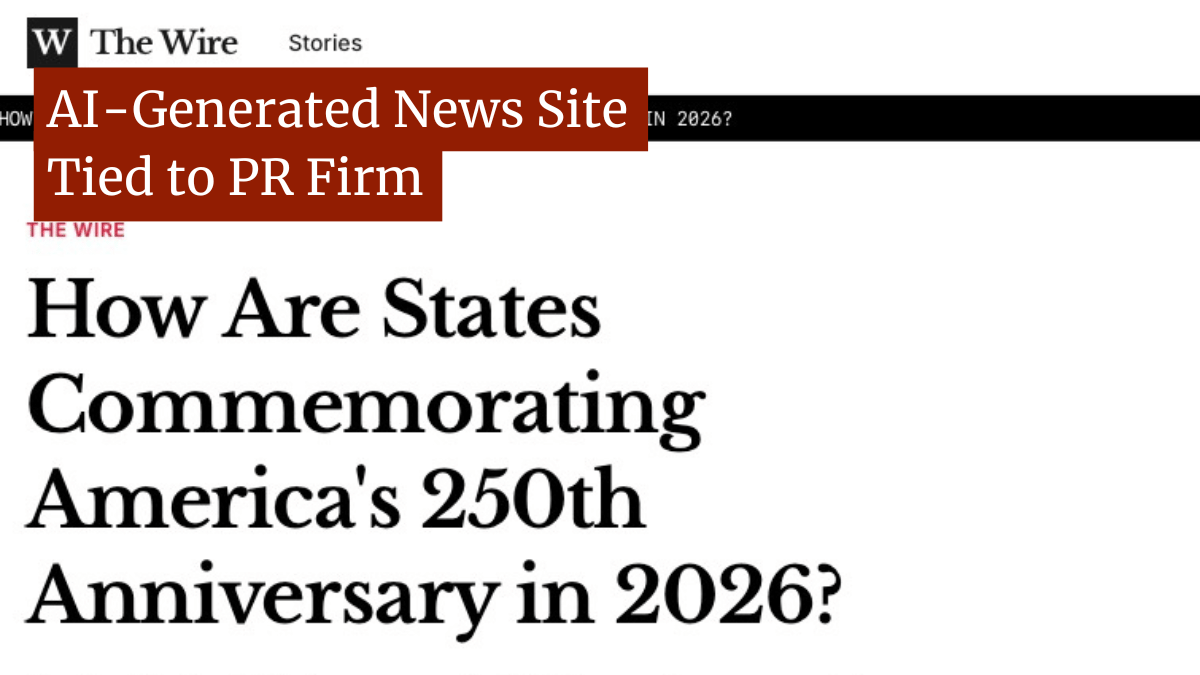
AI-Generated News Site Tied to PR Firm

In April, Nathan Calvin, the vice president and general counsel of the advocacy group Encode, received an email from “Michael Chen,” who claimed to be a reporter for the site The Wire by Acutus.
However, the email was odd. It contained the title of the article, which supposedly hadn’t been written yet, was from a generic email address, not an individual one, and only offered a written interview, which contained loaded questions.
Calvin forwarded to Tyler Johnston at The Midas Project, a group that investigates AI companies and operates the publication ModelRepublic. Johnston conducted his own investigation into both the email and the site. What he found was not only that the email was likely written by AI, but so was almost the entire site.
Since the site is a React app, Johnston was able to find code related to the backend. It was clear that the articles were almost wholly generated by AI. Johnston was even able to recreate the form that a human would have to fill out in order to generate an article.
However, equally disturbing was who the site was tied to. According to Johnston, the site was tied most directly to the PR agency Novus Public Affairs. Novus names Targeted Victory, a right-wing consulting firm as a client, which in turns has connections with Leading the Future (LTF), a super PAC that represents AI companies, most notably OpenAI executives.
Since this story broke, both Leading the Future and OpenAI have distanced themselves from the site and similar operations. Though the site is online, it has not published a new article since the story broke.
Still, it is worrisome that the site was able to operate for several months and publish 94 articles, almost all supporting issues and companies that Novus represents, without anyone noticing. What’s even more concerning his that they are almost certainly not the only one.
The Bigger Problem
To be clear, The Wire by Acutus is not the big problem here. Instead, it’s more about what the site represents and what future sites like it could do.
The Wire, by every metric, was a dismal failure. It received almost no traffic or social media engagement, it was so poorly done that it was obvious to just about everyone and was even exposed by its own source code. It is easy to point and laugh at just how bad the site is.
What the site represents, however, is a big, ongoing change in the nature of AI spam. AI spam is nothing new. Newsguard, a company that vets news sources, has been tracking AI spam news sites for over three years. Its latest update has pushed the number of tracked domains to ever 3,700, up from just 277 in June 2023.
Even that represents just a fraction of the AI spam news sites that are out there.
But this isn’t a story of a random spammer. This is a story about a site that was backed by massive companies, Super PACs and PR firms trying to sway public opinion. It failed, but it also exposes a playbook that could be used, and likely is being used, to great effect elsewhere.
When Leading the Future and OpenAI distance themselves from the site, they may be just doing damage control but they may also be telling the truth. The system of Super PACs, think tanks, PR firms and other agencies keeps a lot of overlapping entities working together, but also with enough separation that if any one entity becomes too much of a problem, they have plausible deniability to distance themselves.
This is and always has been by design. And it’s not just AI news sites. As The Midas Project reported, there are also undisclosed payments to influencers and other tactics. The system enables bad actors to operate with those cutting the checks being far enough removed that they can claim ignorance.
This system isn’t new, but now it’s finding new ways to weaponize AI.
Some Good News
There is good news here. This particular approach did not work and that was true even before the site was exposed. Even if every article had been written by a human, the site still had low-quality content, lacked a focus on a particular topic or region and is visually unappealing. No one had any reason to read this site’s content, regardless of how it was created.
Theoretically, these are issues that can be fixed with better AI. You can design a better site, add AI-generated images, write better articles, focus on a topic, etc. But all that requires work and more human involvement. It’s a game of diminishing returns.
The fear is that AI-generated media will be used to manipulate public opinion the way that human-generated media has done for the whole of human history. But this particular approach doesn’t appear to be particularly effective, at least not with today’s technology.
Instead, where there has been greater success, it has been with AI-generated content on social media. AI-generated images and videos in particular have been shown to be very effective at swaying public opinion and are easy to do at scale.
So while I don’t think that a fake AI-generated news site or media company having a major impact on public opinion, it doesn’t mean that AI generated content isn’t being used that way right now.
Besides, the much bigger threat, as we’ve repeatedly seen, is established media companies using AI to generate dubious content. We’ve seen this with Sports Illustrated, CNet, A.V. Club and many more. Companies that have earned the trust of the public through decades of hard work are now putting their stamp on AI-generated content.
So, as problematic as The Wire by Acutus is, I don’t think it represents the immediate future in this area. It was a clumsy experiment that failed for pitifully obvious reasons. Those seeking to use AI to manipulate public opinion have already found much more effective ways to do so.
Bottom Line
What drew me to this story wasn’t just the comedy of errors that was/is The Wire by Acutus, it was what the site attempted to do.
Between the article generation, the reaching out for “interviews” and the incorporation of other content, it attempted to become something resembling an actual news site. Admittedly, it was a heavily biased, unethical, plagiarizing, low-quality news site, but a news site nonetheless.
In 2026, it was a big swing and a miss that ended up embarrassing the very organizations that it was trying promote. But that doesn’t mean that it will be that way forever. In just a few years, we could be in a very different place.
Still, I don’t think that this type of site will be a major player in the future of AI-generated propaganda. Social media has made it easy to spread AI-generated images and videos in a seemingly organic way. Even if 90% of the viewers recognize it for what it is, that still leaves 10% being swayed by it and that is more than enough to influence public opinion.
So while we do probably don’t have to worry about AI news sites right now, that doesn’t mean that there aren’t many other ways that AI-generated content can infiltrate our lives and influence our opinions.
Want to Reuse or Republish this Content?
If you want to feature this article in your site, classroom or elsewhere, just let us know! We usually grant permission within 24 hours.