Instagram Launches Content Protection Tools

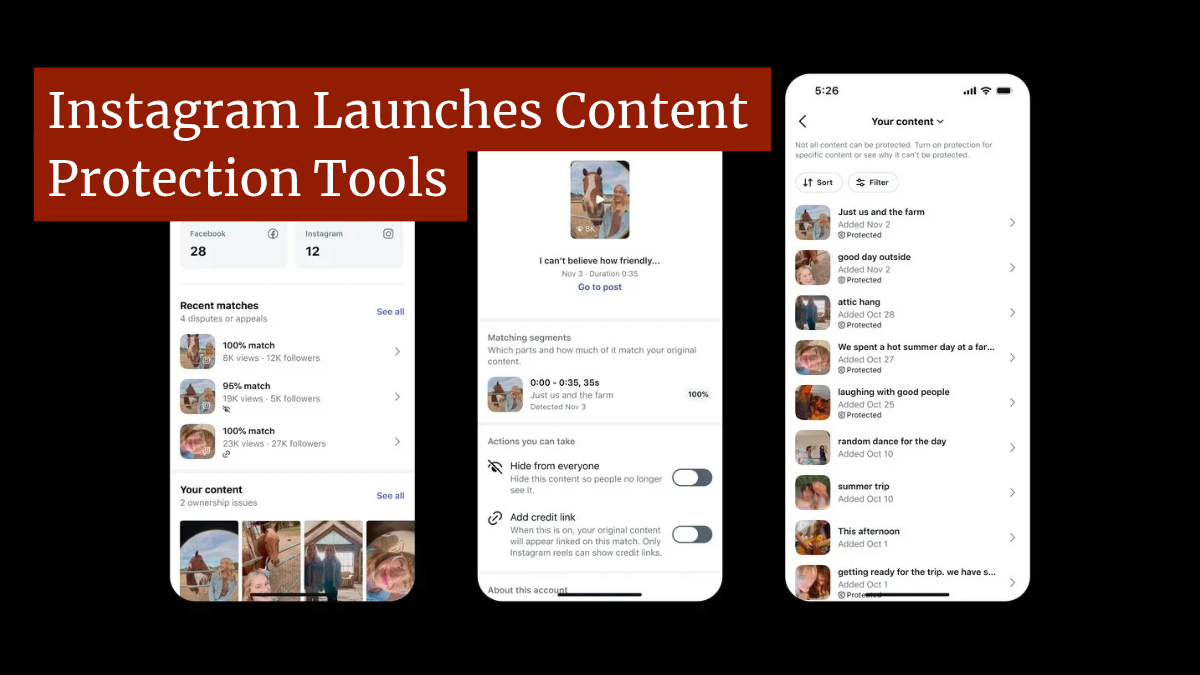
Yesterday, Meta announced that it would be expanding its content protection tools to include Instagram, meaning that users there will be able to automatically detect and respond to copied content.
Facebook, for its part, received the same tools exactly one year ago. These tools will help both Instagram and Facebook users to track how their content is used across both platforms and will allow them to respond as they see fit to any copied content.
As part of the latest announcement, Meta also said that it is starting to roll out a feature that will detect videos that reuse other people’s content but replace the visuals, either with their own video or AI‑generated content.
YouTubers (as well as long‑time readers of this site) will likely notice that these features are similar to Content ID, which is provided by YouTube. That, in turn, raises a difficult question: Why is Meta launching these tools now, almost 20 years behind YouTube?
Unfortunately, there is no clear answer to that question, and things only get more complicated when you look at the limitations of Meta’s system.
What Meta Announced
Meta’s latest announcement basically brings the same tools that are available for Facebook to Instagram. By and large, the tools function similarly to YouTube’s Content ID and other automatic video detection tools.
According to the post, eligible creators will receive a notification in their activity feed. All they then need to do is go to their settings and activate the features. Creators who are not immediately eligible for it can request access in their settings.
Once the system finds a match, users will be able to respond to it in one of four ways:
- Track: Keep the match up and monitor its performance.
- Hide: Make the matching video no longer available on the platform.
- Add Credit Link: Add an “original by” label to link viewers back to the original.
- Release: Release the claim.
(Note: The Credit Link feature was not available to Facebook users at launch but has been added since.)
Instagram also gave creators a look at an upcoming feature that will detect matches even if they are not the same visually. This includes videos that use the same spoken words, but include different visuals, often with the help of AI.
Instagram said that it rolling this feature out slowly but it should be eventually available to all creators who are eligible for the content protection system.
In short, it’s a very positive step that I’m sure many Instagram creators will welcome. However, it also has some severe limitations and, perhaps more importantly, is decades behind competitors.
The Big Problem
The most obvious comparison is with YouTube’s Content ID system. That system allows rights holders of all types to register their content with the platform and have YouTube detect matches on their behalf. Rights holders can then opt to track videos, monetize them or remove them.
The system gets a fair amount of criticism, in particular how it often flags videos that only use very short clips or are engaging in commentary or criticism of the original content.
Despite the issues, the system has been an overall success. According to YouTube, Content ID handles 99.5% of all copyright claims on their platform. In 2018, the company announced the launch of Copyright Match, which brought many of the same features of Content ID to regular YouTube users.
But, while YouTube was looking to expand its content matching system, Meta was drawing significant criticism for favoring pirated content and rewarding “freebooters” with massive view counts. Though Meta launched its own rights management system in 2016, it was more akin to what Content ID was in 2007 (at least in terms of who can access it) than the direction it was heading in the 2010s.
Meta’s 2025 and 2026 announcements bring it more in line with where YouTube was in 2018, still lagging far behind its competitor. Even the new audio matching feature is behind Content ID, which has used both audio and visual matching since the beginning of the tool.
However, the biggest issue for Meta is that, in many ways, they’re addressing yesterday’s problems. As Facebook controversies of the mid-2010s show, one of the biggest threats is not content republished on the same platform, but it being republished on other platforms.
This is especially true with major competitors such as YouTube Shorts and TikTok taking up more and more of the short-form video content market.
To be clear, there’s not much that Meta (or any other platform) can do about this problem without agreements from the others. Still, it’s interesting that Facebook and Instagram are now taking steps to address content copying on their platforms, even as AI and cross-platform copying become increasingly bigger issues.
Bottom Line
As negative as this post sounds, I do want to be clear that I support Meta taking these steps. The adage of “better late than never” applies here.
But Meta is definitely playing catch-up. As I see it, they are roughly eight years behind YouTube in terms of content matching.
That might not be a major deal, but even YouTube is struggling to keep up with the various copyright challenges that it faces. Even being on the cutting edge, at least when compared to Meta, it still often lags behind the latest technologies and trends.
Meta is just eight years further back. For all the struggles that YouTube has had with copyright, its evolution and changes have positioned it better to deal with issues like AI. Meta is still catching up to the problems from nearly a decade ago.
So, while I do think that these are positive steps, the next question for Meta is how does it plan to catch up fully and even pull out ahead of its competitors? If it wants to be a place where people share content, earn revenue and build brands from it, it needs to stop looking backwards and start looking to solving the problem of the present and the future.
Want to Reuse or Republish this Content?
If you want to feature this article in your site, classroom or elsewhere, just let us know! We usually grant permission within 24 hours.