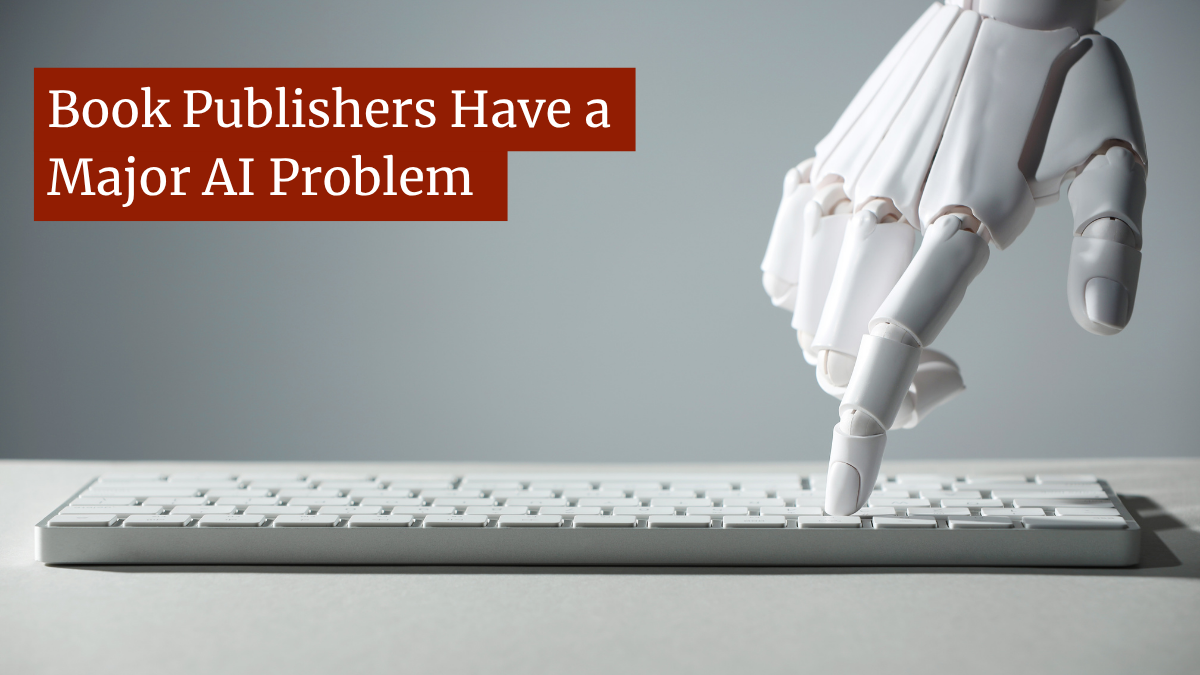
Book Publishers Have a Major AI Problem

On the surface, few companies on the planet seem to be more against artificial intelligence (AI) than Hachette Book Group.
The company has filed or joined multiple lawsuits against AI companies, including Google, Meta, and the “shadow library” Anna’s Archive. They have an extensive policy barring most uses of AI for authors and other creators.
It’s difficult to think of a more anti-AI company. That, in turn, makes what happened in March all the more surprising.
The publisher had released the new horror novel Shy Girl by author Mia Ballard. The book had originally been self-published in early 2025, but Hachette picked up the rights and published it in the UK in November 2025 ahead of a planned release in the US in 2026.
However, in March, a thread was posted on Reddit questioning if the book had been generated, in whole or in part, by AI. Shortly after that, a 2-hour video on the YouTube channel Frankies’s Shelf entitled I’m Pretty Sure this Book is AI Slop quickly amassed over 1 million views.
Ballard, for her part, has strongly denied using AI. In a comment to the New York Times, she put the blame on an editor whom she said she was preparing legal action against.
Hachette, for its part, pulled the book from publication in the UK and cancelled the US release.
One interesting point is that, during its initial self-published run, the book enjoyed solid reviews and sales. However, after the republication, the book began drawing sharp criticism. In the aforementioned Reddit thread, the book editor author said, “If it isn’t AI, she’s a terrible writer. Her writing is truly indistinguishable from an LLM.”
It’s a frustrating story, but, ultimately, an isolated incident. That is, it would be if it hadn’t been the first time Hachette had been accused of publishing AI-generated content.
Book Covers and AI Allegations
In June 2023, freelance artist Robert Santora filed a lawsuit against Hachette for allegedly using AI to alter his work to make new book covers.
Previously, Santora had been contracted by Hachette to create book covers for 10 books by author Sandra Brown. As part of a reprinting, the company redesigned the covers and, according to the original lawsuit, used AI to replicate and modify Santora’s work.
To be perfectly clear, Brown was not implicated in the lawsuit. She has not been accused of using AI in any way. It was her publisher, Hachette, who was accused.
Hachette, for its part, denied the allegations and said that the book covers were created by the company’s in-house (human) designers. However, the AI issue ended up being largely moot. The case was dismissed because, according to the judge, Santora had not been able to prove that the works were “substantially similar” to his.
Santora still has the option to appeal the decision.
But then there’s the bizarre rub in the case. Santora didn’t actually accuse Hachette of using AI to generate the book covers. In his original complaint, he said:
“The plaintiff Robert E. Santora avers, upon information and belief, the defendant Hachette Book Group, Inc. created or authorized the creation of book covers for books authored by Sandra Brown by techniques such as artificial intelligence using the copyrighted artwork of the plaintiff Robert E. Santora to derive and create such additional book covers as illustrated in Exhibit D.”
This was the only mention of artificial intelligence in the original complaint.
Note: I have not been able to access the amended complaint, so I don’t know if there were more AI mentions in it; however, much of the coverage began before the amended complaint was filed.
In short, he didn’t actually accuse Hachette of using AI to make the new book covers; he said it was one possibility for how the book covers were created. He believed that the new covers were unlicensed derivatives off of his work and that AI may have been a part of it.
However, all of the coverage of the case, as little as there was, focused on the AI angle.
In reality, it was a mundane copyright infringement case dismissed for equally mundane reasons. But it points to the very real issue that publishers and other creators are facing with AI.
The Problem with AI
These two stories illustrate the problem that publishers (and other creators) are facing with AI. Right now, AI is understandably vilified. Readers don’t want to pay money for AI-generated content. Human creativity is still highly prized.
But AI is also difficult to detect and even define. AI has become almost a boogeyman. Wikipedia, for example, has a 21,000-word guide on identifying signs of AI writing. It includes everything from em dashes, not X but Y, rules of three, capitalization, and formatting.
For example, my use of title case in subheadings and headlines is a sign of AI writing according to the guide. To be clear, I don’t use AI to generate any part of my work. You can see my AI disclosure for more details. But if someone wanted to accuse me of using AI, that would be something they could point to, even though it’s been my standard for over 20 years.
The problem with AI isn’t just AI itself. Human creators aren’t just trying to avoid or limit their use of AI; they are trying to avoid even the appearance of using AI.
As difficult as preventing AI work from being published is, this is even a more difficult problem. This is largely due to the fact that signals of what is and is not AI-generated content are always changing. Em dashes, for example, have not been a major part of AI writing for years.
Simply put, as new AI models are released, the writing style changes. Furthermore, those generating AI content are constantly changing how they prompt the models. Simply changing the prompt can significantly alter the output.
While good human writing still seems to stand out, it’s not always simple to tell the difference between bad/mediocre human writing and AI writing.
This is a problem for all creators, but publishers, including Hachette, are currently on the front lines in a very public way.
Bottom Line
To reiterate, this is not just an issue for publishers or for Hachette. All human creators have the same problem. It’s just that Hachette and other publishers are at the very tip of the spear.
I also don’t believe that Hachette used AI to generate the book covers. Not only was that not a direct accusation that Santora made, but it seems unlikely that Hachette, with its strong statements against AI and in-house designers, would have little reason or need to use AI.
Ballard’s case is more difficult. It seems that, from her statement, AI language got into the work somehow, whether through her or a third party. But unless her work changed drastically between when she self-published and the Hachette release, she is still completely responsible for it.
Ultimately, it is her name on the cover of the book. As we discussed previously when addressing the practice of ghostwriting, if your name is on the cover, you are responsible for what is inside, especially if you self-publish. It doesn’t matter if the content was written by AI, a human ghostwriter, or an editor. You are putting that book out as your own work, and you will be the one who is held responsible for any ethical issues.
Still, Hachette needs to take ownership of this as well. They need to figure out how exactly it got to this point and set up systems to prevent it from happening again.
Because it WILL happen again. It’s only a matter of time.
Want to Reuse or Republish this Content?
If you want to feature this article in your site, classroom or elsewhere, just let us know! We usually grant permission within 24 hours.