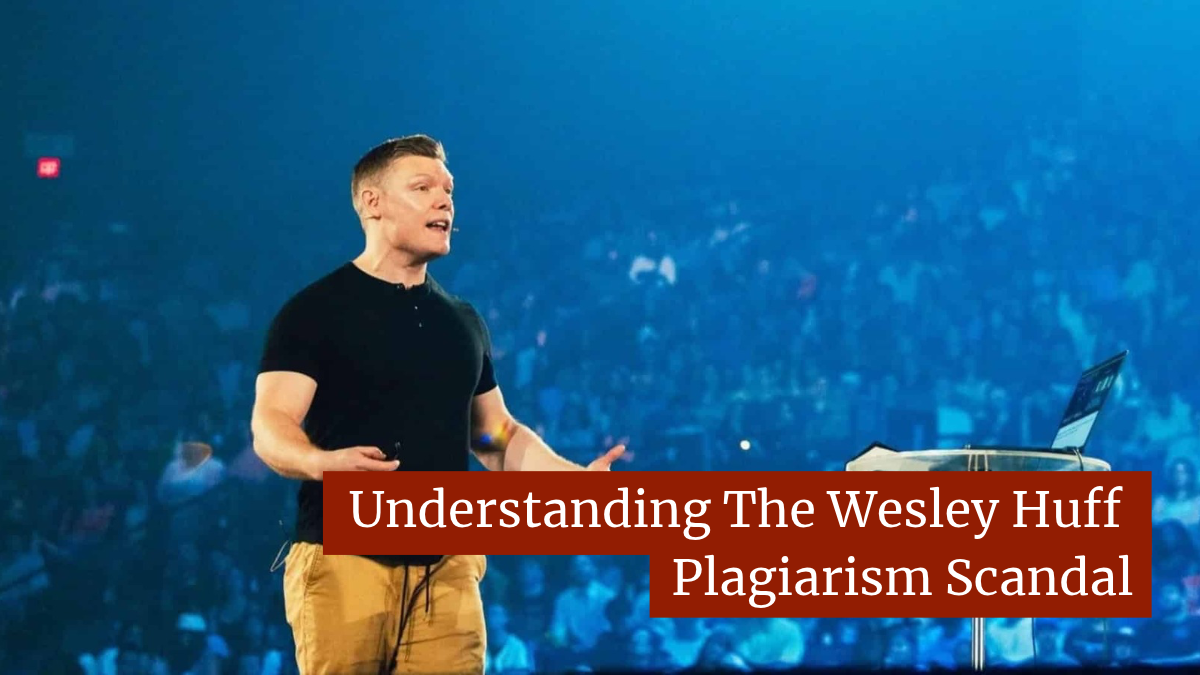
The Wesley Huff Plagiarism Scandal

Over the past two years, Wesley (Wes) Huff has become one of the most famous and influential Christian apologists in the world.
He has appeared on popular podcasts such as The Joe Rogan Experience and Piers Morgan Uncensored. He has also been invited to speak a wide range of conferences, churches and other events. He also has a popular YouTube channel with over 1 million subscribers.
However, just as his career is taking off, he appears to have hit something of a roadblock. That’s because Dan McClellan, another biblical scholar and YouTuber, has accused Huff of plagiarism in works he wrote during his time at Tyndale University.
Huff, for his part, has acknowledged the issues and said that he acknowledges that the work he did at that time was not as good as it should have been.
So how serious is this case? The answer is complicated and it likely hinges on facts which are in dispute. However, it’s still worth examining as some of the excuses do not hold up to scrutiny.
The Story So Far
The case began on November 8 when Dan McClellan published an hour-long video entitled “Did Wes Huff Commit Plagiarism?” on his YouTube channel.
In the video, McClellan said that he received an email from academia.edu, a research paper sharing and social networking platform, that encouraged him to read a 2016 paper by Wesley Huff. Curious to read Huff’s academic work, he did so, but found that the paper was oddly similar to a 2010 paper by Florida pastor Brian J. Wright.
He then compared the two papers and found that they mirrored each other in argument and structure. They even included some verbatim text matches and, perhaps most damningly, the same citation errors.
Huff initially uploaded a response to the allegations. In a now-deleted 8-minute video, he acknowledged the issues in the paper and said that he too wanted to “cancel” 2016 Wesley Huff. He said that his research at the time was not as good as it should be and that the paper was a draft that was not actually submitted to the university or published.
As part of that video, he brought on Wright to discuss the issue. Wright said that this was a “hit job” and questioned the motives of McClellan.
On November 13, Huff removed the video and said he would be taking a step back from the story to focus on his daughter, who, at the time, was in the hospital due to a medical emergency. He said that he is also waiting for the Apologetics Canada Board, of which Huff is a Vice President, to conduct its review of the case.
Since then, other allegations of plagiarism have been made. This includes one involving his ongoing Ph.D. coursework as well as other work from his master’s degree. There are also allegations that he has been dropped by his would-be doctoral supervisor over plagiarism concerns. However, those allegations have not been confirmed.
The result of all this has been a great deal of bickering between those who support Huff and those who are condemning him. However, the division appears to be more along ideological and theological lines than anything to do with the alleged plagiarism itself.
That makes understanding how serious this case is far more complicated, especially given the elements that we still do not know.
My Take on the Allegations
Normally, I would be loathe to comment on a case like this one. Not only are cases involving a mixture of religion and plagiarism very volatile, but there is no universal standard for plagiarism. This is especially true in religious settings where different denominations and even churches within the same denomination can have very different standards for when and how to cite outside sources.
However, this case is somewhat unique. It involves academic work that was written (though possibly not submitted) as part of obtaining a degree from a university.
The first excuse Huff gives, that the papers were rough drafts that were not intended to be made public, does not hold up to scrutiny. If you’re writing a paper properly and using the cleanroom writing technique, your first draft will have the exact same amount of plagiarism as the final draft. None.
Even if it was an early draft, it should not have contained any plagiarism. This is especially true considering that the paper appears to be heavily based on the earlier work that was not cited at all. This isn’t a case of poor paraphrasing or omitting a citation, the entire work is in question.
Even if it wasn’t submitted to the university, it was submitted to Academia.edu. Though Huff claims that he used the site similarly to Dropbox (and the site does offer non-public uploads), the site’s primary purpose is to “Amplify your research” and “Publish and disseminate your work, track your impact, and discover new research.”
His second claim, that this issue pertained to “2016 Wesley Huff,” is also on shaky ground given the allegations against his more recent work. But, while I’m willing to grant that the allegations need to but in the proper context, it’s important to note that this was not a high school paper. It was work done as part of earning a master’s degree. The same degree that earned him the opportunity to participate in his current doctoral program.
Because of this, examining both his master’s and doctoral work is legitimate. But it’s also important to put this work into context. The work that he’s best known for, namely his podcast appearances and YouTube channel, have not been questioned. While having a master’s degree and possibly a doctorate certainly can boost his credibility, they aren’t why people have been drawn to him.
That, in turn, likely explains much of the divide around this story. Those who love his work see this as a distraction and irrelevant to his work while his critics see it as a major blow to his credibility. Both things can be true.
Bottom Line
To me, this story is interesting for a variety of reasons. The biggest is the dichotomy between academia and religion. Clearly, Huff sought out these higher degrees to further his career. However, the comments and the feedback about these allegations have highlighted just how much mistrust there is for academia in this community.
Still, if you’re seeking the benefits of higher education, it’s important to follow the rules and standards of the institution. By all appearances, Huff did not do that and was at best reckless with his work. The question of what, if anything, should happen to him falls to the relevant schools.
(Note: I will be interested to see how the Apologetics Canada Board handles this case.While investigating the allegations is a positive step, avoiding the appearance of bias and various conflicts of interest in this case will be difficult as Huff is a Vice President of the board.)
That said, I can’t fathom that Tyndale University would be eager to pursue a ten-year-old case that may not have even been submitted to the university. Even if they wanted to pursue the case, the evidence may already be lost time. However, it’s likely that his current doctoral program, University of Toronto, would be more inclined to pursue a case as he is an active student.
When it’s all said and done, Huff wouldn’t be the first to have attribution issues when writing outside of his comfort zone. In 2017, the Rev. Bill Shillady was accused of plagiarism in a book. Four years earlier, megachurch pastor Marc Driscoll faced similar accusations in his book. But, as those cases highlight, it’s important to follow the citation guidelines of the institution you are writing for, not the ones that you are most used to.
Ultimately, it seems unlikely that these allegations will have a significant impact on Huff’s career. Though his degrees raise his credibility, they are also largely secondary to why he is popular. Simply put, he likely doesn’t need a doctorate, or even a master’s degree, to be successful.
But the reminder is there. If you’re going to seek out the benefits of academic achievement, it’s important to follow the rules and standards of academia. Failing to do so can call into question not only your academic work, but your integrity as a whole.
Want to Reuse or Republish this Content?
If you want to feature this article in your site, classroom or elsewhere, just let us know! We usually grant permission within 24 hours.