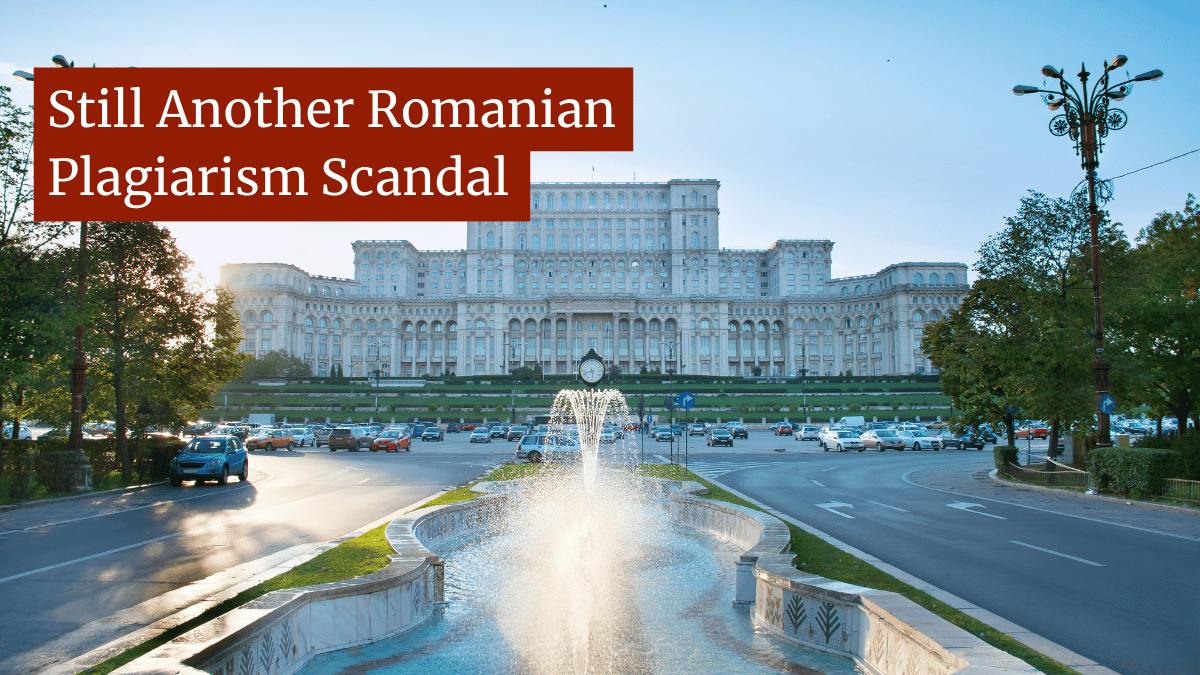
Still Another Romanian Plagiarism Scandal

Yesterday, reporter Alexandra Șerban at the site Recorder published an analysis of the 2003 thesis of Romanian director of the Protection and Guard Service (SPP), General Lucian Pahonțu.
According to the analysis, Pahonțu’s thesis contained some 52 pages of plagiarized content, representing 30% of its 175 pages of content (and 205 total pages).
The scandal comes at a time when Pahonțu is already battling other allegations of impropriety. Last week, Recorder claimed that he took part in the repression of the December 1989 Revolution and the June 1990 Mineriad. He staunchly denied that, citing official records.
Then, earlier this week another publication, Snoop, claimed that his salary combined with his military pension means that he earns more than double the Romanian President per month.
Pahonțu has not responded to the allegations.
Long-time readers (and some short-time readers) of this site will be familiar with the plagiarism insanity in Romania. The country has had a long struggle with academic integrity and Pahonțu is just the latest in a long line of high-ranking officials in the country who have been accused of plagiarism.
However, this doesn’t mean that the allegations will likely derail Pahonțu’s career. If anything, the country has shown a willingness to protect officials accused of plagiarism.Among those, Pahonțu is one of the most insulated from these kinds of allegations.
To understand why, we first have to look at the allegations against him and how they stack up against ones made against other Romanian officials.
Understanding the Allegations
The allegations against Pahonțu are relatively straightforward. According to Șerban’s analysis, Pahonțu’s thesis contained many lengthy passages that were verbatim or extremely similar to various sources. Some of which were not mentioned in the bibliography.
One of the most damning examples involves the 1976 document entitled “Regulamentul Trupelor de Securitate” (Regulation of the Security Troops). Pahonțu’s thesis contains some 210 identical lines from that document but there is no mention of it in the bibliography.
There are other examples of books who were mentioned in the bibliography and in-text citations, but the text was not put in quote marks or otherwise indicated to be a direct quote. All totaled, the analysis alleges that Pahonțu plagiarized some 52 pages of his thesis, representing roughly 30% of its content.
However, the allegations against Pahonțu also run a deeper than simply copied and pasted text. Șerban also argues that Pahonțu’s thesis contains very little original research and mostly a compilation of military definitions and regulations.
It’s worth noting that the term “thesis” outside of the United States refers to what we would call a “dissertation.” This means that the document is supposed to present some degree of original research, which Șerban claims the paper does not do.
In addition to submitting the thesis to obtain his degree, Pahonțu also published the thesis as part of his 2003 book Terrorism and Destabilization. According to Șerban, the book also contained the plagiarized content.
Șerban also highlights grammatical errors in the thesis, raising additional questions about the quality of the vetting of the document.
While the report against Pahonțu’s thesis is damning, if history is any indication, it’s unlikely that his career is in danger. That is, at least not due to the plagiarism allegations.
Why It Won’t Matter
Ultimately, Pahonțu’s is the latest in a long line of Romanian officials who have been accused of plagiarism. Going back to 2012, we’ve seen three Prime Ministers and countless other high-ranking officials accused of plagiarizing their academic work.
Ultimately, none of it ended up mattering, at least from a career perspective. In one of the most egregious examples, in 2022, the country’s Prime Minister, Nicolae Ciucă, was “cleared” of plagiarism in his dissertation in a sketchy process that involved a hand-picked judge.
During that process, the nation’s Constitutional Court ruled plagiarists can keep their degrees, even if the evidence of plagiarism is overwhelming. Instead, it was the journalist who reported on the plagiarism allegations who became the target, which included a campaign of harassment and non-consensual pornography.
In short, the entire country’s government and legal system have been weaponized to protect officials accused of plagiarism. My concerns are more about Șerban’s future than Pahonțu’s.
But, as well-insulated as Romanian officials have been from plagiarism allegations, Pahonțu is even more so. He is not a minister or a traditional politician. Though he was appointed to be the head of the SPP, he came up through the military.
Though he was promoted to General after he received his doctorate, it’s unclear what role, if any, his degree has played in his career.
In the end, there’s almost no hope for Pahonțu’s career to be affected by the allegations in any way. The system itself is wired to protect him and far more significant officials have faced far more serious allegations without consequences.
While, normally, it’s difficult to say how such allegations will affect the career of the accused, here, history is a pretty clear indicator.
The only way that Pahonțu’s career is in any jeopardy because of plagiarism is if the other allegations combine with the plagiarism ones to have an impact. If that happens, the plagiarism allegations will only likely be a footnote in the discussion.
Bottom Line
I want to take a moment and show my appreciation for the work of Alexandra Șerban and the other journalists and academics who have worked on this and similar cases in Romania. While many examples of such investigations are politically motivated and can be considered examples of weaponization of plagiarism, here, the weaponization clearly points the other direction.
Unfortunately, that has real consequences for the country, in particular its students. By defending the degrees of plagiarists, the government has devalued the degrees of those who did their own work. Romania, justly or unjustly, has built a reputation for being a safe haven for plagiarists.
That’s not the fault of the academics working in the country. It’s the fault of a government that uses its position to silence any criticism of it, no matter how legitimate.
When the government moves to defend and ignore plagiarism allegations to protect its own officials, it’s the students and researchers who pay the price. And it’s a price that’s paid over decades, not months or years.
In the end, my only hope is that I am wrong and that this story begins a new era in the country’s history with plagiarism. However, I am not optimistic.
Want to Reuse or Republish this Content?
If you want to feature this article in your site, classroom or elsewhere, just let us know! We usually grant permission within 24 hours.