What Doom Clones Teach Us About Tropes
On December 10, 1993 id Software released the hit game Doom. It almost immediately became a massive success and dominated would go on to sell an estimated 3.5 million copies over the next few years. To this day it remains one of the most important and influential games of all time.
With that success saw a number of similar games released. Some used the Doom engine, such as Heretic and Hexen. Others used different engines, such as Duke Nukem 3D and Quake, another id Software game.
However, all these games (and many others) were given a rather unflattering moniker: Doom clones.
It didn’t matter what these games did, how similar they were to Doom or how they evolved the genre, they were still compared to Doom and, even then, were only labeled as a copy of it.
However, by the end of 1998, the term “Doom clone” had fallen almost entirely out of use. It was replaced by a much friendly and more accurate term: First Person Shooter or FPS
So why did the term “Doom clone” fall out of favor? Why was it used in the first place? The answer speaks a lot to the nature of tropes and norms not just in the gaming industry, but in the entertainment industry more broadly.
After all, nearly every industry has experienced this phenomenon. The Doom clone story simply encapsulates it in a nearly perfect way.
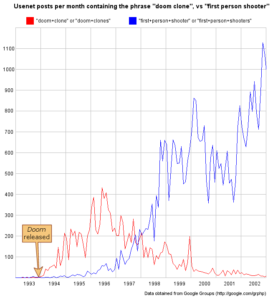
Note: The above graph comes from several different sources, most notably here. Though I’ve traced the data back to Google’s acquisition of archived newsgroup postings, I have not been able to independently verify the data.
A Very Brief History of Doom Clones
To be clear, Doom was not the first first-person shooter, much less the first first-person game.
Depending on how you define it, first person games have been around since at least the mid1970s. But even ignoring those, id Software released Wolfenstein 3D in May of 1992, over a year before Doom. It was a true first-person shooter in every sense of the word.
However, Doom was the unmitigated and undeniable success. Sold and marketed as shareware, the first episode of the game landed in countless homes for almost no cost. It represented a major technological leap from Wolfenstein 3D and its demonic themes and gritty gameplay ensured a decent amount of controversy to boot.
With this success, predictably, came a number of other developers who wanted to capitalize on the trend. However, most of those games were described as “Doom clones” rather than first-person shooters or some other moniker.
For some, that was actually a fair description. They used the Doom engine (licensed by id Software) and created similar-feeling games like Hexen and Heretic. However, other games were working to push the genre forward.
One notable example is Duke Nukem 3D. Developed by 3D Realms and released in January 1996, the game used a different and more advanced engine and leaned heavily into humor and satire. Another example is Descent, developed by Parallax Software and released in March 1995, that offered more freedom and the first true 3D graphics.
But, despite these differences, these games were still widely labeled as Doom clones. In fact, as the chart shows, both came out at the peak time for the term.
However, the term was already starting to fall out of favor. This was in part due to the release of id Software’s Quake, in June 1996. Meant as the follow-up to Doom, Quake greatly expanded the use of true 3D graphics and became a cultural phenomenon, especially for multiplayer gaming.
However, it was in late 1998 that the term almost completely fell off the radar. That drop-off can be largely attributed to one game: Half-Life.
Developed by Valve and released in November of 1998, Half-Life was a completely different experience from most of the games that came before it. The game was heavily focused on story and unfolds like a movie. It also puts a major focus on tactical gameplay and strategy, rather than just running and gunning.
It was a completely different experience from Doom and most of the other early first-person shooters and it also launched several important multiplayer mods, including Team Fortress Classic and Counter-Strike.
By the end of the 1990s, the term “Doom clone” was almost completely out of the lexicon. The first-person shooter genre had evolved and the term was no longer an accurate descriptor.
Is it Plagiarism, a Trope or a Genre?
So why did the term “Doom clone” rise and fall so quickly? There are many reasons.
First, for many gamers, Doom was the first exposure they had to a first-person shooter. Though it wasn’t the first game in the genre, it was the first massive success (largely thanks to its shareware model) and, as such, it was the only reference point for many gamers.
As such, though the term “Doom clone” is something of a pejorative today (though it has been somewhat replaced by “boomer shooter”), it wasn’t then. It was seen as descriptive and many companies leaned into the term. It was a quick way to describe an unfamiliar game and one that was quickly understood by the audience.
Second, the idea of a shooting game seen from the first-person perspective became useful for far more than just Doom-like games. Half-Life is the most obvious example from the period, but more modern examples include role-playing games like Fallout and The Elder Scrolls series, sandbox games like Minecraft and survival games like Escape from Tarkov.
First-person games have become akin to first-person stories. It’s a device used to tell a story, not just a particular type of game.
Finally, the term first-person shooter was and is simply a better descriptor. The first-person aspect of Doom was only part of what made the game unique. Sure, it was what resonated the most at the time, but that was because of the technological leap. There have been many more such leaps since then. You can see many of those leaps in the Doom reboot series, which began in May 2016.
In short, the term “Doom clone” fell out of favor because games stopped being clones of Doom. The genre began to move forward and the term was no longer accurate. What separated the first-person shooter from the doom clone was years of iteration and evolution. Though much of it wasn’t recognized at the time, it went from being a copy to being a trope to being its own genre.
Today, it’s really just a format for gaming that isn’t tied to one particular genre. That’s how first first-person gaming has evolved.
Bottom Line
The reason I tell this story is not because it is unique to video games. It’s a microcosm of how such things evolve in many different fields and industries.
MP3 players, for example, were once called “iPod Clones.” Many TV series were considered clones of The Game of Thrones, though now the term “prestige fantasy” is more common. In short, when something becomes a cultural phenomenon, anyone who follows it is likely going to be called a clone at first. It’s only in hindsight, after others have followed and pushed things into new territory, that something is recognized as a new genre.
Whether it’s a “-clone” a “-like” or a “-killer,” newer works are able to separate themselves from their predecessors if they are able to push the genre forward. It just takes time.
But there are examples of the opposite as well. Google, for example is still used as a generic term for a search engine, much to the chagrin of Google itself (not to mention its competitors). That’s because no one has been able to really evolve the search engine in a way that feels meaningfully different.
Though that may seem like high praise for Google, it actually comes with some serious issues. Many companies lose formerly lucrative trademarks because the term becomes “genericized” over time. So, while the comparison to Doom may have been beneficial at the time, if it had continued, it might have harmed id Software more than helped it.
Still, it’s interesting to watch the evolution of of the first-person shooter genre. Over the span of just a few years, it went from a clone to being a genre and then a format of gameplay that isn’t tied to any particular genre.
It really comes down to how others use the format and whether it moves past its forebears.
Want to Reuse or Republish this Content?
If you want to feature this article in your site, classroom or elsewhere, just let us know! We usually grant permission within 24 hours.