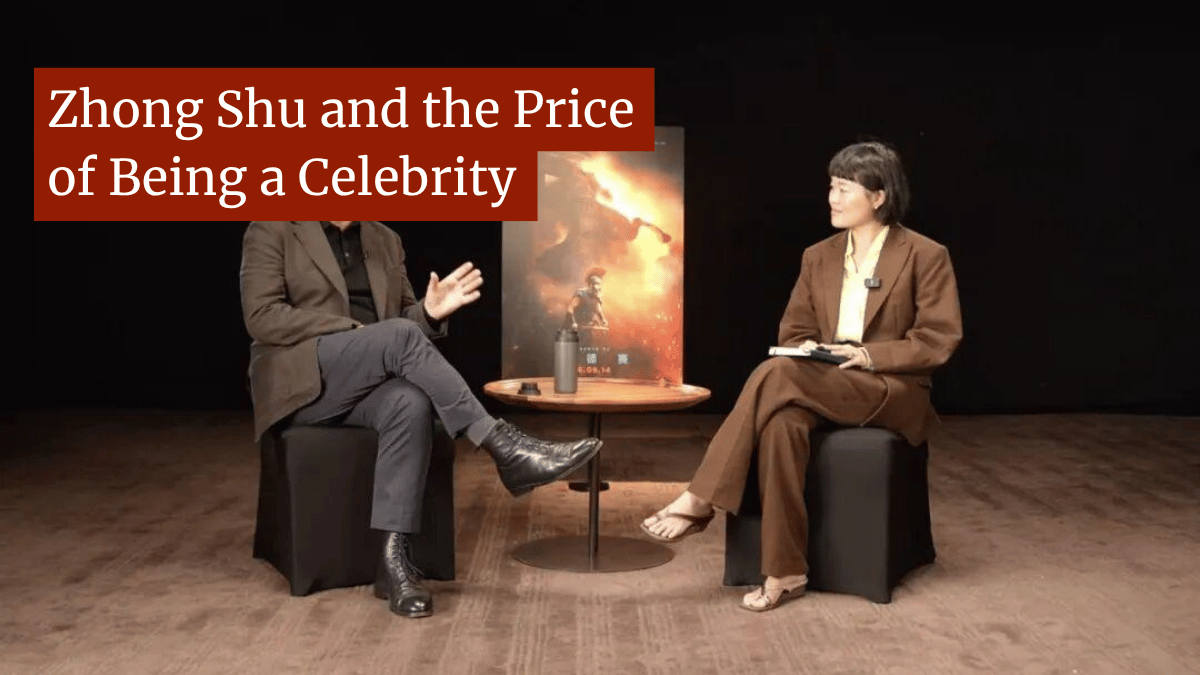
Zhong Shu and the Price of Being a Celebrity
On July 31, Mandarin-language podcaster Zhong Shu published a 17-minute interview with director Christopher Nolan, where she asked him deep, philosophical questions about his most recent film, The Odyssey.
The interview was heavily praised for asking deep questions about the film and Nolan’s career. It was hailed as an example of excellent journalism, all from a 29-year-old doctoral student who was previously largely unknown outside of China.
Zhong Shu (Note: Zhong Shu’s name is sometimes written as Zhongshu), whose real name is Zhuge Yiyang, was already well-known in China for her Mandarin-language podcast Du Shu Bu Cheng Lin, which translates to” A Single Tree Does Not Make a Forest, ” (Note: The English title of the podcast is often presented as “Monologues of a Committed Observer”) and has over 970 thousand subscribers on the Chinese podcasting platform Xiaoyuzhou.
However, with the Nolan interview, Zhong Shu became an international name. The video itself has received millions of views on various platforms.
But with that viral fame came a new level of scrutiny, in particular from Chinese netizens. According to a site created to track her work, they checked 125 of her 360+ episodes at random and found that 75 had some degree of attribution issues.
So, are the allegations against Zhong Shu serious, and if so, what do they likely. mean for her career moving forward? The answer is extremely complicated.
Understanding the Allegations
The bulk of the allegations against Zhong Shu deal with her podcast. In particular, they claim that she used English-language sources, including papers, news reports and other podcasts, without properly citing them.
One of the most damning examples involves the podcast Breaking History. In a podcast about the Iranian government, Apple’s AI transcript misheard the phrases “health corps” and “literacy corps” as “courts.” That error was then present in Zhong Shu’s podcast on the same topic.
The searchers also found examples of other similar passages, including jokes, that were similar between Zhong Shu’s episodes and other podcasts.
In addition to the podcast allegations, she was also accused of plagiarizing an article she published on the business news site Caixin. They compared it to a May 2026 article from The Atlantic, and found that the first paragraphs of the two articles were almost identical. Caixin has since removed the article from its website.
Zhong Shu, for her part, doesn’t deny using English-language sources when working on her podcast. However, she’s also not directly addressed the allegations. In one interview she said, “We live in an age that demands apologies from greatness,” a callback to her Nolan interview.
In a more recent interview with Sixth Tone, Zhong Shu compared herself to a fisherman who returned home amid a major storm. She also says that her recent book tour cancellations were not a result of these allegations, but instead were due to the health of her family.
That said, in the same interview, she said that she is “seriously considering” whether to continue with her podcast. “Maybe tomorrow I’ll decide I’m done, and quit” she said.
That said, Tyler Cowen is planning on hosting an episode of his podcast, Conversations with Tyler, with Zhong Shu. He has said that the allegations are in dispute and will move forward with the interview, despite many of his fans being against it.
As such, this isn’t likely the end of the story for Zhong Shu. But that does raise the question of what lies ahead.
The Problem with Being a Celebrity
What makes this story somewhat unusual is that, despite living in the United States and her viral video being a major success in the United States, most of the pushback around Zhong Shu’s work is coming from China.
However, this makes complete sense when you look at Zhong Shu’s body of work. The Christopher Nolan interview was really her first foray into the English-speaking zeitgeist. Her work up until that point had been in Mandarin. Despite having a massive following in China, she was still relatively unknown elsewhere.
But that viral interview gave her international exposure in a way she had never had before. This, in turn, raises another question: Why did this come out now?
Zhong Shu has been podcasting for years and has more than 360 episodes online. She has amassed nearly (or possibly more than) 1 million followers. By any reasonable measure, she was already a celebrity in China. Why did it take an internationally viral interview to make her a target for plagiarism allegations?
I don’t have an easy answer for that question. That said, much of it is likely due to the nature of the allegations themselves. Podcast plagiarism is difficult to discover and prove under the best of circumstances. Throw in translation issues, in particular going from Mandarin to English, and the difficulty only rises.
Discovering allegations like these takes a great deal of time, even with modern translation and captioning tools. The question becomes whether her newfound international exposure motivated others to launch the investigation, or if the flood of new attention caused someone to discover the similarities organically and start pushing.
In Zhong Shu’s case, I think the latter is more likely. It’s difficult to imagine the viral interview brought detractors out of the woodwork. But, either way, it points to a very real problem for creators: Things that you do when you’re growing your audience can come back to haunt you when you make that breakthrough.
That’s the problem with becoming a celebrity, the scrutiny doesn’t just apply to what you do from that point on. It applies to everything you have ever done to get there. What flies under the radar when you have 100 followers suddenly makes headlines when you have a million.
Whether its targeted or organic, it doesn’t really matter to the subject. Either way, they are in a storm and, in Zhong Shu’s case, she opted to return to port.
Bottom Line
This is easily one of the most difficult cases to predict the outcome of.
First off, we don’t really know what Zhong Shu plans to do next. She said herself she may stop podcasting and. But, even if she continues, I don’t really have a handle on how much these allegations have impacted her core audience, namely her listeners in China.
While it’s easy to look at the allegations and news coverage and say “she’s done,” we don’t know what percentage of her audience is even aware of the allegations, let alone takes them seriously to stop listening.
To be clear, we’ve seen this in the United States. Benny Johnson is an excellent example of a celebrity who was accused of plagiarism, and even fired for it, but has maintained his audience. The allegations don’t matter if the audience doesn’t care. I don’t feel like we’ve really heard from her core audience.
In the end, it’s oddly appropriate that Zhong Shu would be deeply philosophical about the allegations. While I don’t think that she’s answered them adequate or explained what she will different moving forward (if she moves forward at all), it is strangely appropriate for the philosopher to be philosophical about this.
Whether this will impact her career remains to be seen. But one thing is for certain, it will follow her. Rightly or wrongly. Fairly or unfairly.
That’s simply the nature of these kinds of allegations.
Want to Reuse or Republish this Content?
If you want to feature this article in your site, classroom or elsewhere, just let us know! We usually grant permission within 24 hours.