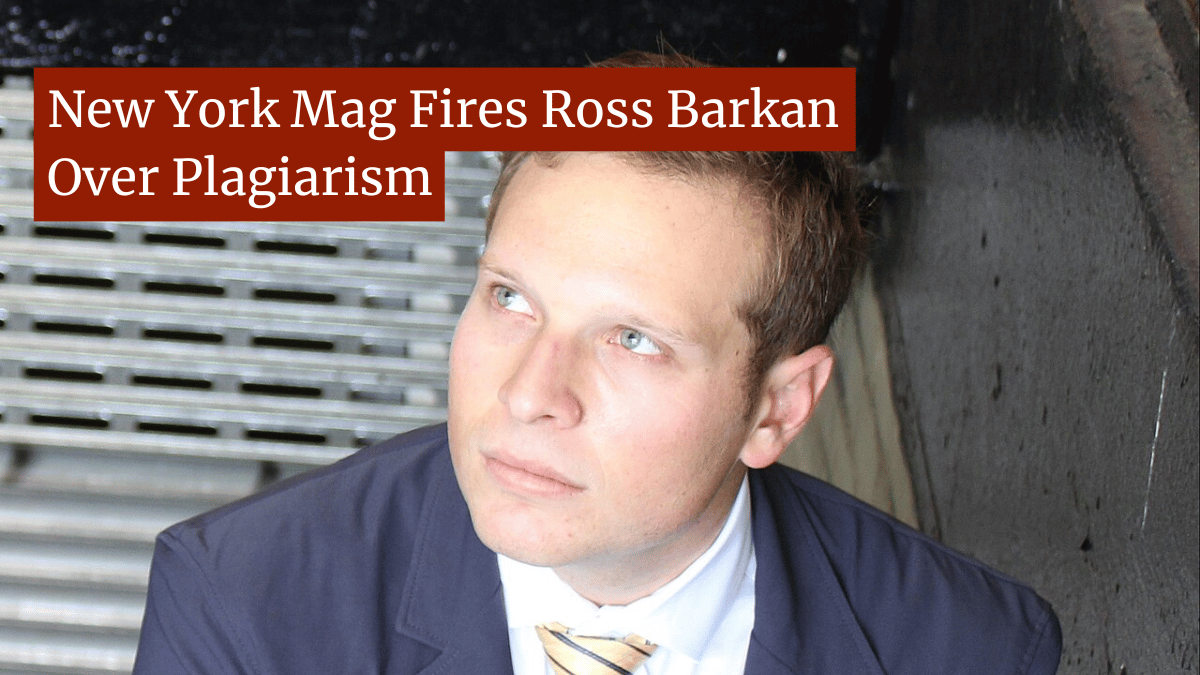
New York Mag Fires Ross Barkan Over Plagiarism

Update 08/19/2026: Penguin Random House has suspended the publication of Barkan’s upcoming book, The Revolutionary: Zohran Mamdani and the Remaking of American Politics. The book was slated for publication in October but has since been pulled from the release schedule.
New York Magazine has announced that it has parted ways with political columnist Ross Barkan after an investigation into his work found at least 67 instances of plagiarism in his columns.
According to their statement, the magazine is in the process of updating the columns that did not include proper attribution. The magazine also said that it would not continue to publish Barkan’s columns.
Barkan, for his part, acknowledged that “there were times I should have been more careful with citation.” He also announced that he plans to launch his own newsletter in September.
This announcement brings an end to a month-long saga that began when Drew Harwell, a reporter for The Washington Post, alleged that Barkan had plagiarized his lede.
However, what’s most interesting about this story is not the outcome for Barkan, but how the magazine is catching widespread criticism for its handling of the situation.
That’s especially odd considering that, after it learned about the issue, the magazine did almost everything right. It’s what happened before then that’s coming under fire.
The Story So Far
The story. began in May of this year when Drew Harwell, a reporter for The Washington Post, alleged that Barkan had copied his lede. This prompted NPR reporter Bobby Allyn to perform a “spot check” of Barkan’s work and he found two more instances that he described as plagiarism.
New York Magazine said that it would be performing its own investigation into Barkan’s work, which amounted to over 150 columns at that time. Barkan, for his part, downplayed the issue and said that he gave attribution to his sources in the form of hyperlinks. (Note: In his most recent statement, Barkan said that he had published “nearly 250” columns, so it is unclear what the exact number is.)
However, as both myself and others pointed out, the hyperlink defense was woefully inadequate. While hyperlinks are great for providing context and a source for information, he was accused of lifting text from those articles. There was no indication that the text was not his own including no quotation marks or block quotes.
Still, he stood behind his track record and said, at the time, that it was a question about just three of his columns.
Now, it appears that New York Magazine has completed its investigation, or at least done enough to reach a conclusion. That conclusion was that some 67 of Barkan’s columns had citation issues and that his work did not meet the magazine’s standards.
As such, the magazine said it has parted ways with Barkan and added corrections to the columns that they have found issues in. While this brings an end to Barkan’s tenure at the magazine, it doesn’t really end the story for either party.
For Barkan, these allegations will likely follow him wherever he goes. For New York Magazine, the question has flipped from “Did Barkan plagiarize?” to “How did it go on for so long?”
Understanding the Problem
First off, I have to give credit to New York Magazine for taking the issue seriously and doing everything right after they learned about the allegations.
They read the allegations, performed an investigation into Barkan’s work, took an appropriate amount of time to come to a conclusion and then were transparent about their findings, including issuing corrections.
In short, they did a great deal right over the past few months. But that raises the obvious question: What happened over the past few years prior?
Even with the most generous interpretation of the numbers, 67 instances of plagiarism amount to well over a quarter of his columns.
So, if the magazine was able to discover these issues after the fact, why were they not caught before?
The simple reason, most likely, is that they weren’t looking. Plagiarism detection, unfortunately, is not a common practice for publications like New York Magazine. The editorial process, instead, focuses more on accuracy and correctness rather than ensuring originality.
But omitting plagiarism detection is a huge mistake. While fact checking is important, especially from a legal perspective, plagiarism stories, like this one, can greatly damage a publication’s reputation.
That, in turn, is what is happening here. Even though the publication did everything right in the aftermath, the publication is still being widely criticized for allowing it in the first place. While it is true that much of that criticism is politically motivated, it doesn’t change the fact that the magazine is on record saying that it failed to catch 67 instances of plagiarism.
So, while Barkan may be the one responsible for the plagiarism, New York Magazine is going to share in the reputational damage that comes with it.
Bottom Line
There’s one simple truth here that every publication needs to understand: It is much easier to detect plagiarism before something is published than it is after. What is a fairly trivial check before publication becomes a significant time drain after the fact.
Proof of that is in the analysis the New York Magazine did here. They spent three months going through Barkan’s work output. What could have only taken a few minutes per column before publication takes months. Being familiar with the time frames of such investigations, this sounds about right.
There’s another timeline where New York Magazine was checking for and catching these issues in the editorial process. In that timeline, either Barkan corrected his bad habits early and no one was any the wiser, or he was quietly let go from the publication years ago.
Either outcome would have been better for everyone involved.
So while I do think the publication did a good job after the fact, it’s hard to call this a win for anyone. Both the magazine and Barkan have taken reputational hits far greater than necessary. Hopefully the magazine learns from this and finds ways to integrate plagiarism detection into its editorial process.
As for Barkan, it’s hard to say. As we’ve seen with other political commentators, it’s very possible for them to land on their feet after a plagiarism or other integrity issue. If they still have an audience, someone will always find a way to bring them on board.
It’s just not clear if Barkan has that kind of audience. That will be something we have to answer in hindsight.
Still, I can’t help think about how much better this would have been for everyone if these issues had been caught and corrected years ago. It’s a missed opportunity that should keep editors and publishers up at night.
Header Image: Helpingzero1630, CC BY-SA 4.0, via Wikimedia Commons
Want to Reuse or Republish this Content?
If you want to feature this article in your site, classroom or elsewhere, just let us know! We usually grant permission within 24 hours.