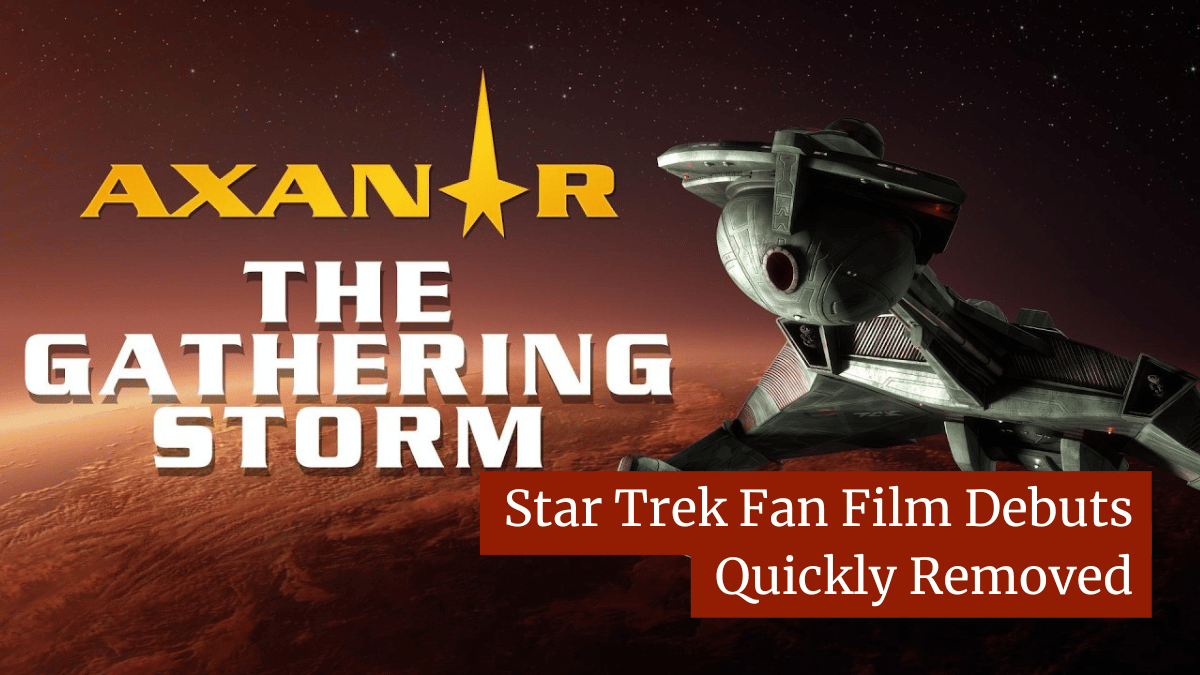
Star Trek Fan Film Debuts, Quickly Removed
On July 26, 2026, director Alec Peters debuted his long-delayed Star Trek fan film, The Four Years War: The Gathering Storm.
Twelve years, almost to the day, after his short film Star Trek: Prelude to Axanar debuted, the first of two planned sequels was being debuted at a theater near San Diego Comic Con. Shortly after, the film was uploaded to Axanar’s YouTube channel for the full world to see. It garnered over 120,000 views and, though reviews have been mixed, it was still vindication for Peters and his project.
Then, less than three days later, the film was gone. It was removed from YouTube due to a copyright claim filed by Paramount Pictures, the owners of the Star Trek franchise. Peters seems to have anticipated this, saying that his over/under on the time for a takedown was 36 hours.
As of this writing, the film is currently available on the Axanar website. You can access it either through BitTorrent or by providing your email address and streaming/downloading the film directly.
However, that has greatly diminished the reach of the film. According to the Axanar website, the film has had less than 2,000 views and/or downloads. When the YouTube version disappeared, so did most of the film’s audience.
How we got here is a story over a decade in the making. But in the end, Peters only has himself to blame for the predicament he is in.
The Man Who Changed Star Trek Fan Films
The original Prelude to Axanar was seen as something of a coup for the Star Trek fan films. The 21-minute short was praised for its production values and its story. At the time, there were no other Star Trek TV shows on the air, just the JJ Abrams films in theaters, so the film found a fandom that was hungry for more Trek.
However, Peter’s next steps would forever change the landscape of Star Trek fan films. Turning to Kickstarter, he raised over $1.1 million to create the sequel, a full-length feature film. Unfortunately, as the film went into pre-production, Paramount and CBS filed a lawsuit against the film.
As the lawsuit was progressing, Paramount announced guidelines for future Star Trek fan films. It imposed a series of restrictions including a ban on fundraising more than $50,000, limiting each project to 2 15-minute episodes and required that films not have “Star Trek” in the title. It also placed a ban on using any actor who had previously appeared in a Star Trek film or TV show.
During the case, Peters attempted to argue that his film and his fundraising were protected by fair use. However, the judge did not agree and ruled in favor of Paramount, deeming the film to be a derivative work. Days before the case was set to go to trial, Peters and Paramount reached a settlement. It allowed Axanar to move forward, but only under the above guidelines.
However, almost immediately after the settlement was signed, tension between the parties began to grow. In May 2022, Paramount’s patience ran out and the company filed an arbitration case against Peters and his company. This included uses of the Star Trek branding, Peter’s continued fundraising and drawing a salary from his production.
In September 2023, the arbitrator ruled in favor of Paramount, awarding them nearly $300,000 in costs. Paramount has filed with the courts to enforce this ruling but it is unclear what, if any, progress has been made.
Because of this, many had assumed that the Axanar project was functionally dead. However, the debut last month brought the project back to the forefront.
Unfortunately, the project also violated many of Paramount’s guidelines. That includes being too long, 21 minutes (with four minutes of credits), having previous Star Trek actors in the film and the previous fundraising issues. Though Paramount has not said why they filed the notice against the film, these reasons are likely at least part of the cause.
But Peter’s own comments indicate that he knew this was likely coming, meaning that he was aware that Paramount would likely see the film as an infringement, and he posted it anyway.
Depending on what happens next, that could be very costly, both for him and for other Star Trek fan projects.
The Battle Over Fan Fiction
Fan fiction (along with fan art and other fan creations) has always been a point of contention between rights holders and fans.
On one hand, they are almost always a form of copyright infringement. A fan fiction or film, by its very nature, is a derivative work. Paramount would be well within its rights to file lawsuits or takedown notices against almost all fan creations, regardless of length, fundraising, etc.
But they, and most other large rights holders, don’t. It isn’t just pure charity either. Rights holders are reluctant to go to war with their fans. Fan creations have long filled gaps in the release schedule (as the original Axanar short did) and rarely compete with the official releases. If anything, they keep interest alive for those releases.
A strong, healthy and active fan community is a boon for any franchise. However, this comes with an unspoken agreement that fans will create these works both purely out of love for the franchise and not for profit. When fan creations have crossed those lines, rights holders have consistently responded.
In addition to Star Trek it includes Harry Potter, Lord of the Rings, Star Wars and many, many more.
Star Trek, up until relatively recently, had been one of the more lenient franchises. The fact that the original Prelude to Axanar film was permitted speaks volumes. However, Peters’ actions pushed the envelope, forcing Paramount’s hand and giving other fan creators a much more strict set of guidelines to follow.
As I’ve said several times before, Paramount didn’t want to go to war with its fans. Peters’ actions forced them to and the result impacts everyone.
To be clear, there was always going to be someone like Peters. Someone was always going to be the one to go too far. Fan creations have been seeing more and more commercialization for decades, with some successful authors starting out as fan fiction writers.
But for Star Trek, it was Peters who compelled Paramount to set the bar. Everyone else has to find their own way to deal with the obstacle it created.
Bottom Line
One of the questions I’ve seen repeatedly asked is, “If Alex Peters has so much funding and talent, why doesn’t he just create his own science fiction franchise?”
It’s a valid question. Shows like The Orville have created Star Trek-like universes without the need for a license. However, there are two problems for Peters. First, it’s not what he promised in the Kickstarter. Second, it’s very difficult to create a new franchise and get people excited for it. It’s much easier to start with an existing IP and build from there. The familiarity gap is often just too great.
That’s not to say that no one has done it. The 50 Shades of Grey series began life as a Twilight fan fiction and Cassandra Claire, the author of the Shadowhunter series, got her start as a Harry Potter and Lord of the Rings fan fiction author. However, it’s much easier to take that gamble with a book than it is with a film.
In the end, Paramount was always going to have to lay down the law. While Peters was the one who forced their hand, a reckoning was coming no matter what.
That said, it’s difficult to think of someone who was worse for this role than Peters. His routine flouting of the settlement agreement and his attempt to fight a clearly doomed legal battle have made Paramount much more aggressive than they might have been otherwise.
The proof is in the outcome. Twelve years ago, the original Axanar film was permitted to move forward. Now, a film of similar length and style is not. Peters could have been a hero of Star Trek fan creators, but he opted to fight Paramount rather than work with them.
Every Star Trek fan project, big and small, will pay the price for that choice.
Want to Reuse or Republish this Content?
If you want to feature this article in your site, classroom or elsewhere, just let us know! We usually grant permission within 24 hours.