
Perplexity Drops the Academic Integrity Mask

Last week, I looked at a meta-analysis by Youngstown State University that examined how AI is increasingly used in the classroom by both instructors and students.
Though the news was worrisome, as AI use was rapidly increasing, and there seemed to be a great deal of confusion about what is and is not a violation of academic integrity. However, there was also good news: the vast majority of students recognized that using AI to write an entire paper was a significant violation of academic integrity.
To be clear, the battle over AI in the classroom has been ongoing for nearly 3 years. This is a space that is still very much in flux. The findings next year, or even just in another study, could be very different.
But, through all of this, one group has been relatively quiet: AI companies.
AI companies have, by and large, paid relatively little attention to the academic implications of their tools. Ever since OpenAI closed its AI detection service in July 2023, AI companies have focused most of their public-facing efforts on corporate/business uses, as that is where the money is.
But in a recent spate of ads for its new Comet AI browser, Perplexity is not only targeting students, but doing so in a way that encourages them to use AI to cheat.
This represents a dangerous turn in how AI is marketed and may even be illegal in some countries.
Here’s why it matters.
The Story so Far
Note: I’ve been unable to locate the video shown, including on Perplexity’s social media. Though the posts appear to come from Facebook, I was unable to find the video on their page. It may have since been removed.
Guy Curtis is an associate professor at the University of Western Australia. He has a particular focus on academic integrity and, like most in the space, has been very focused on AI in recent years.
Last week, on his LinkedIn page, he shared two screenshots from a Perplexity ad that directly targeted students and encouraged them to use their tools to cheat.

The first screenshot featured a student making a mixed drink. According to Curtis’ image, the video said, “In the time it took me to make this drink, Comet wrote a whole assignment for me. #worksmarternotharder.”
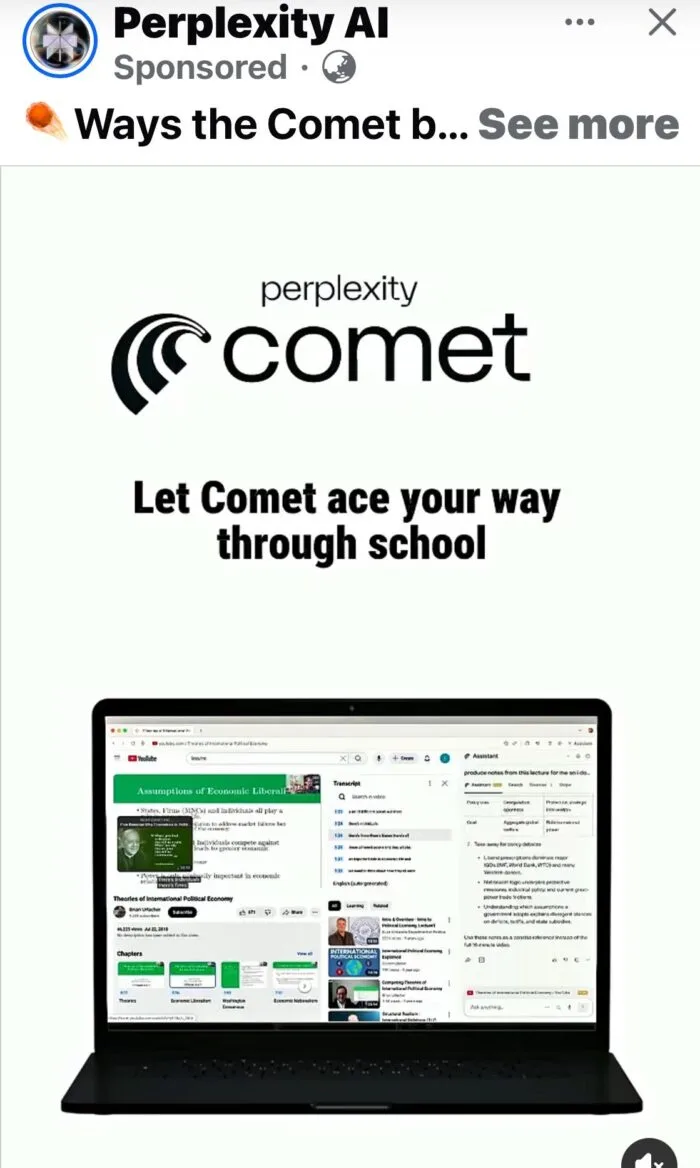
The second screenshot was an image that simply read, “Let Comet ace your way through school.”
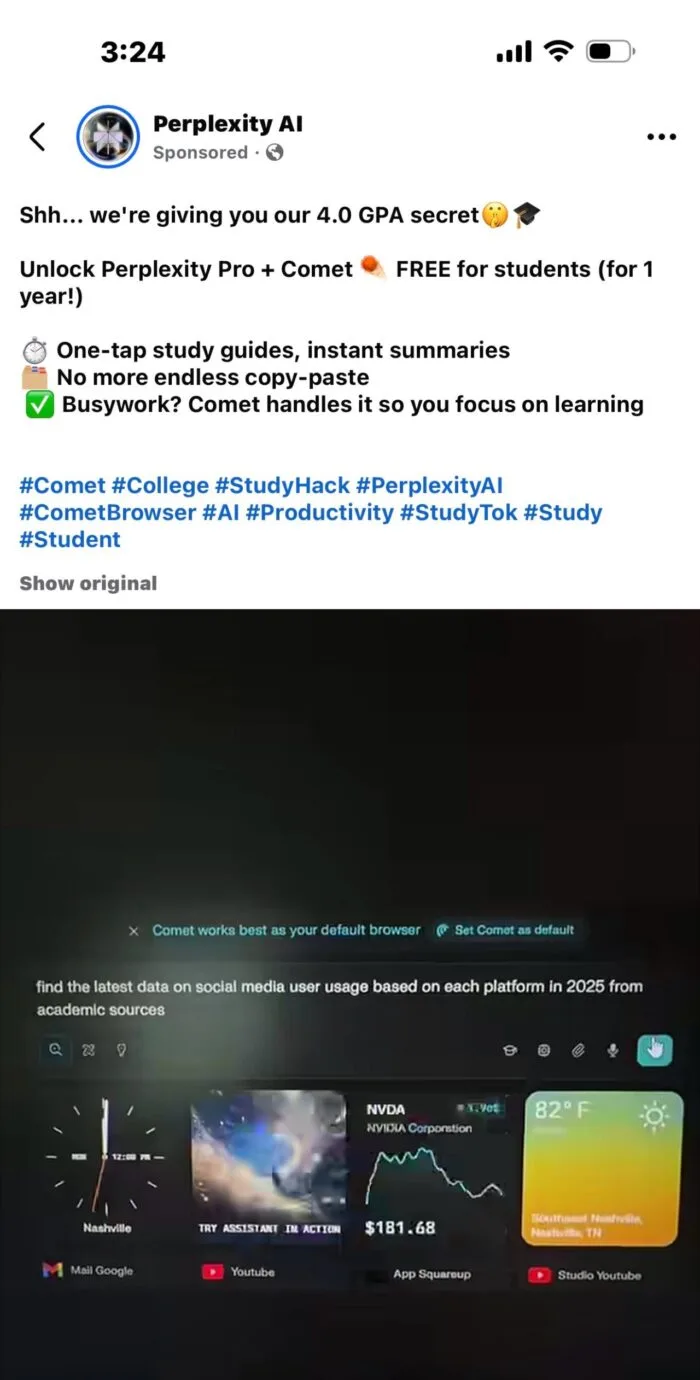
In the comments of the second post, Tricia Bertram Gallant, the author of The Opposite of Cheating, President Emeritus of the International Center for Academic Integrity, and the director of academic integrity at the University of San Diego, shared another image of a Perplexity-sponsored post.
That post said, “Shh… we’re giving you our 4.0 GPA secret,” touting its “instant summaries” and its ability to handle “busywork” for you.
In all three posts, the message is clear: The Comet web browser can help you cheat in your classes, and that is why you should try/use it.
This represents a significant turning point in the relationship between academia and AI companies, one that could end up in court.
The Problem
Up until now, the major AI companies have maintained a degree of plausible deniability regarding academic cheating. Though they’ve acknowledged that their tools can be (and are) used for academic cheating, they’ve always billed them as general-use tools.
Even controversial companies like Grammarly, which offers both generative AI and grammar-checking tools, have tried to maintain some respectability. Grammarly even offers a controlled writing environment that highlights whether AI was used.
This has given AI companies a small degree of legitimacy regarding academic integrity. They’ve been able to claim that, though they made the tools available, they are multi-purpose tools, and they never encouraged or told students to cheat.
To many, including me, these claims have sounded glib. But now, that mask has been dropped altogether. Even though it appears to be just one ad, the fact that a major AI company would make this leap is a huge turning point.
To be clear, we have been here before. In the late 2010s and early 2020s, the essay mill industry was famous for targeting students with spam messages, infiltrating classroom chats and even advertising on mainstream platforms.
This prompted some nations, most notably Australia, to pass strict legislation against the promotion of academic cheating services. As Curtis points out, the Perplexity ad may violate those laws.
Though the laws didn’t have a significant impact on essay mill services, that was because those companies had very little to lose. They frequently would close and reopen as needed. However, Perplexity has an estimated valuation of over $20 billion. That’s not an option for them.
So why did Perplexity take this risk? The answer is likely that they felt they had no choice.
Desperate Times, Desperate Measures
Right now, there is a tremendous debate about whether AI is in a bubble. As someone who is not a financial expert, I am not qualified to comment on that. However, three facts are abundantly clear.
First, AI companies are not profitable. None of the major players in AI are earning money from AI investments. At Perplexity, they spent an estimated 164% of their revenue on AWS, Anthropic and OpenAI.
To make matters worse, enterprises that adopt AI have not been seeing excellent results out of the gate. An MIT study found that 95% of companies that adopted AI failed to see any significant benefit. Though the study blames poor education and integration, there’s still good reason to believe that AI adoption will not be rapid.
Second, in this hyper-competitive space, Perplexity is falling behind. As of this writing, they are the fourth-largest chatbot, with only 6.6% market share. However, some of the bots behind them may be better-positioned. Claude may be in fifth place, but it has carved a niche with programmers. Grok may be sixth, but its connection with X (formerly Twitter) gives the bot its own platform.
Finally, we are entering a different phase of the AI war. The latest battle is over AI browsers, or agentic browsers. This includes Dia, Fellow, Opera Neon, ChatGPT Atlas, Microsoft Edge Copilot, Gemini in Chrome, Brave Leo, and Perplexity Comet, to name just a few.
Standing out in this space is nearly impossible. For Perplexity, targeting students likely made sense, since it’s an area other AI companies have ignored. However, they’ve ignored them for a damn good reason, because it risks turning the rocky relationship between AI companies and schools into a full-blown war.
In that light, Perplexity’s move is obvious. Here’s an untargeted market that has a great deal of “use” for AI and could become future business owners and workers who would be familiar with, or even dependent upon, their bot.
But just because it’s a savvy business decision doesn’t make it ethical. During a period when people are worried about the ethics of AI, it’s a move likely to cause concern both inside and outside academia.
Bottom Line
In the end, this move isn’t surprising. Targeting students this bluntly was always going to happen. As the fight for market share, revenue and awareness grows more intense, no market is going to be entirely off the table.
But what’s striking is that Perplexity didn’t learn the lessons of Chegg and other “homework help” companies. Even as their name became a slang verb for cheating, Chegg maintained that they were just there to help students ethically. They weren’t cheating aids, they were “study guides,” “homework help,” or “example essays.”
The veil with those terms is ridiculously thin. But it did help Chegg rocket to a $12 billion valuation of its own. Though the company is now on the verge of collapse, that’s because of generative AI, not their marketing.
Perplexity has just skipped to the final stage. It’s acknowledging and promoting its bot as a tool to cheat for you. It’s a move I would expect from an especially shady essay mill or other “homework help” site, not a $20 billion company.
The fact that they did this speaks to their desperation. Not only are they targeting a less-than-lucrative market, but they are doing it in a way that sacrifices even the veil of ethical behavior.
But, while Perplexity may be the first to do this, they won’t be the last. Schools and teachers need to be aware of this and prepare for it. Soon, you’re likely to have one of the most extensive advertising campaigns known to mankind working directly against academic integrity.
Because when the wolves get hungry, nobody is safe from being eaten.
Want to Reuse or Republish this Content?
If you want to feature this article in your site, classroom or elsewhere, just let us know! We usually grant permission within 24 hours.