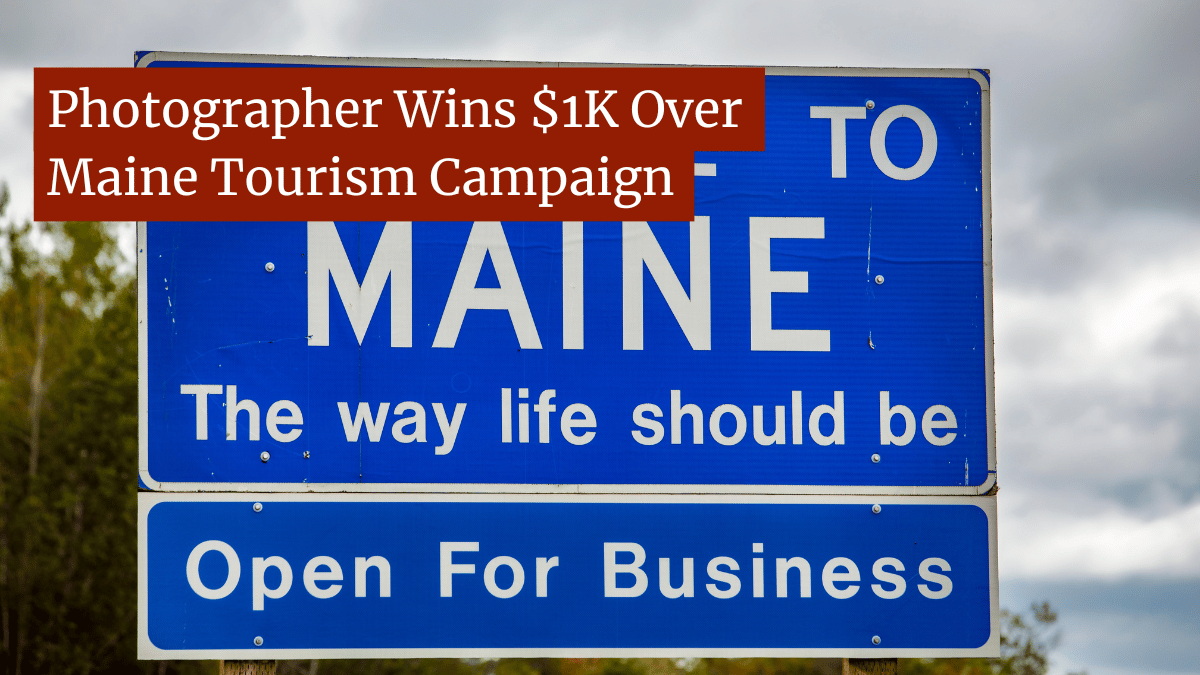
Photographer Wins $1K Over Maine Tourism Campaign

Earlier today, the Copyright Claims Board (CCB) handed down a final determination that awards a Maine photographer $1,000 in damages after a public relations firm uses an image he took in a campaign to promote tourism in the state.
Though the case ended in a technical victory for the photographer, it’s actually a warning to both photographers and social‑media users alike. Ultimately, neither side is likely to be happy with this outcome, with the photographer having asked for significantly more damages than he received.
More to the point, this case also highlights that the CCB is being remarkably consistent in its decisions, whether you agree with them or not. This could have significant implications for whether future cases end up before the board or pivot to federal court.
While the CCB was, almost certainly, the best venue for this case, it’s easy to see how other photographers might look at this ruling and think it would be better to go a different route if they want more damages.
As such, it’s worth taking a look at the case and seeing how the CCB reached its conclusions.
History of the Case
The case began in May 2025. That was when photographer Corey Kinnan snapped a photo of a loon sitting on the water. Almost immediately after taking the photo, he uploaded it to his Instagram account and also registered it with the United States Copyright Office.
However, shortly after that, he noticed that the photo had been posted on the @visitmaine Instagram account. He quickly reached out to the account via both direct message and public comment. The next day, the account responded, acknowledging that the photo was used in error and that they had removed it. All in all, the image was on the account for roughly 18 hours and had received around 300 likes.
Despite that, Kinnan demanded a licensing fee for the use of the image and asked for $1,750 to retroactively license the use of the image. The account, which is operated by the PR firm Marshall Communications, declined to pay, prompting Kinnan to file the claim with the CCB a week later.
According to Marshall Communications, they thought they had received permission to use the image. They were running a campaign encouraging people to use the hashtag #MaineThing to tag images that they could reuse. It’s unclear how this error occurred, but the firm did acknowledge that the image was not tagged and was used in error.
In his claim, Kinnan sought $7,500 in statutory damages. This would have been a bit over 4X the an amount that he was saying the license fee should have been.
However, the CCB came to a very different conclusion.
The main issue was that Kinnan had no evidence that anyone had ever paid that amount to license one of his images. He had a page on his website that quoted that rate, but the page was created after the alleged infringement. Furthermore, the board also noted that, website-listed prices are not sufficient evidence of a fair market rate for such a license.
After determining that and examining the brief period use, presence of attribution and the expeditious removal among other factors, the CCB decided to start with the $750 statutory minimum. The board then raised that amount by $250 due to the commercial nature of the infringement, the creative nature of the work and the fact that Kinnan is a professional photographer.
That brought the board to the $1,000 award, which was its final determination.
Most Likely, No One Will Be Happy
On paper, this is a win for Kinnan and $1,000 is not a small amount of money. That said, it’s barely more than the statutory minimum and less than his initial demand. In short, by not paying the license and going through the CCB, the respondent saved at least $750.
This illustrates something that I’ve written about many times before. The CCB is going to base its statutory damages on the actual damages. However, to prove actual damages, you need to prove that someone actually paid for a license of the work at the price you claim.
Simply having a pricing page on your site or citing what other stock agencies charge is not enough. It has to be specific to you and your work. Kinnan didn’t have that and, because of that, the damages started at the statutory minimum of $750.
While I agree with all the reasons that the board gave for increasing the award amount, I’m still a bit surprised that it did so at all. The post was put up in error, was quickly removed, had limited reach and no direct commercial impact. The board has certainly done so in the past and there seemed to be more factors in favor of keeping it at the minimum than raising it.
Ultimately, I can imagine that neither side is particularly happy with this outcome. Kinnan got far less than he asked for, and Marshall Communications still has to pay $1,000 for an 18‑hour mistake.
Still, that may be more an indication that the CCB struck a decent balance. Neither side is a villain here. I believe the mistake by Marshall Communications was an honest one, but, as the board notes, copyright is a strict‑liability offense. Whether it was an honest mistake or a deliberate act, it’s an infringement all the same.
Bottom Line
In the end, I believe that no one was satisfied with this outcome. However, I think that it’s also the most fair.
Though Kinnan didn’t get the $1,750 license fee that he asked for, much less the $7,500 in statutory damages that he sought, he still gets $1,000 for an image that was up less than a day and carried proper attribution.
For Marshall Communications, it’s an expensive lesson but one that could have been much, much worse if it had gone to an actual trial. Legal fees alone would have likely been more than dozens of times the amount of this award. It’s a painful lesson, but not a crippling one.
The ultimate question is whether the glass is half full or half empty. You can make an argument for either on either side.
That said, it re‑raises the question of whether the CCB is the right venue for photographers to bring these kinds of claims. Though it was much less expensive and faster than going through federal court, it still took a year and a half to get to a decision.
But the bigger concern is that, outside of some very narrow circumstances, the CCB has shown reluctance to award even modest amounts of damages. Does that automatically mean that one should roll the dice in federal court?
I don’t think so. But I am also certain that many photographers (and other creators) will be looking at decisions like this one and adjusting their calculations moving forward.
Want to Reuse or Republish this Content?
If you want to feature this article in your site, classroom or elsewhere, just let us know! We usually grant permission within 24 hours.