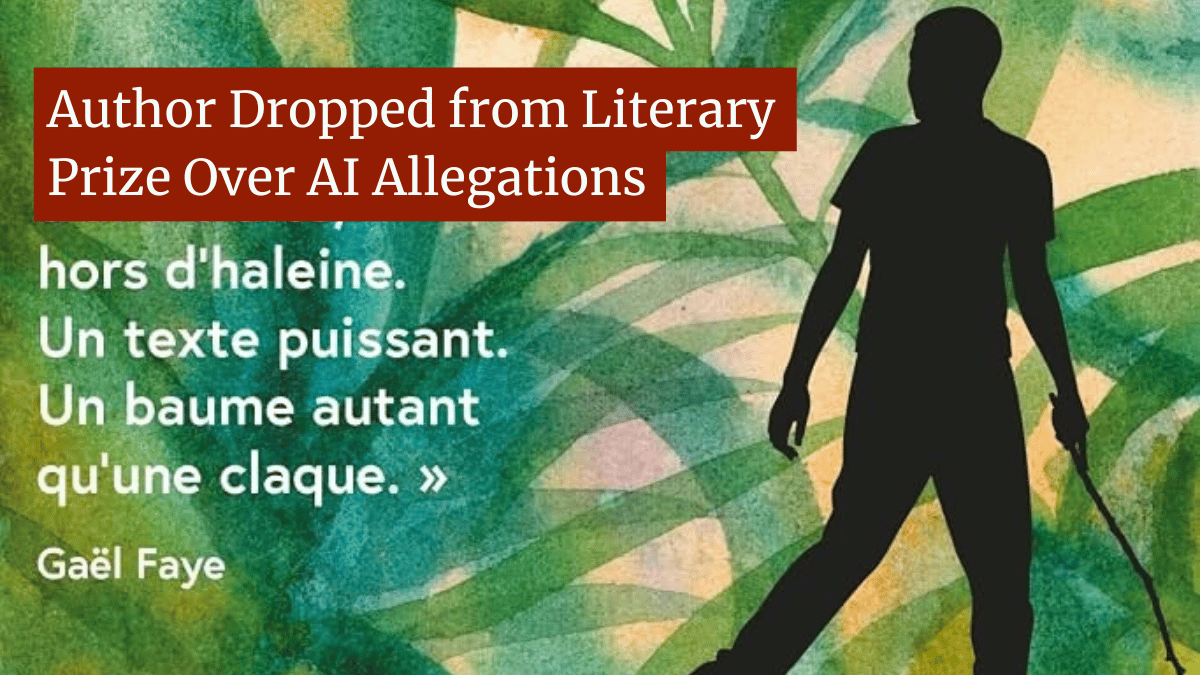
Author Dropped from Literary Prize Over AI Allegations
This should be a time of celebration for Thélyson Orélien. He had just won the Prix du Roman Fnac, a major literary prize in France, and was on the long list for the Goncourt literary prize, widely considered the most prestigious literary prize in the country.
His novel, C’était Ça ou Mourir (It Was Either That or Die) had already sold over 35 000 copies and his publishers had sold translation rights for over 20 different regions.
However, the same day he won the Prix du Roman Fnac, a pseudonymous X (formerly Twitter) account named Balance ton Claude (Denounce Your Claude) posted screenshots of an AI check of the novel’s content created using Pangram. According to the images, Pangram had found that the novel was 100 % AI‑generated.
Avez-vous entendu parler de ce roman ? C’est le « phénomène de la rentrée littéraire ». Il est lauréat du Prix Fnac, du Prix Méduse, du Prix Première Plume, fortement pressenti pour le Prix Renaudot, et il est en lice pour les prix Goncourt, Femina, Médicis et Décembre. Ah oui,… pic.twitter.com/9evcXrPyFD
— Balance ton Claude (@Pangramed) September 21, 2026
Orélien, for his part, has staunchly denied this. In one interview, he said that he had written the first draft of the novel in 2019, well before generative AI was widely available. According to French media outlets, other AI detection tools have said that the novel is human-written.
However, this didn’t stop the Goncourt literary prize organizers from dropping Orélien from the long list of nominees. In a statement, they said that the decision was made, “to preserve the integrity of the Goncourt Prize and that of the Academie, whose central role is to promote and honor literature written by women and men.”
Shortly after the AI allegations, other allegations of plagiarism began to surface. These included a 2012 short story and a 2013 opinion piece as well as various social media posts.
Despite these allegations, both his French and Canadian publishers have said that they are standing by Orélien and, while they are pausing promotional activities, that is for his “well-being,” not due to the allegations. The book remains available for purchase.
The story raises new questions about the role of AI detection tools in the literary world.
A Reckless Revocation
Note: Since much of this material is in French, I used automatic translation tools to help me read and understand the content. However, such tools are not perfect and can introduce errors.
Right off the bat, I am disappointed with how the Goncourt literary prize organizers handled the situation. While I applaud them for taking the issue seriously and taking a firm stance against AI‑generated content, the decision to remove Orélien from the long list of nominees was premature.
The reason is simple. The only proof of AI usage that we have right now is the Pangram results. While I agree that Pangram is one of the better AI detectors out there, even the best AI detectors make mistakes. Another further wrinkle is that tools like Pangram may not work as well in certain languages, or certain kinds of writing.
In short, even the best tools can have blind spots. While I’m not saying that is what happened here, it has to be considered.
Orélien and/or his publishers deserved a chance to refute the allegations. If it is true that he began writing the novel in 2019, then it should be reasonably easy to show that the novel was not AI‑generated.
In that regard, this is the opposite of the Jerry Falade story from August. There, it was his agents, those most familiar with the book, who pulled it from consideration. In Orélien’s case, it was the Goncourt literary prize organizers who made the decision.
Removing someone from contention based on an accusation alone is a dangerous precedent. It opens the door for outsiders to remove a book from consideration for any reason at all. While I don’t know what investigation the Goncourt literary prize organizers conducted, given how quickly they made the decision, it doesn’t seem like it was a detailed one.
While I am more worried about the past allegations of plagiarism, especially since the probe into them appears to be expanding. However, these allegations are also over a decade old. They are also a very different kind of alleged plagiarism. (Note: It’s unclear if these allegations played a role in the decision to remove Orélien from the long list.)
While there’s no doubt that some plagiarists will move from translated and/or copy/paste plagiarism to AI-generated plagiarism, it doesn’t establish a pattern. That said, if Goncourt wanted to remove the book due to his past issues, they could have just said so. Instead, they pinned the decision on his alleged AI usage.
But those allegations are still unproven and the fact that his publishers are standing by him, at least for now, indicates that there is more to the story.
A Familiar Playbook
What’s most disturbing about this story is not the allegations themselves, but how they came about. The Balance ton Claude account is a pseudonymous account that started publishing just four days before making the allegations against Orélien.
Initially, it was unknown who was behind the account. However, it was later revealed by Le Figaro that the account was run, at least in part, by one of their own columnists, Samuel Fitoussi.
La Figaro is widely considered a conservative publication, and Fitoussi is known for his right‑wing views. According to him, he just wants to sound the alarm on AI usage in the literary world. He claims that the account is a “collective project” but doesn’t name any of the other contributors.
He denies that race or politics played a role in his decision to publish the allegations. However, it’s impossible to ignore the parallels between this story and the Jason Arday story from July. There, a conservative academic, Nathan Cofnas, published the allegations against Arday, a black academic. Then, same as here, the allegations were picked up by a growing number of mainstream publications.
Here, we have a conservative journalist, Fitoussi, publishing allegations of AI usage against a black author, Orélien. Now the story is being picked up and expanded upon by larger publications.
But, even if we ignore the parallels, this begs a simple question: Why did Fitoussi, who has a massive platform through his various publications, choose to publish the allegations against Orélien using a pseudonymous X account? While Fitoussi may argue that he is a whistleblower, that’s a tough claim to make given that Orélien has no authority over him. There was nothing stopping him from publishing the allegations under his own name other than he didn’t want to be associated with the claims.
If anyone has the power in this dynamic, it’s Fitoussi, not Orélien. Fitoussi had nothing to fear from Orélien.
Journalists, better than anyone, understand the importance of context. The context of who is making the claims is important. Fitoussi’s decision to make the allegations using a pseudonymous X account without a clear reason for doing so is an attempt to remove that context.
That brings with it its own set of problems and concerns.
Bottom Line
In the end, I do believe that the allegations against Orélien should be taken seriously and investigated carefully, ideally by a third party. Plagiarism is a serious issue, and the allegations, both past and present, should be examined closely and fairly.
However, this time I walk away more alarmed by what happened around the allegations than I am by the allegations themselves.
You have an award committee that seemingly made a decision based on a single allegation. You have a well‑known journalist who chose to publish the allegations anonymously. Finally, you have a career that may never be able to recover from this, even if the allegations are proven false.
There has to be a better way to address these issues. There has to be a balance between taking a strong stance against AI and protecting authors against bad‑faith or dubious allegations.
As the Jason Arday story should have reminded everyone, behind these allegations are real people. Yes, plagiarism is bad and it’s a serious issue, but we can’t lose sight of our humanity in the fight against it.
Because, without our humanity, we’ve already lost the thing we were scared of that AI would take away from us.
Want to Reuse or Republish this Content?
If you want to feature this article in your site, classroom or elsewhere, just let us know! We usually grant permission within 24 hours.