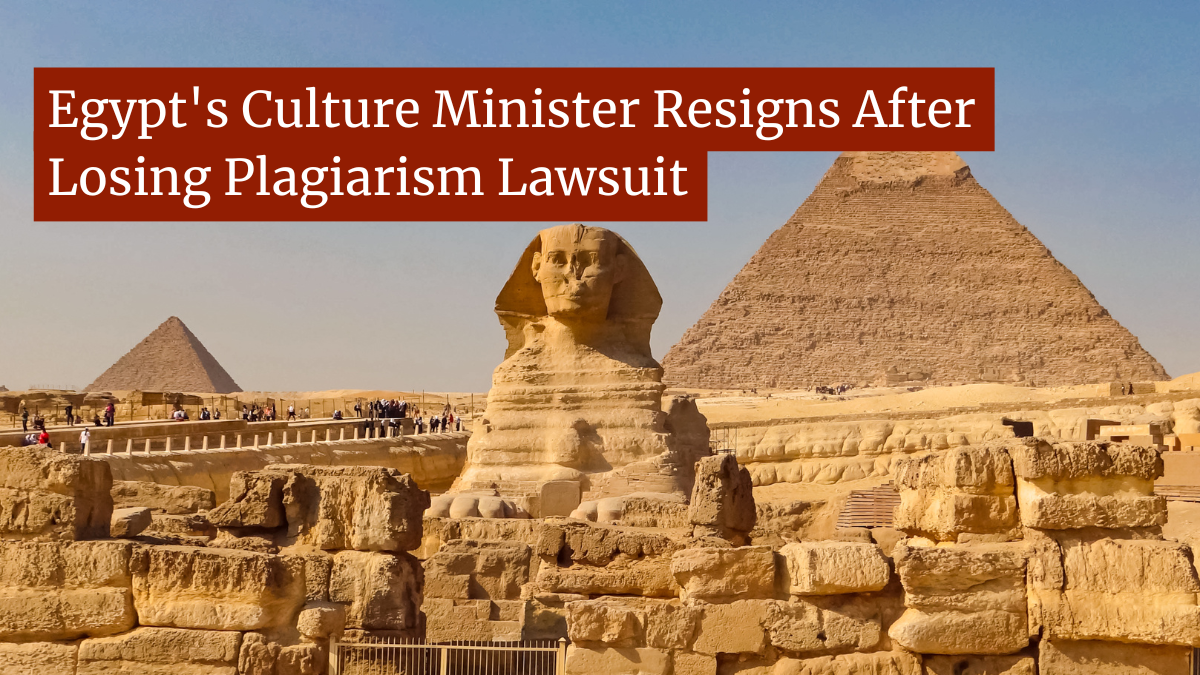
Egypt’s Culture Minister Resigns After Losing Plagiarism Lawsuit

In February 2026, Jehan Zaki was appointed the Culture Minister of Egypt. In his role, she headed the Ministry of Culture of Egypt, which oversees the preservation and promotion of the country’s cultural heritage.
Unfortunately, according to a recent court ruling, she is also a plagiarist.
That decision follows a lawsuit filed by Soheir Abdel-Hamid, the author of a 2022 book, The Assassination of Kout El Kouloub Al‑Demerdashiya, Lady of the Palace. The book is a biography of the Egyptian aristocrat and writer, Kout El Kouloub.
In 2024, at the Cairo International Book Fair, Zaki introduced her own biography of Kout El Kouloub, titled Coco Chanel and Kout El Kouloub: Braids of Formation and Treason. However, Abdel-Hamid claimed that Zaki’s book lifted large portions from her work, prompting her to file a copyright infringement lawsuit and Zaki to file a defamation lawsuit against Abdel-Hamid.
Unfortunately for Zaki, her lawsuit was quickly dismissed. The copyright lawsuit continued with the lower court assembling a three-member panel of experts to review the case. That panel estimated that about 50 percent of the original work was plagiarized, and the amount far exceeded that which is permitted by fair use.
Zaki filed multiple appeals, but those have been rejected. The lower court’s decision has been upheld, and Zaki has been ordered 100,000 Egyptian pounds ($2,500) in damages and to pull her book from the market.
Following the denial of her appeals, Zaki resigned from her position as Culture Minister, capping her tenure at approximately five months.
It’s a sad end to a short tenure, but she’s far from the first government official to be put in this position. Still, there are several things that do make this case stand out, even in this crowded field.
The Most Avoidable Plagiarism Case Ever
Note: Many of the names in this article have multiple spellings in English. I attempted to find a consensus spelling for each name based on local English-language sources. However, please note that some names may be spelled differently elsewhere.
If you’re a long-time (or even medium-time) reader of this site, you know that there have been countless examples of high-ranking government officials being caught plagiarizing and resigning.
We’ve seen stories like this one in Norway, South Korea, Germany, Austria, Spain, and the United States (to name a few) where officials have resigned or dropped out of races after being caught plagiarizing.
It is an astoundingly common occurrence. However, even in this crowded field, this case stands out.
The reason is simple. In nearly all the other cases, the alleged plagiarism took place during the official’s academic career, not their professional or political career. Zaki’s book was literally published just two years ago. The original book was only published four years ago.
In so many of these cases, we’re focusing on dissertations and theses that are that decades old. It’s understandable how those documents were not caught in their time. The officials, then students, relied on trusting professors and the lack of plagiarism detection tools or search engines to catch them. Technology caught up to their plagiarism, and their plagiarism caught up to them.
That is not what happened here. There were multiple opportunities to prevent this from happening, and all of them were missed.
First, Zaki could not have plagiarized. That is the most obvious point. She could have chosen to write her book ethically and legally. Judging from the tribunal’s findings, she clearly did not.
Second, her publisher could have caught the plagiarism and either refused to publish the book or demanded significant edits. Even if Abdel-Hamid’s work was not in plagiarism detection databases, a simple examination of other books on the topic would have likely revealed the problem.
Finally, the Egyptian government could have vetted her properly, including an examination of her book. To be clear, the lawsuit was already ongoing when she was appointed Culture Minister. The government had every reason to investigate the claims in that lawsuit but did not.
In short, this was likely the most avoidable government plagiarism scandal ever. Yet, somehow, it still happened. A lot of people, not just Zaki, have some difficult questions to answer.
One Bitter Irony
Few countries have a history that is nearly as lengthy or as rich as Egypt’s. That is a major part of why the Culture Minister has such an important role. They oversee the protection and promotion of over 5,000 years of history, culture, and art.
However, one footnote in that history is what is likely the first example of a public plagiarism dispute. Though it wasn’t the first time the word “plagiarism” was used, that would come a century and a half later. Two high-profile authors had a dispute over copied paragraphs and passages, something very similar to what we have here.
Egypt’s own history provides a cautionary tale about why one shouldn’t plagiarize and how it can harm one’s career and reputation many, many years later.
For an Egyptian Culture Minister to plagiarize so brazenly (according to the court’s findings) requires them to ignore warnings from their own country’s history. Yes, it is a relatively obscure story, but if anyone were going to know it, I would think it would be a well-respected Egyptologist and the Culture Minister of the country.
Sadly, this seems to be one lesson from her country’s history that she did not learn.
Bottom Line
In the end, a lot of people, not just Zaki, have some difficult questions to answer. Not only was she able to publish this book, but she was appointed Culture Minister as the lawsuit was ongoing. While litigation shouldn’t preclude someone from being appointed to a position, it should at least be investigated.
This story raises serious questions about the vetting process for government officials in Egypt. While she is far from the first high-ranking official to be caught plagiarizing shortly after being appointed, this case was easily one of the most preventable.
Hopefully, lessons will be learned from this and new systems will be put in place. This is incredibly frustrating and embarrassing, especially for the Egyptian government.
It’s bad enough to have any high-ranking government official be caught plagiarizing, but it’s even worse when it’s the Culture Minister, the work involved was incredibly recent, and the lawsuit over that plagiarism was ongoing.
Stories like this one make everyone look bad, not just the plagiarist. As such, I’m hoping that this story will serve as a wake-up call not just for the Egyptian government, but for all governments.
Want to Reuse or Republish this Content?
If you want to feature this article in your site, classroom or elsewhere, just let us know! We usually grant permission within 24 hours.