A Plagiarism Fight Over Sideways Church Pews

German artist Dorothee Bielfeld is asking Manifesta 16 Ruhr to remove an installation by Turkish artist Nasan Tur from the expedition, claiming that it is a plagiarism of her earlier work.
Manifesta is an art event that takes place every two years in different cities. This year’s is taking place in the Ruhr region of Germany with the theme of “This is not a church.” Appropriately, the event is hosted by 12 historical churches in the region.
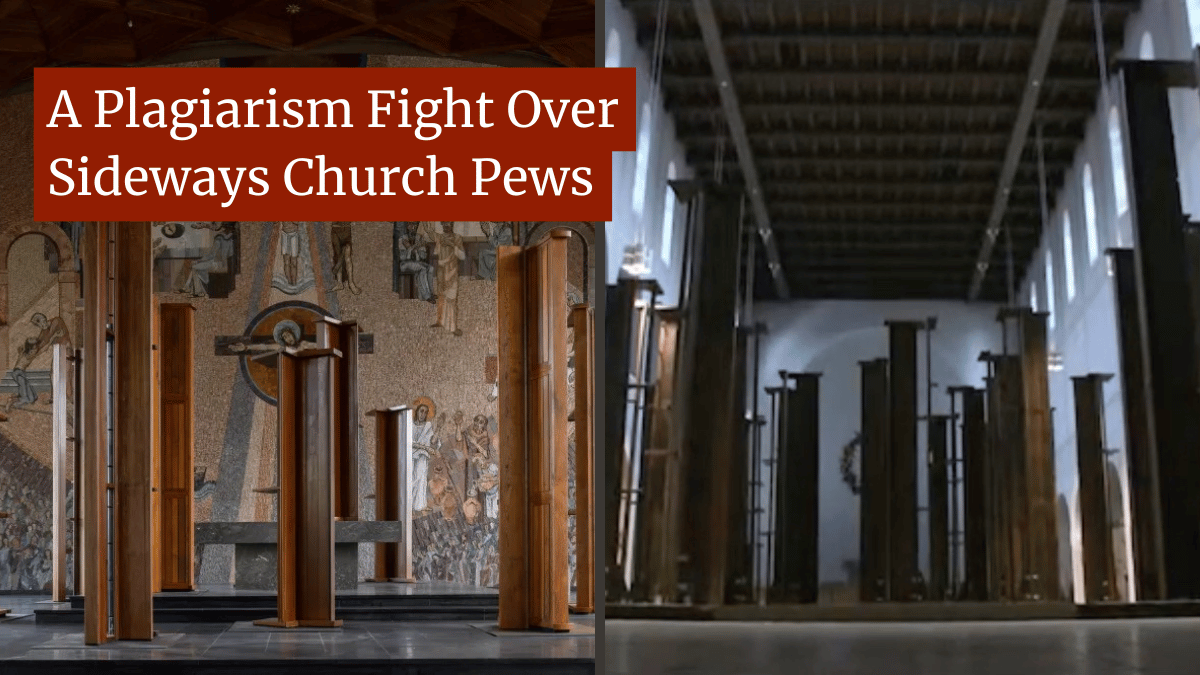
One of those exhibitions is Tur’s Elevation. The installation consists of a series of reclaimed church pews that have been carved on and positioned on their ends to resemble towers. According to Bielfeld, the installation is a plagiarism of her 2010 work Aufrichten (Raising Up), which featured a “forest” of 27 different pews also placed on their ends.
Bielfeld created her work for a 2010 cultural campaign entitled Ruhr.2010. Though the installation was meant to honor the Ruhr region, it was installed in Hamburg’s Christ-König-Kirche and represented just one work in a long history of Bielfeld reclaiming church items for her art.
However, Manifesta has already denied Bielfeld’s allegations. They claim that Tur’s work is original and that the similarities are superficial. Tur himself denied the allegations, saying that they are “false and baseless” and that they had affected him “deeply.”
So is this a case of plagiarism? Or is it just a case of two artists with similar ideas? That may be impossible to know for sure.
Artistic Similarities, Artistic Differences
Back in August 2025, we discussed the case of artist Tyrrell Winston, who filed a lawsuit against the New Orleans Pelicans alleging copyright infringement of various sculptures he had created featuring deflated basketballs. That case is ongoing.
In that case, Winston alleged that the Pelicans had seen his work at one of the various NBA-related installations, and then coopted the idea to create their own sculpture that they used as a background for promotional posts.
That is incredibly similar to what happened with Bielfeld and Tur. Biefeld doesn’t allege that Tur directly copied her work but that he used the big idea from it and created a new, likely derivative, work without her getting her permission or giving her attribution.
That said, this introduces a great deal of complexity into the case. First, it’s entirely possible that two people could come up with the same idea of upturned pews, especially when Tur was creating something intended to be displayed in a church at a church-themed event.
Furthermore, according to Manifesta, Tur’s work was created over a lengthy period of time and the project is still ongoing. It’s also worth noting that Tur’s work is more about the messages carved into the pews and Bielfeld’s work is more about being lost in a forest of pews.
However, Bielfeld’s connection with the Ruhr region is either an amazing coincidence or a warning sign. It’s also possible that Tur saw Bielfeld’s work and decided to take that idea and do something different with it. That would raise serious ethical and possible legal questions.
Based on the information we have right now, it’s more or less impossible to draw a meaningful conclusion. That would require a lawsuit with discovery and a possible trial to really learn all the relevant facts.
Unfortunately for those wanting to know, a lawsuit in this case is unlikely.
The Problem with a Lawsuit
Note: My area of focus is on US copyright law. As such, there may be differences in other countries where a case could be filed.
According to Bielefeld, she has obtained a lawyer. However, she says that she did it in response to legal threats from Manifesta, not necessarily because she intended to sue.
Even if we set aside the potential practical problems, such as cost, jurisdiction, determining who to sue, etc., there’s not much of a copyright issue to glom onto here.
Simply put, the most obvious similarity is that both works feature upturned pews. While it is an unusual idea, ideas are not protected by copyright.
As we saw in 2023 with the lawsuit over a banana duct-taped to a wall. The idea itself is not protected by copyright, only the implementation of that idea. This creates an issue in this case because the implementations are inherently different.
First, they are two different works in different spaces. Second, Tur’s work puts the focus more on the anonymous messages carved into the wood, where Bielefeld’s focuses more on the pews themselves.
So, even though the “big idea” is the same between them, the implementations are different. From a copyright standpoint, it’s going to be incredibly difficult to prove that Tur infringed on Bielefeld’s work. Without some additional information that is currently unavailable, the similarities, as overt as they are, are not protected by copyright.
This isn’t to say that Bielefeld is wrong to be upset about this or is mistaken in her feelings. When looking at the images side-by-side, almost anyone can see the similarities, and if I were in her position, I would likely feel the same way.
This isn’t even a case of someone seeing patterns and creating a false plagiarism claim. The similarities between the two works are real, but they most likely are not protected by copyright.
We may never know if the similarities between the two works are a coincidence or if Tur did copy Bielefeld’s idea, but even if he did, it’s not likely a case of copyright infringement.
Bottom Line
In the end, I think the question of whether Tur copied Bielfeld’s work or not is moot. Even if he did come up with the idea on his own, it’s still too similar to another work from the same region. This controversy was inevitable, and it has harmed everyone involved.
In their defense, I will say that Bielfeld’s work is more difficult to find online. To get the images I used above, I had to find an obscure YouTube video, which only has about 130 views as of this writing. Still, by working with the local art community, they had an opportunity to learn about this installation and avoid the controversy.
What personally bothers me the most is not the similarities between the two works. I could easily dismiss that as a coincidence, especially given the theme of this year’s Manifesta. Rather, it’s the fact that both works have such a strong connection to the Ruhr region.
According to Wikipedia, the Ruhr region has a metro population of about 10.6 million people. It’s not a small region by any stretch. But for two installations to have the same overall theme and be tied to the same region is a bit too much to just brush off as a coincidence.
Manifesta needs to take a lesson from this. Simply put, they need to be more proactive in these issues and work to ensure that none of their installations are too similar to earlier works, especially those from the same region.
Whether Tur copied or not doesn’t really matter. Manifesta failed here. They should have been more proactive in protecting both their artists and themselves from these types of issues.
With Manifesta, the focus should be on the art. Instead, now the headlines focus on allegations of plagiarism. That is not what anyone wants.
Image Credits
Left Image: Nasan Tur, Elevation, 2026. Installation view. Photo: Rainer Schlautmann. © Nasan Tur and Manifesta
Right Image: Kunst-Kirche Bochum Video Kick 2010 – Aufrichten © Kunst-Kirche Bochum and Dorothee Bielfeld
Want to Reuse or Republish this Content?
If you want to feature this article in your site, classroom or elsewhere, just let us know! We usually grant permission within 24 hours.