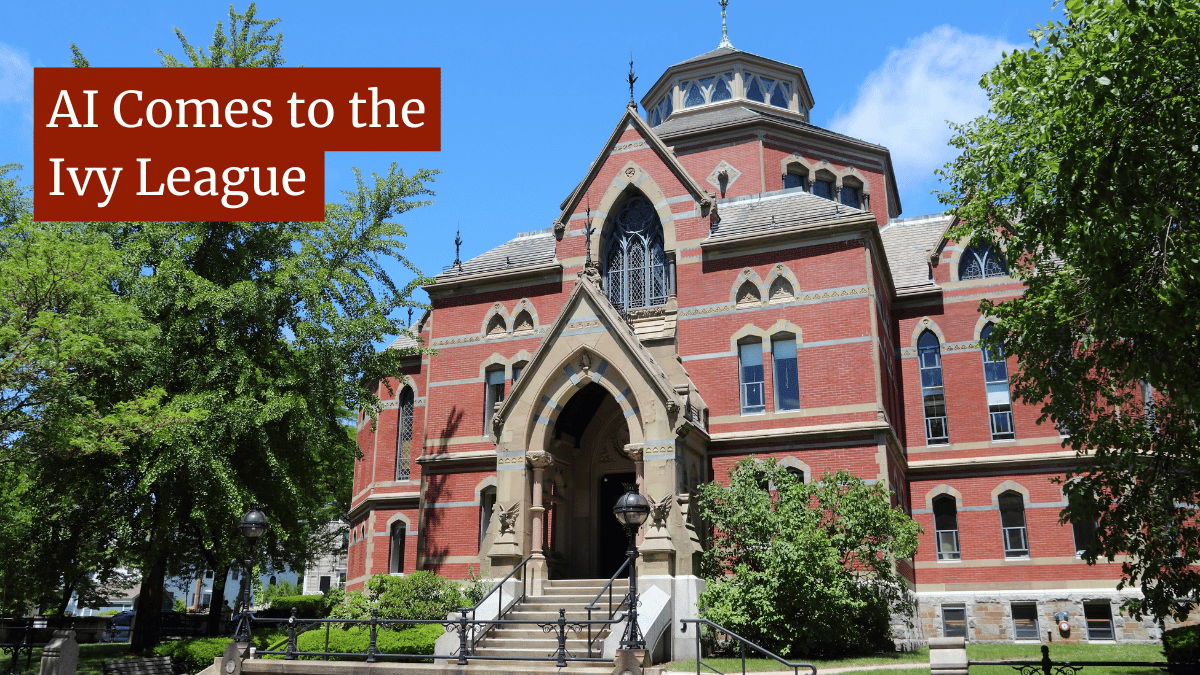
AI Comes to the Ivy League
Roberto Serrano is a professor of economics at Brown University. He is widely known for his expertise on game theory in economics and has earned numerous awards for his work.
However, he also recently learned just how widespread AI cheating is in his classroom.
First covered by El Pais and then picked up by Futurism, he discovered, with convincing evidence, that the majority of his students in his mathematical economics class were using AI, or something else, to cheat on a midterm exam.
He gave his students a closed-book, take-home midterm exam. He said he preferred that format because it allowed him to ask more difficult questions and allow the students to take the time they needed to complete the exam.
However, 40 out of 86 of the exams came back with a perfect score of 100. The class average was a sky-high 96. He further noted that several of the answers contained passages that were similar to what ChatGPT said after being fed the questions.
Any doubts about the cheating were dispelled with the final exam. He moved the final exam to in-class and told his students that, if the scores didn’t align with the midterm, only the final exam would count.
27 students, including 22 who got a perfect score on the midterm, didn’t even show up. For those who remained, the class average dropped to 48, exactly half of the midterm average.
The story speaks to a bitter truth. Cheating, most likely AI cheating, is rampant in Ivy League classrooms. However, that shouldn’t be that surprising. The warning signs were there well before AI became broadly available to the public.
The Early Warnings
In the 2012 spring semester, Harvard University faced its largest cheating scandal in history. Nearly half of all the students in the “Introduction to Congress” class were accused of cheating on the final exam.
What started with a handful of similar papers grew quickly into an investigation that involved 125 students and accusations of collusion. At its peak, the investigation involved roughly 2% of the school’s student body. Roughly 70% of those students were forced to withdraw.
This story should have been a wake-up call for Ivy League schools. However, the schools, including Harvard itself, didn’t take any significant action following the scandal.
Then the schools got another warning in the form of the highly publicized Varsity Blues scandal. That scandal saw prospective students cheating on college entrance exams, often with the help of stand-in test takers, to get access to Ivy League and similar schools.
This is not to be confused with the Harvard fencing scandal, which happened in 2020.
Elite schools are often the ones who put the most faith in their students not to cheat. However, those students are subject to the same pressures and temptations as everyone else. It’s not a surprise that Ivy League students, or prospective students, would cheat to get ahead.
That’s just as true today as it was in 2012. It’s just that AI has made the issue much more difficult to ignore.
Turning the Battleship
Ivy League schools are famous for being tied to their traditions. One of those traditions is trusting students not to cheat and to report other students who are cheating. They tend to put the focus on the honor code, not the enforcement of it.
We’ve seen this at Princeton. For 133 years, the school had a policy of not proctoring exams. Instead, students were expected to take the exams on their honor and report any cheating that they saw.
However, that policy was rescinded just last month. Though disciplinary decisions will still be made by fellow students, the school will now proctor exams.
The reason for the change, according to the school, is the “perception that cheating on in-class exams has become widespread.”
The problem with that is, as studies have shown, AI is giving students a new way to cheat, not necessarily creating new cheaters. The problem was always there; AI has just shined a light on it.
Changing the environment in academia is often likened to turning a battleship. However, the Ivy League schools are the biggest battleships with the largest turning radius. Their reputations are tied to their traditions, and quick changes, even for the better, can harm that reputation.
However, the battleships are definitely turning. It will be interesting to see what course they ultimately take.
Bottom Line
Ivy League schools have long been put on a pedestal for their academic excellence. They are great schools. Their prestige is deserved and the reputations earned. But they are still subject to the same human flaws as every other school.
It’s not a matter of if students will cheat. It’s a matter of how, when, and how much. That’s just as true at Harvard as it is in your local community college. Prestigious schools are not immune to the pressures that exist everywhere else.
Historically, such schools have leaned more on their honor code than preventative measures. That is a choice they can certainly make, but it does mean removing one of the layers of deterrence when it comes to cheating.
Previously, this was, at least from the perspective of the schools, acceptable. However, AI has made the issue much more difficult to ignore. Stories like Serrano’s have only brought more attention to the issue.
In the end, Ivy League schools are just like every other college or university. They will get the same flawed students that will have to endure the same pressures and temptations while working in the same imperfect system.
Despite the headline, the news isn’t that AI has come for the Ivy League. It’s that it’s come for all schools, and the Ivy League may just be the slowest at turning the battleship.
Want to Reuse or Republish this Content?
If you want to feature this article in your site, classroom or elsewhere, just let us know! We usually grant permission within 24 hours.