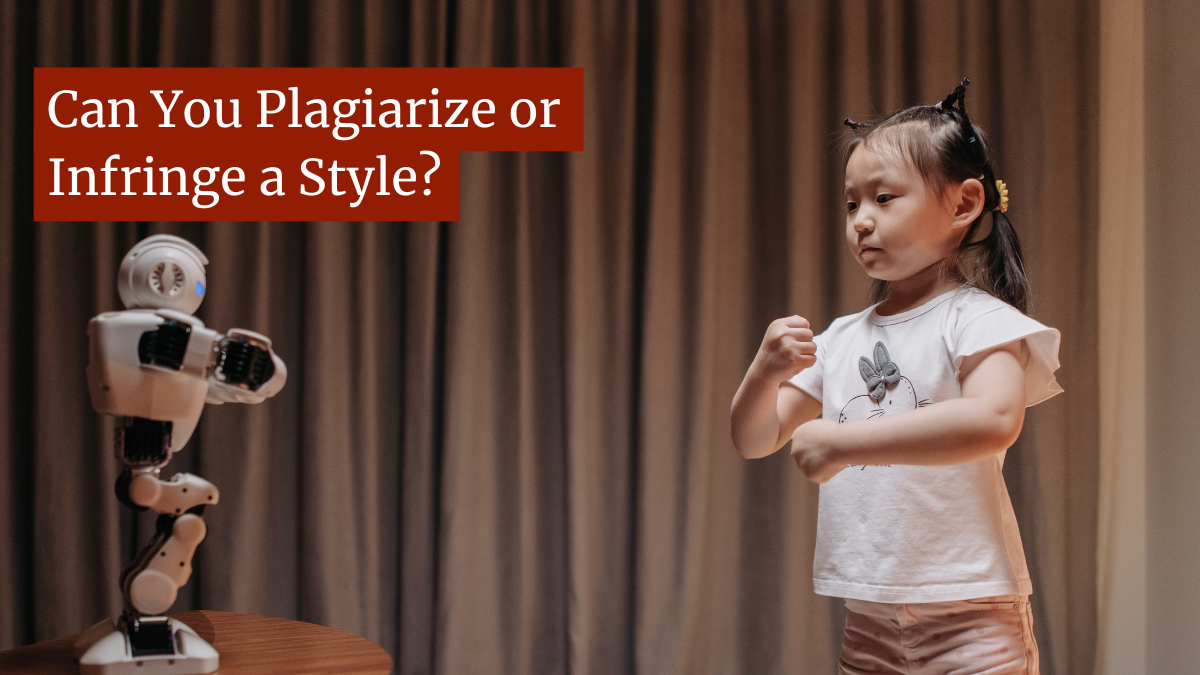
Can You Plagiarize or Infringe a Style?

One of the oldest debates in the plagiarism space is the line between inspiration/influence and plagiarism. When does inspiration bleed into plagiarism? When does influence turn into copyright infringement?
These are not simple questions. The lines are often blurry. They often depend on the nature of the work and the circumstances in which both works were created. Even then, reasonable people can and do disagree about what is and is not acceptable.
While it has always been a thorny question, for most of human history it has been a largely academic question. Sure, there are many stories of bad blood between authors or artists, but the legal and ethical boundaries made this largely a fringe issue. It was often more of a subject for trivia buffs than anything else.
However, the rise of AI has changed that. Now it is a very pointed question and one that needs a definitive answer.
That’s because AI has made it incredibly easy to generate content that is in the style of another creator—whether it is images, text, music, or video. This raises a whole slew of both ethical and legal questions, questions that the AI companies themselves have not come up with a consistent answer to.
Despite that, it may be one of the most important questions when it comes to AI and the future of human creativity.
AI and Mimicking Styles
In the nascent days of generative AI, fantasy artist Greg Rutkowski quickly became one of the most popular artists in the world—just not for his own work. Users of art generators like Midjourney and Stable Diffusion were simply adding his name to their prompts to generate images in his style.
Rutkowski, for his part, simply continued his craft as he always had. He preferred to continue creating physical paintings on canvas rather than using digital tools, let alone AI, to create his work. But what took him around 10 months to create others could mimic in a few seconds.
This led to what has now been a years-long discussion about the ethics of using AI to generate work in the style of another creator.
This has resulted in a flood of “in the style of” content including books based on existing authors, images based on similar artists and music based on existing musicians. The latter has been especially thorny as it not only copies the creative style of another person, but also their voice. This has led to a massive pushback against “deepfakes” and other songs imitating other artists.
AI companies have been torn in how to handle this. In July, OpenAI announced that it would not allow users to generate text in the style of another author. According to a study by No Latency, not all AI companies follow that protocol. Google’s Gemini, for example, allows users to generate text in the style an author regardless of whether they are alive or not. Claude and Copilot will also complete the request, but will reframe it slightly.
Perplexity, by contrast, will not process such requests. It, instead, will refuse the request and redirect the user to a more acceptable prompt.
But as with most things AI-related, if the major companies bar or restrict a feature, someone else will create a new system specifically for that purpose. This leads to Fulcrum’s Echo, an AI tool specifically designed to mimic another person’s writing style.
According to the Echo website, the model was trained for less than $5,000 and they plan to open source the model soon.
So, even as the major AI companies wrestle with these issues, others are jumping in to fill the gap. So what, if anything, can be done about it?
The Legality of Style Replication
One of the significant challenges in this space is that copyright law, in general, does not protect the style of one’s work. While it protects a specific work, it doesn’t protect the artist’s style, no matter how unique it may be.
But that doesn’t mean that there’s never anything that can be done. First off, it’s entirely possible that an AI, when aping the style of a human creator, could create a work that is similar enough to existing material that it could be considered a derivative work.
It’s also possible that, if the work is presented in a way that could cause confusion as to its origin, it could raise trademark or right‑of‑publicity issues. For example, this has been a major sticking point in AI‑generated music. Music in the style of Taylor Swift is one thing, but claiming, or even alluding, that the song is by Taylor Swift is another.
However, those examples deal with specific cases. Taken as a whole, mimicking the style of another creator is, generally, not illegal. As long as the content itself is original and doesn’t copy the original work or is directly derivative of it, it’s considered non‑infringing.
Looking back at Rutkowski’s case, most of the images generated in his style were not directly clones of his work. His name was simply used in the prompt to generate images similar to something he might have created. The same as another human painter could mimic his style without issue, so can an AI.
So what can human creators do? One thing is to have clearly defined official locations for your work. Make it clear that your work is only available on your official channels, whatever they may be. Make it clear that anything that is not on those sites, even if attributed to you or similar to your work, is not you.
However, that is extremely cold comfort. Having an official home does nothing to curb the practice nor does it prevent people from getting confused. That said, it is the reality that we are facing.
Bottom Line
Copyright law was written and developed for humans. it was meant to protect human creativity from human infringers. Even the rise of the internet didn’t change that. While the delivery mechanism changed, it was still humans at either end of the line.
AI changes that. This raises a slew of new questions about authorship and what it means to be a creator. Society isn’t ready for those questions, let alone copyright law.
Bringing things back to style replication, historically, this has been a fringe issue largely resolved with shaming. If someone too closely copies the style of another creator, others would call them out on it. Terms like “Knockoff” or “The Lite Version” would be used to describe them.
This not only shamed the copycat, but pushed them to find their own voice and their own style. However, those who use AI to mimic a creator’s style are immune to such shaming. They’re already using AI. They clearly don’t care about showing of their personal creativity and originality. Calling them a copycat would be a waste of breath.
Previously, calling someone a copycat was an insult, but it at least indicated that the person was competent enough to mimic that work. That is no longer the case.
In the age of AI, I could easily generate a song that mimics the style of Johnny Cash or generate a painting that mimics the style of Vincent van Gogh. However, I have zero musical or artistic talent. I don’t even need the level of skill that one would previously need to imitate the style of a great artist or musician.
That puts the discussion about style replication in a new light. Imitation isn’t a steppingstone to greater understanding or to finding one’s own voice, it becomes the end goal.
That makes imitation much more dangerous to human creators and makes these difficult questions that much more important to answer.
Want to Reuse or Republish this Content?
If you want to feature this article in your site, classroom or elsewhere, just let us know! We usually grant permission within 24 hours.