Copyright Claims Board Awards Attorneys’ Fees to Respondent

In a first-of-its-kind ruling, the Copyright Claims Board (CCB) has awarded attorneys’ fees to a respondent, finding that the claimant acted in bad faith when filing the claim.
Though the award amount is small, just $900, it is still the first time that the board has awarded attorneys’ fees in a final determination.
To that end, the case is a truly bizarre one. It involves two companies, both of whom produce unauthorized golfing paraphernalia featuring scenes from the movie Happy Gilmore. However, Universal Pictures, the owner of the film, is not a party to this case.
Instead, it’s a dispute between two smaller companies, both of which make similar products, over their respective interpretations of Universal’s intellectual property.
It’s a copyright dispute that never should have happened and, judging from the final determination, it’s clear that the board agrees.
Background of the Case

The claim was filed in June 2024 by PerfectPinz LLC (PerfectPinz), a company that sells golfing equipment and apparel. The respondent was a competitor of theirs, K9 King LLC (K9 King).
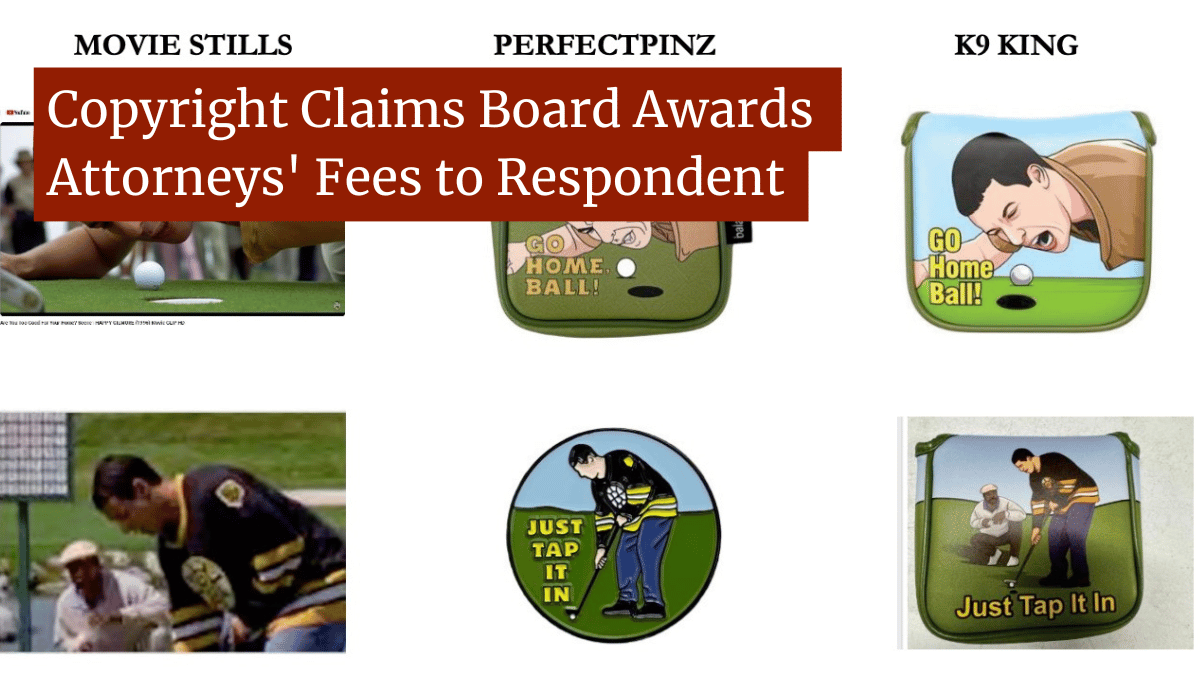
The issue focuses on four images, each representing a different scene from the movie. The first focuses on a scene where Happy Gilmore, played by Adam Sandler, yells at a golf ball with the phrase “Go Home Ball!.” The second features Gilmore learning to putt and uses the phrase “Just Tap It In.” The third features a scene where Gilmore is learning how to swing a golf club and uses the phrase “It’s All in the Hips” and the fourth features the fight between Gilmore and Bob Barker.
In the original claim, PerfectPinz did not mention Happy Gilmore at all, referring to these images in generic terms. For example, the first image was described as, “Up-close image of a short-haired man’s face, neck and shoulders (wearing a brown henley t shirt) screaming at a golf ball resting on the putting green next to the hole with the words, ‘Go Home, Ball!'”
According to PerfectPinz, the claim was the latest round in a long-running dispute between the two companies. They had accused K9 King of infringing on their copyright by sending their creations to third-party designers for replication.
However, as was quickly revealed in this case, K9 King had not done that here. Instead, they had only sent the still from the film, not PerfectPinz’s images. As a result, though each of the images feature the same scenes, they have differences in style, coloring and other details.
Unaware of that, PerfectPinz filed a takedown notice with Amazon, prompting K9 King to file a counter notice. That counter notice is what prompted the claim.
In addition to the claimed infringement, PerfectPinz attempted to seek sanctions against K9 King, alleging that the company had deleted messages with their designer. The board, however, found that those messages were not relevant to the case and that they were automatically deleted, possibly before PerfectPinz’s initial takedown notice.
But the board did find a much bigger issue with PerfectPinz’s claim, ruling that the company had acted in bad faith and that it was liable for $900 in attorneys’ fees, roughly 20% of the what K9 King’s claimed expenses.
The Reasoning
From the Board’s perspective, the reasoning was remarkably straightforward. One look at the images provided showed that these were not generic images, they were images from the movie Happy Gilmore.
As the board put it:
“Both PerfectPinz’s protestations in its Party Statement and in its interrogatory response are objectively false, and it is somewhat insulting that PerfectPinz might have thought that the Board would not know that its Works were direct copies of some of the most famous lines from one of the most famous comedies of all time. Attempting to pull the wool over the Board’s eyes in this manner, as discussed below, is not in accordance with PerfectPinz’s duties of ethics and truthfulness before the Board.”
As such, the board concluded that PerfectPinz had acted in bad faith and that it was liable for attorneys’ fees. The only question was the amount.
K9 King alleged that it spent $4,320 in attorneys’ fees over the course of the case. However, the board reasoned that there were legitimate issues given the history between the two companies and that only a percentage of those fees were attributable to the Happy Gilmore issues. It ultimately awarded K9 King $900 in attorneys’ fees.
This represented roughly 20% of K9 King’s claimed expenses and two hours of the attorneys’ time.
Another interesting issue involves Cory Lapin, the in-house counsel for PerfectPinz. The board made it clear that he was not personally liable for the fees. Lapin was able to show that he relied on the work of a copyright litigation attorney who was hired by PerfectPinz for the case. As such, the bad faith award only applies to PerfectPinz the company, not Lapin as an individual.
What’s obvious is that, from the board’s perspective, this case was doomed from the start. The copyright registration, filed before the claim, also failed to mention Happy Gilmore and the original claim didn’t either. That alone was more than enough for the board to conclude that PerfectPinz had acted in bad faith.
Everything that happened after simply reinforced that conclusion.
Bottom Line
In the end, the board did the right thing. PerfectPinz tried to be sneaky and present these as original works when they clearly were not. If they had been, that would have changed the calculus significantly. K9 King’s works would have been clear derivative works and likely would have been infringing.
But that’s not what happened and it was clear from day zero. Realistically, the only company that should have considered filing a claim was Universal Pictures, the owner of the film. Both PerfectPinz and K9 King have created derivative works based on the film that they are selling.
Universal Pictures, however, is either unaware of these companies or isn’t motivated to take action. Either way, both companies should likely be grateful that they aren’t facing litigation from the studio and stop worrying about each other.
I simply cannot recall a case where one company, who is making and selling derivative works based on a major film, would file a claim against another company making similar works based on the same film. The only thing that comes close is when a fan fiction author sued Amazon and the Tolkien estate for copyright infringement.
While I understand that there is a history between the two companies (a history I know little of) but looking at the images in this case, it’s clear that both companies have much larger concerns…
Want to Reuse or Republish this Content?
If you want to feature this article in your site, classroom or elsewhere, just let us know! We usually grant permission within 24 hours.