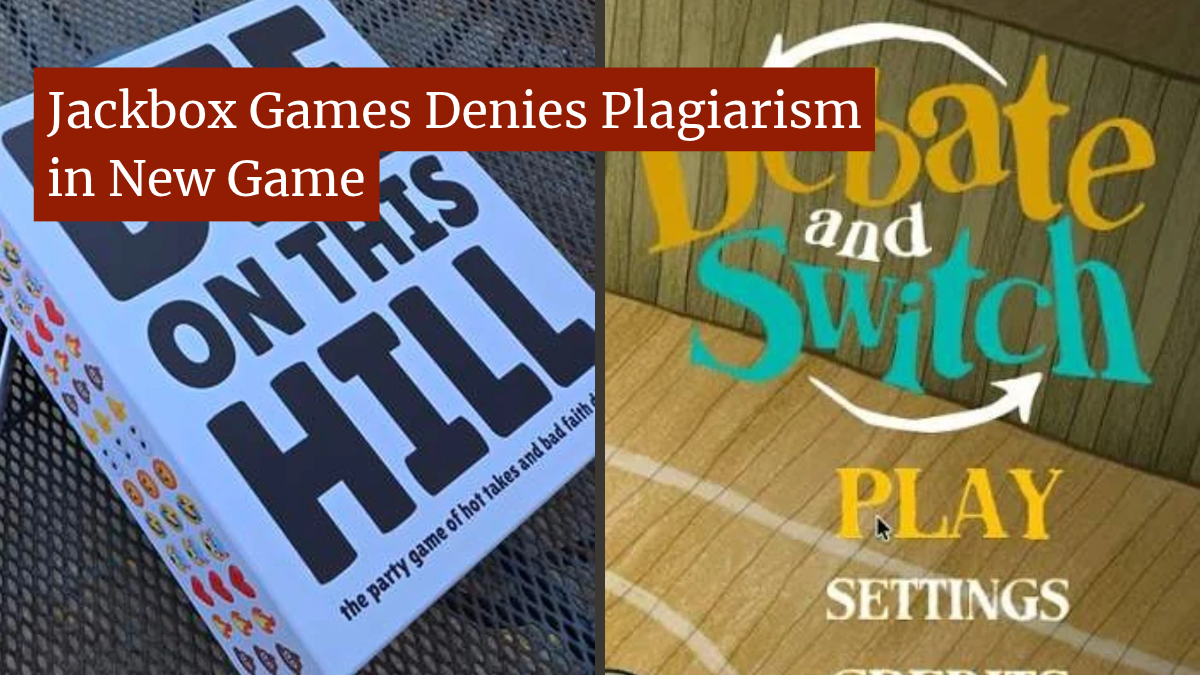
Jackbox Games Denies Plagiarism in New Game

For fans of digital party games, the Jackbox Party Pack is something of an annual tradition. Created by Jackbox Games, the creators of the “You Don’t Know Jack” series, the Party Pack is an annual collection of new digital games for various platforms and numbers of players.
The 12th installment of the franchise came out earlier this month and featured five games, including “Debate and Switch,” a card game where players build absurd debate topics and then argue with each other over them.
However, according to solo developer Sam Greszes, the game bears a striking resemblance to his earlier physical card game, “Die on this Hill.” According to Greszes, he had previously submitted his game to Jackbox Games for consideration and, after some back and forth, the company ultimately decided not to publish the game.
Instead, Greszes turned to crowdfunding to develop and publish the game himself in early 2025. He said that, while the game did turn a profit, it was not particularly lucrative.
According to Greszes, seeing the similarities between the two games “feels like a betrayal.” However, he acknowledged that there likely isn’t much that he can do, as game mechanics are not protected by copyright and he didn’t have a contract with Jackbox Games.
Jackbox Games, for its part, did not deny that they had received Greszes’s game. However, they said that the game was reviewed by their business development team, not their game‑development team. They said that they deliberately keep those two teams separate and never share submissions with the development team.
Still, it’s easy to see why Greszes is frustrated. Jackbox Games is a massive player in this space, and its launching a game with similar mechanics to his could not only harm his existing product, but also his plans for a digital version of the game.
Ultimately, the story is a cautionary tale about game development. While a good idea can create a successful game, protecting that idea may prove difficult.
Understanding the Allegations
The allegations themselves are pretty straightforward. According to Greszes, he began working on his game in 2024 after being laid off from his job. He developed “Die on This Hill” as a physical card game where players first create ludicrous debate topics and then argue with each other over them for points.
He claims to have submitted a prototype to Jackbox Games in early 2025, but the dialogue didn’t go anywhere. According to Jackbox Games, they didn’t even have time to play the game. This prompted Greszes to self‑publish the game via crowdfunding. The game remains available for purchase on Greszes’s website.
Earlier this month, Jackbox Games released the 12th edition of its Party Pack franchise. One of the five included games was “Debate and Switch,” a card game with a very similar premise to Greszes’s game. Greszes took to social media to express his frustration, but acknowledged that there wasn’t much that he could do other than ask for others to support his game.
Jackbox, for its part, has acknowledged its communications with Greszes but has cited a firewall between its business‑development and game‑development teams. As such, they claim their game was fully independently developed and was not based on Greszes’s game in any way.
Greszes has said he is not considering legal action and isn’t alleging any legal wrongdoing. Instead, he said that he simply wants acknowledgement of his work, perhaps as a “special thanks” credit.
Jackbox Games has not offered that credit as of this writing. That said, they don’t really have any obligation to do so. Their arguments are relatively strong, and it seems likely that this is a case of coincidence rather than plagiarism.
Coincidence or Plagiarism?
For Greszes, there is one significant obstacle to any allegations of plagiarism: the idea of a party‑card game where people create and debate absurd topics could easily be independently created by multiple people. As long as the execution of the two games is different, it’s going to be difficult to prove that the Jackbox game is based on Greszes’s.
And, though I have not played either game, there is already one notable difference. Jackbox’s game is a digital game, while Greszes’s is a physical game. That alone is going to cause the games to have some significant differences. It also, as Greszes points out, wouldn’t be enough to sustain any kind of legal action.
As we discussed in July 2018, games do enjoy a great deal of protection—just not for their idea or mechanics. In Greszes’s case, he can protect the specific cards, the instructions, any artwork, etc., but he can’t protect the broad idea, which seems to be the extent of the alleged copying in this case.
So, even if Greszes could show that Jackbox’s game is based on his work, he wouldn’t likely have a legal case. This is something that he has already acknowledged.
However, I don’t really see a reason to doubt Jackbox Games’s claims. The practice of creating such a firewall is a standard industry practice. While it’s entirely possible that one of the game developers at Jackbox Games learned about Greszes’s game and brought the idea with them, that will be difficult to prove.
There simply isn’t a smoking gun, and the idea, as interesting as it sounds, doesn’t preclude the possibility, or even the likelihood, of independent creation.
So, while I’m sympathetic to Greszes’s frustration, I don’t think there’s enough evidence to show that Jackbox Games did anything wrong other than have a similar idea and bad timing.
Bottom Line
It’s completely easy to understand why Greszes is upset. He is a solo developer who came up with, to the best of my knowledge, a unique idea in the crowded field of party card games.
This is a genre that isn’t exactly known for its originality. The most famous entrant in the space is Cards Against Humanity, which is itself largely based on the pre‑existing game Apples to Apples.
But that doesn’t mean that there isn’t room for innovation and growth. Greszes’s game, by all accounts, did that at least to some degree. Having a major player in the space release a game with a similar idea does put a damper on that.
But that is one of the perils of being a game developer. Board games and card games are very idea‑driven. The premise, more than anything else, is what sells the game. But ideas don’t get copyright protection. Though developers can (and should) protect their writing, artwork, audio and other elements, copyright doesn’t protect ideas, only their expression.
That makes it possible for others to release a game with the same premise, either accidentally or intentionally, without worrying about legal action. This problem is only going to get worse as AI enables more people to quickly copy others’ ideas.
We are already seeing this in video games, and there’s no reason to believe that it won’t also happen with physical games.
Want to Reuse or Republish this Content?
If you want to feature this article in your site, classroom or elsewhere, just let us know! We usually grant permission within 24 hours.