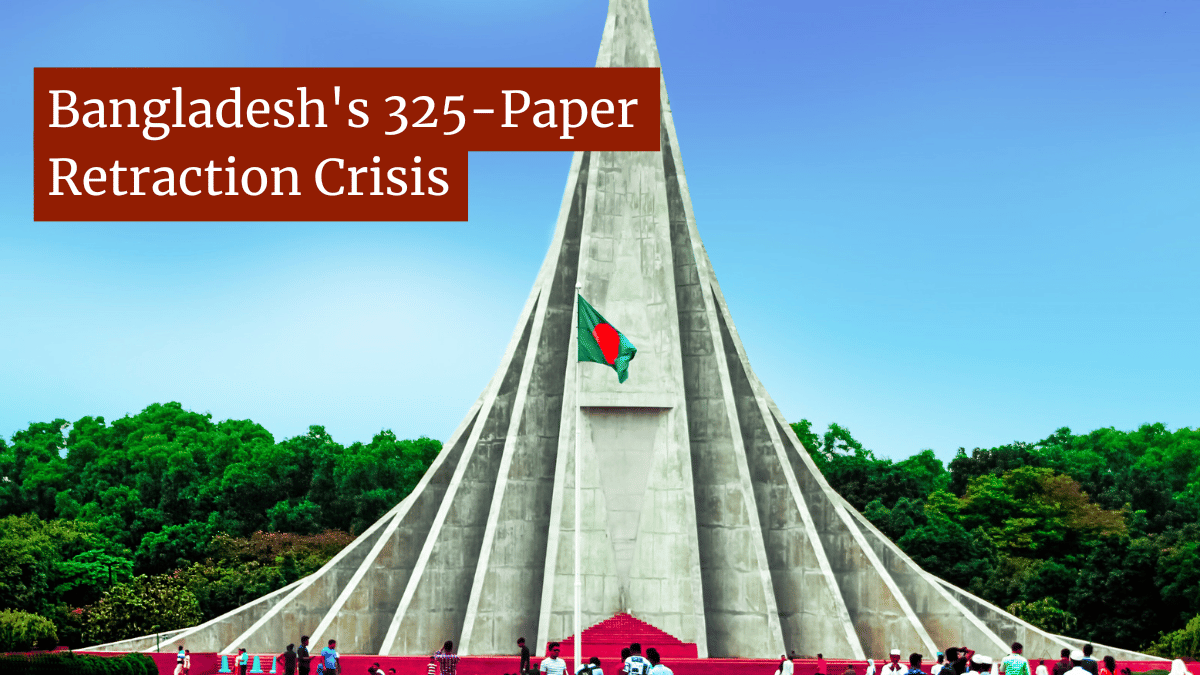
Bangladesh’s 325-Paper Retraction Crisis

Last week, Ahmed Ullah Yousuf at Prothom Alo, the largest news publication in Bangladesh, published an article claiming that at least 325 research papers from the country’s universities had been retracted between 2019 and 2026.
One researcher alone, Mohammad Moniruzzaman Khan at North South University, was responsible for 26 of those retractions, six of which he was the lead author on.
Of the universities, Daffodil International University led the way with 44 retracted papers. North South University was second with 42, which is notable as 26 of the papers were attributed to Moniruzzaman.
All totaled, more than a dozen universities had at least six papers retracted. Five universities had at least 20 papers retracted.
The causes of the retractions were varied. They included peer review manipulation, plagiarism, duplicate publication, the use of “paper mills” and inconsistencies in the data to name a few.
According to the original article, these retractions represent a relatively recent trend and one that risks damaging Bangladesh’s reputation on the global stage. But what makes the story worse for the country isn’t just the numbers, but that the universities have largely been silent on the issue, not taking action against researchers whose work was retracted, even due to misconduct.
That, in turn, may be the much more important issue and it’s something that Bangladesh, as a country, will need to address. Unfortunately, as we’ve seen elsewhere in the world, pushing for academic and research accountability is often an uphill battle.
An Emerging Powerhouse
On paper, Bangladesh has all the tools it needs to become a leader in research and academia. It is the eighth most populous country in the world, with over 169 million people. The country has been making major strides economically, quadrupling its GDP per capita since just 2010.
The country has also made major inroads in education, greatly increasing the number of students enrolled in both primary and secondary education.
Though the dominant language in international research is English and the country’s official language is Bengali, English is still widely used in the country and there’s even a variety of English known as Bangladeshi English that is very common, especially in administrative settings.
In short, the country is in a great position to become a global leader in research, especially if these trends continue. But, as the original article points out, repeated retractions can harm not just one research’s reputation, but the entire country’s.
But retractions are a part of the research process. Though Moniruzzaman’s 26 is an impressive number, it’s not even in the top 30 on the Retraction Watch leaderboard. He would need 11 more retractions to even crack the list.
Furthermore, the original article doesn’t indicate how many papers were published in the first place. We have no idea if this represents a significant percentage of the country’s research output or not. The numbers, by themselves, are fairly meaningless and are probably not that damaging.
However, the country’s schools and universities should still be concerned. That’s because they have a bigger problem hiding behind the numbers that is much more difficult to dismiss.
A Lack of Accountability
In the original article, the author confronted many of the researchers and their universities about the issue. What he repeatedly found was that the researchers involved were not held accountable for their actions and, if they were disciplined, it was usually a slap on the wrist.
In one particularly telling example, Vice-Chancellor of Begum Rokeya University, Professor Showkat Ali, told the paper that neither university nor its oversight bodies had an established policy for dealing with retractions and that hampered efforts to address this issue.
This has put a particularly unfavorable light on the country’s University Grants Commission (UGC), a regulatory body that oversees the country’s research. As Syed Saad Andaleeb put it in his article for The Daily Star, “the UGC has neither demonstrated the capacity nor the resolve to nurture research at the level required for sustained academic advancement.”
He calls out the lack of a dedicated research-integrity office at universities and the lack of funding for the infrastructure required to support, monitor and enforce research integrity. The piece goes on to call the report a “wake-up call for institutional action” on the issue of research integrity.
And, on that point, he is completely right. Repeated retractions are certainly not a good sign and can harm a country’s reputation on the international stage. However, things get much worse when a country’s systems fail to respond to the problem or even enable it through inaction.
We’ve seen similar issues in other countries, such as Romania, where the country’s systems have been used to protect plagiarists, even while good academics fight to protect research and academic integrity.
But where Romania’s issues were largely tied to political pressure, Bangladesh’s issues appear to be more about the systems being under-resourced and not fully in place. That may already be changing as the government has already given the UGC greater oversight over the country’s research funding. That alone may help give it the authority to step in and address research integrity issues.
That said, the move is not universally beloved in the country’s schools. Many have expressed concerns about academic freedom and independence.
But regardless of how it happens, it’s clear that the country needs to build out these accountability systems. Bad research and bad researchers are a fact of life, but when the schools either don’t or can’t respond to the issues, that turns a individual failing into a systemic one.
Bottom Line
To be clear, Bangladesh is far from alone here. Many countries have similar issues with academic and research integrity. However, it is rare for them to be spelled out so clearly in a single article, like Bangladesh’s were.
While it’s easy to treat this as an embarrassment, it’s also an opportunity. With the issue the topic of public discussion, it’s a chance to have the difficult conversations that need to be had.
These aren’t easy challenges to address. Nobody has gotten it perfect. But it is still important to address them and that means insuring that the infrastructure and oversight systems are in place. Research integrity violations, especially repeated ones, need to have real consequences.
This means that schools need to step up to address these issues when they arise. It also means that oversight committees need to be able to step in when schools fail to do so.
What’s at stake isn’t just research dollars and publication space. It’s the reputation of all the academics and researchers working in the country. As unfair as it is, researchers and academics are often judged in part by the schools they are with and the country they are from.
If Bangladesh wants to become a global leader in research, it needs to start by ensuring that it puts integrity first.
Want to Reuse or Republish this Content?
If you want to feature this article in your site, classroom or elsewhere, just let us know! We usually grant permission within 24 hours.