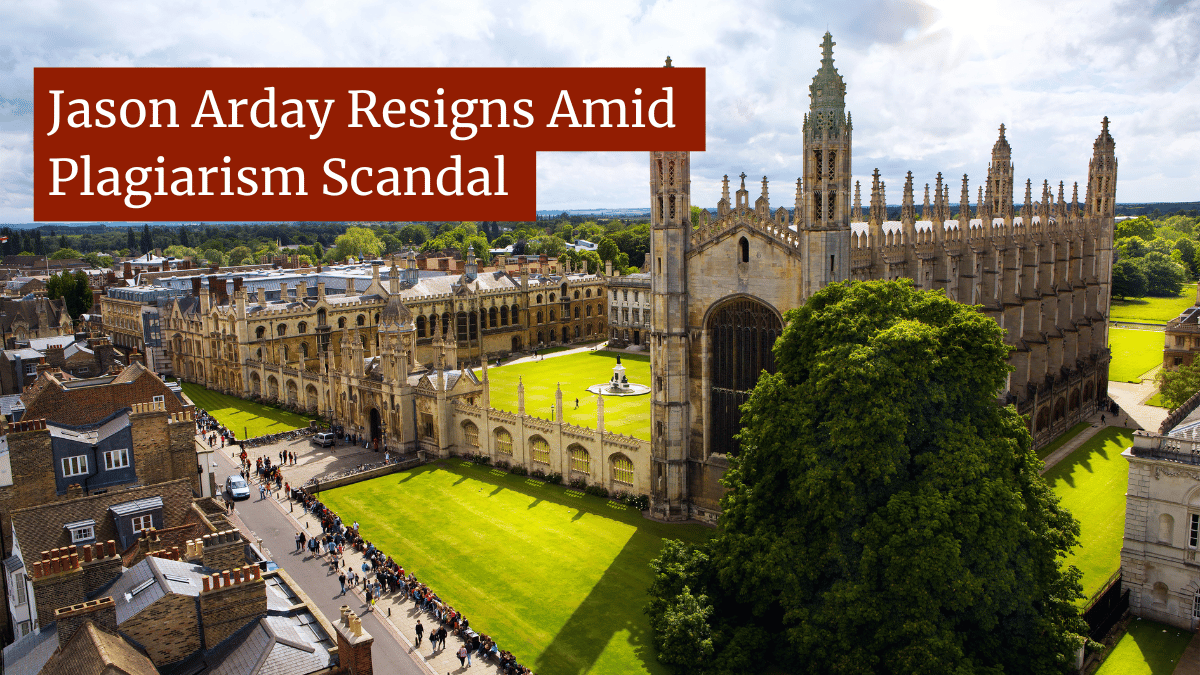
Jason Arday Resigns Amid Plagiarism Scandal

Last week, we discussed the story of Jason Arday, a now-former Cambridge University professor who was accused of plagiarism both in his dissertation and in his later academic work.
Since then, more allegations and questions regarding Arday’s past have surfaced. This included allegations that he had falsified parts of his job history and other claimed accomplishments.
With the potential of more investigations looming, Arday, through the Good Law Project, has announced that he is resigning from his position at Cambridge effective immediately.
According to Arday, the allegations and scrutiny were taking a toll on his mental health and his family. In the statement, he said:
“I have a family. I want to be present for them. I want to reclaim some peace, some privacy and some semblance of an ordinary life. I no longer wish to feel as though I am living under a constant spotlight, where every aspect of my life is subject to public examination and judgement.”
The resignation marks the end of a multi-week saga that began as a simple allegation of plagiarism but expanded to nearly every aspect of Arday’s life. But while it brings an end to his chapter at Cambridge, it doesn’t appear to have impacted the publication of his upcoming memoir.
In an article with The Guardian, Simon & Schuster, the book’s publisher, said that it plans to move forward with the book’s publication, which is slated to be released on August 11, 2026 in the United States.
So, while this isn’t likely to be the end of Arday’s career, it’s worth recapping what happened over the past week.
The Latest Developments
Previously, we examined the plagiarism allegations against Arday. Originally made public by former Cambridge researcher and DEI (diversity, equity and inclusion) critic Nathan Cofnas, the allegations initially focused on Arday’s dissertation but expanded to include his later academic work.
At the time, the allegations were focused on his academic work, accusing him both of plagiarism and of falsifying some of his data. However, even at the time, other allegations were being made that Arday had either falsified or exaggerated his history and accomplishments.
The biggest of the allegations, which originally came from The National Review, was that Arday had falsified some of his job history. For example, Arday claimed to have been a visiting professor at The Ohio State University but the school had no record of him. Similarly, Glasgow University also denied that Arday had been a visiting professor there.
His athletic and fundraising achievements had also been called into question. His claim of having run 600 miles in six days was challenged and later edited to say that he had run the distance in 12 days. Similarly, his claims that he had raised £5.5m for charity faced scrutiny, with public records showing that he had raised less than £11,000 through his platforms.
After that, the Committee for Academic Freedom also reported that Arday had reported one academic critic, David Harris to the police after Harris contacted him about potential plagiarism and other issues with his work. This dovetails with the previous Retraction Watch article that claimed Arday successfully killed a plagiarism story in the Times Higher Education by hiring a law firm and threatening litigation.
Arday also faces questions over discrepancies in various stories of harassment and violent threats that he claimed to have faced. No evidence was found to support the claims.
In short, nearly every element of Arday’s career has been called into question. Yesterday, citing new information, Cambridge University announced that it would be launching an investigation into Arday. Arday opted to resign from his position, but according to Cambridge, the investigation will continue regardless.
What Changed? What Went Wrong?
The change in the story is obvious. In the beginning, both Cambridge staunchly defended Arday and his work. Even in the face of serious allegations with credible evidence, the university stood by him.
However, two things changed. First, the allegations against Arday began to pile up. It went from being a simple plagiarism/research integrity issue to an examination of his entire career. There is simply too much to ignore.
Second, the scandal began to enter more mainstream conversation. Though the initial allegations were made by ideological opponents who were motivated, at least in part, by both personal and philosophical differences with Arday and/or Cambridge, the story has been picked up by mainstream outlets, in particular in the UK.
To be clear, there’s not much denying that the initial public allegations against Arday were made for dubious reasons. The goal wasn’t to improve academic integrity, but to damage both Arday and Cambridge. Cambridge, understandably, attempted to deflect and discredit the allegations rather than address them. They didn’t want to lend credence to people who the school believed were motivated by political and ideological reasons.
However, just because the source of the allegations are dubious doesn’t mean that the allegations are false. While many of the allegations against Black academics and supporters of DEI initiatives have been shown to be weak and unremarkable, that was only determined after a thorough investigation.
This time around, there was a fire behind the smoke and all of the subsequent investigations in the media have shown that.
What frustrates me the most is that Cambridge has no one but themselves to blame for this. A thorough examination into Arday’s work, his job history and his various other claims should have spotted enough red flags to warrant, if nothing else, a deeper investigation into his background. This could have and should have been done before he was hired.
However, the school got multiple second chances when allegations were raised behind the scenes and journalist Jack Grove from The Times Higher Education also raised questions.
For whatever reason, Cambridge ignored those warnings. In doing so, they handed an easy victory to the very critics that they tried to protect Arday from and gave themselves a significant black eye on the international stage.
Bottom Line
There is one claim of Arday’s that I fully believe and agree with. That he is facing heightened scrutiny that others in his position do not.
A combination of race, celebrity, his youth and his political views have made Arday a target for who are critical of him, what he represents and his work. He was undoubtedly singled out and targeted in a way that most others are not.
To be clear, Arday is not alone. There have been many other Black or DEI-supporting academics who have faced similar scrutiny. Those allegations have been a mixed bag, with some being weak to the point of pointless to others highlighting serious issues.
In a moment of irony, those who protest what they see as a two-tiered system for academic standards are themselves creating a two-tiered system of academic standards. By limiting their scrutiny to one group of academics, they are building the very thing that they are protesting against.
While I understand universities wanting to protect their faculty from such targeted attacks, the schools still have a responsibility to ensure that academic and research integrity is upheld. Regardless of what one thinks about DEI and related initiatives, it cannot come at the expense of academic rigor.
As I’ve said before, when it comes to plagiarism and academic/research integrity issues, the problem isn’t DEI, it’s a deeper issue in academia. DEI is the target, but the flaw isn’t limited to just one race, gender, religion, sexuality, political ideology or age. As we saw with Neri Oxman, these attacks can just as easily be reversed and directed at anyone.
Academia needs to address these issues on a much higher level. Otherwise, targeted attacks of all kinds will continue and more Jason Arday’s will be found, harming the schools that hired them.
Want to Reuse or Republish this Content?
If you want to feature this article in your site, classroom or elsewhere, just let us know! We usually grant permission within 24 hours.