
ImageStamper: Prove your License

One of the problems with using images under a Creative Commons license is that, sometimes, those applying the license might change their mind and switch to another license. Though, in theory, that doesn’t affect those that used the work previously, it can be difficult to show which license the work was used under.
ImageStamper, however, feels it may have a solution for that problem, at least as it pertains to images. The idea behind the service is that, before you use a CC-licensed photo, you “stamp” it, creating a record of the date that it was found and the license that it was under at that time.
It seems to be a simple idea but the question is will it work and, if so, is it worthwhile? As usual, the answers are far from straightforward.
How it Works
To use ImageStamper, you first have to register for an account in the public beta. The process is very simple and only takes a few seconds.
Once in, you’re given two ways to “stamp” an image, the first involves pasting the URL of the page with the image (being careful to make sure that both the image and the license are on the page) and the second involves the use of a bookmarklet that you drag to your browser’s toolbar and click when on a relevant page.
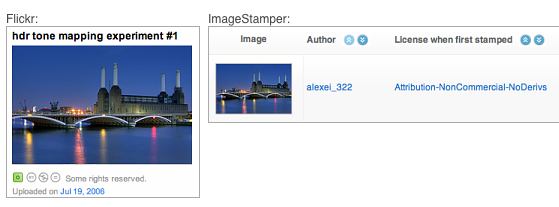
From there, ImageStamp saves a copy of the image along with the license information and provides a permalink to access the image details (see example/original).
These permalinks are available to anyone, including those not logged into the site, so they can be presented as evidence in the event a dispute arises.
It is worth noting that the service will let you stamp “All Rights Reserved” images as well as CC ones, even though images without CC license probably should not be used.
All in all, the process is very simple and there isn’t that much to say about it. Currently, all accounts can stamp up to 1000 images, though more can be requested by sending an email to support.
Why Use It?
One of the largest fears many have had when it comes to the idea of using CC-licensed works has been that the licensor may, for whatever reason, change their mind about the license and back out. This could, theoretically, cause a conflict down the road when the licensor finds someone using their work and, thinking that they’ve changed the license, may not realize that the user obtained permission when the CC license was in effect. Some even think CC licenses could be used to trap unsuspecting users.
However, this fear seems to be largely unfounded. Though it could happen, most people don’t change their CC licenses (save, in many cases, to make them more permissive) and most who do recognize that those that used their work under the old conditions still have a right to do so. Most of the time, when one removes a CC license, they aren’t thinking so much of past works, but future ones.
Still, considering the potential risk, it is worth setting up a system to protect against this. Though there are countless ways to timestamp and affix a license to a work, most of them require the rightsholder to submit it. Non-repudation services (services that provide third-party verification of copyright ownership, date and time), such as Numly, Safe Creative, MyFreeCopyright, etc. protect the creator of the content and only Numly provides any means for the licensee to protect their interest.
The problem is that the vast majority of rightsholders upload their work with no sort of verification at all. ImageStamper hopes to fill in that hole and expand on the normal process by giving licensees a chance to use their own form of non-repudiation. It is a smart idea, if even the potential uses are even more limited than traditional non-repudiation services.
The question is whether anyone will use it and, if so, will it actually be able to fill its role.
Limitations
The biggest limitation is that, currently, ImageStamper only works with Flickr pages. Though there are plans to add new pages, including deviantArt, it isn’t possible to use this service with any page on any service. For example, if you find a CC-licensed image on a blog, you can’t stamp it.
Also, since the service focuses on images, you can’t use it to stamp text, video or audio. All in all, this means that only a small fraction of all CC-licensed work is available for stamping at this time. Though more will be available, it seems likely that, even at its best, only a small amount will be available for use.
The other problem is whether or not the service would be usable in a court of law. As with other non-repudiation services, if a dispute reached that point, the creator of the site would have to be deposed on how the site operates and whether the site would provide good evidence depends heavily on factors beyond the scope of this article including how it gathers the information, the security of the system, etc.
However, the main function, most likely, wouldn’t be to defend in a court case. As with other services, it is more a matter of winning in the court of public opinion, something it could help with most definitely.
Bottom Line
If you are using CC-licensed images from Flickr on a routine basis, it probably makes sense to consider adding this as a step in the process, especially if you are a corporate user or someone else that might make a good target for a lawsuit.
Though the odds of such a dispute are still very slim, it’s easy to see why many want to protect themselves against it and this service has the potential to add at least a thin layer of protection.
As with most solutions, it has a lot of room to grow and improve, but it is better than the current solution, which is none at all. Considering that it is free, at least for now,
In the end, how well the service does will likely depend more on the perceived need for it than the service itself. The question is whether there are enough people uneasy about using CC-licensed work to make it feasible and, if so, if they will be placated by what ImageStamper has to offer.
Want to Reuse or Republish this Content?
If you want to feature this article in your site, classroom or elsewhere, just let us know! We usually grant permission within 24 hours.