


For authors wanting to publish a book, there are more options available than ever before.
Traditional publishing, as always, remains a viable path for many authors. There is a lot to be said about having the backing of a major publisher and the resources that come with it.
However, for authors who want to go it alone, it is something of a golden era for self-publishing. Amazon’s Kindle Direct Publishing (KDP) is the obvious giant in the space, but there are many alternatives including Lulu, IngramSpark, Blurb, and more.
There are many good reasons to self-publish. It gives authors greater control over their work, a greater share of the profits and lets you tap in more directly to your existing audience. Furthermore, traditional publishing is still viable, with some books starting out as self-published before being picked up by a traditional publisher (though not always with great results).
But with those benefits comes a lot of responsibility. Not only will you be in charge of promotion, distribution, editing, packaging and more, but you will also be responsible for protecting your work.
That is both an intimidating and confusing task. Authors, typically, don’t write books to become a copyright enforcer.
However, one important thing to understand from the beginning is that there are two registrations that you will likely need: a copyright registration and an ISBN.
Despite how similar they sound, they do very different functions and getting one without the other can be a costly mistake.
Here is a breakdown of what they both do.
Understanding ISBNs
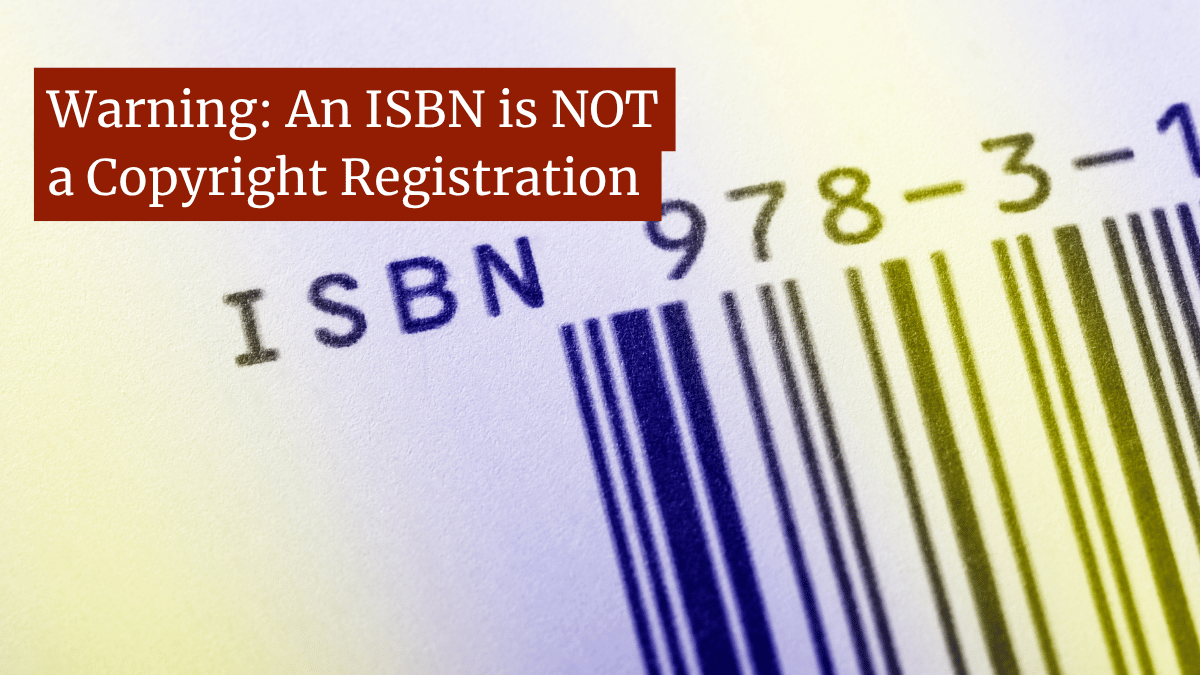
ISBN stands for International Standard Book Number. It’s a 13-digit code that, on most printed books, is featured above the barcode and is also part of the barcode itself. It identifies the title of the book, its publisher/imprint and the country/region, that publisher is in.
With that in mind, every book (and every edition of a book) should have a unique ISBN. So, if you’re releasing an ebook, a paperback and an hardcover, you will need three ISBNs.
Fortunately, KDU, Lulu and IngramSpark all offer free ISBNs to their authors. However, those free ISBNs come with a severe limitation. They can only be used on the respective platforms. So a free ISBN obtained through KDP can only be used on KDP.
This defeats much of the purpose of an ISBN. The point is that, wherever the book is published, it should have the same ISBN. So, if you publish a book on KDP and use a free ISBN, you can’t use that same ISBN on Lulu or IngramSpark.
You may be able to publish on those platforms depending on the terms and conditions of the platforms, but you can’t use the same ISBN. This makes ordering and distribution difficult. Furthermore, your platform will be listed as your publisher, whereas, with a paid ISBN, you can list yourself as the publisher or imprint.
You can obtain a paid ISBN from ISBN.org. However, the price varies depending on the country you’re in. Canada, for example, gets free ISBNs. Meanwhile, those in the United States will pay $125 for a single ISBN or $295 for a set of 10.
The important thing to remember is that ISBN is a number that identifies the book for the purposes of distribution. It has nothing to do with copyright, which is what a copyright registration is for.
Copyright Registrations
For this purpose, copyright registrations are unique to the United States. It’s an important step that you need to take to ensure that you are able to enforce your copyright in the work.
Registering a work with the US Copyright Office is relatively simple. You go to the online registration portal, create an account and then fill out the required information. For a book with one author, the current fee is $45 (Note: There is a proposal to raise this fee to $55 in the near future).
Though copyright protection in the US is automatic after the work is created, a copyright registration gives you several advantages that make it worth considering.
- A registration is required before filing a lawsuit in federal court or with the Copyright Claims Board.
- Registration provides prima facie evidence of ownership if done timely.
- If registered timely, a copyright registration grants you the ability to claim statutory damages.
- Allows you to establish a record with US Customs and Border Protection to protect against the import of illegal copies.
In short, while your work is automatically protected by copyright just by creating it, if you actually want to sue someone for copyright infringement, you will need a registration and if you want statutory damages, you will need to do it timely.
To that end, the best time to file a copyright registration is either before or as you publish, or within three months of publication. If you missed that window, the second-best time to do it is now.
A late registration is still better than no registration. However, sooner is always better.
So Which Do I Need?
In an ideal world, every book self-published in the US would have both a paid ISBN and a copyright registration.
A paid ISBN ensures the best portability and distribution. A timely copyright registration ensures that you have all the rights you need to enforce your copyright. They are both important, but for very different reasons.
That said, we don’t live in an ideal world and not everyone’s needs are the same. If you only plan to distribute your book on one platform, a free ISBN is likely more than enough. To be clear, it’s not a “lesser” ISBN. It is still a full ISBN and will appear in lookups and databases. It’s just one that can’t be used on other platforms and may close some distribution channels.
That may or may not be important to you. However, it is important to understand the limitations of a free ISBN, and if you have questions, I would speak with a representative from the platform you plan to publish on.
The copyright registration, on the other hand, is more clear-cut. If you think you. may want to sue someone for copyright infringement in the future, even if it’s just an outside possibility, then you should get a copyright registration and, if possible, do it timely.
That said, if you don’t care about protecting your book, a copyright registration is likely superfluous. Especially since you can take many enforcement steps, such as filing takedown notices, without one.
But if copyright issues ever go to court or the Copyright Claims Board, you will need a copyright registration and you will be in a much better position if the one you have was filed timely.
Bottom Line
In the end, you as the author have to make these decisions. I can only give you the information to the best of my ability. These are ultimately your choices.
There are definitely times and situations where it makes sense to forego a copyright registration or a paid ISBN. It depends on your goals and what you hope to achieve with the book.
That said, if this is a serious financial endeavor (or you would like it to be), then it makes sense to get both a paid ISBN and a copyright registration. The total cost, as of this writing, is $170 for both, $335 if you get multiple ISBNs.
It is a worthwhile investment and one of the better ones you can make for your book.
Still, the most important thing to remember is that an ISBN is not a form of copyright registration. While it provides many benefits when it comes to distribution, it is not a substitute for a copyright registration from the US Copyright Office.
On that note, if you are intimidated by this, you may want to consider either hiring a professional to handle this for you or finding a service that can help. You may also want to consider traditional publishing as these are things typically handled by such a publisher.
Want to Reuse or Republish this Content?
If you want to feature this article in your site, classroom or elsewhere, just let us know! We usually grant permission within 24 hours.