
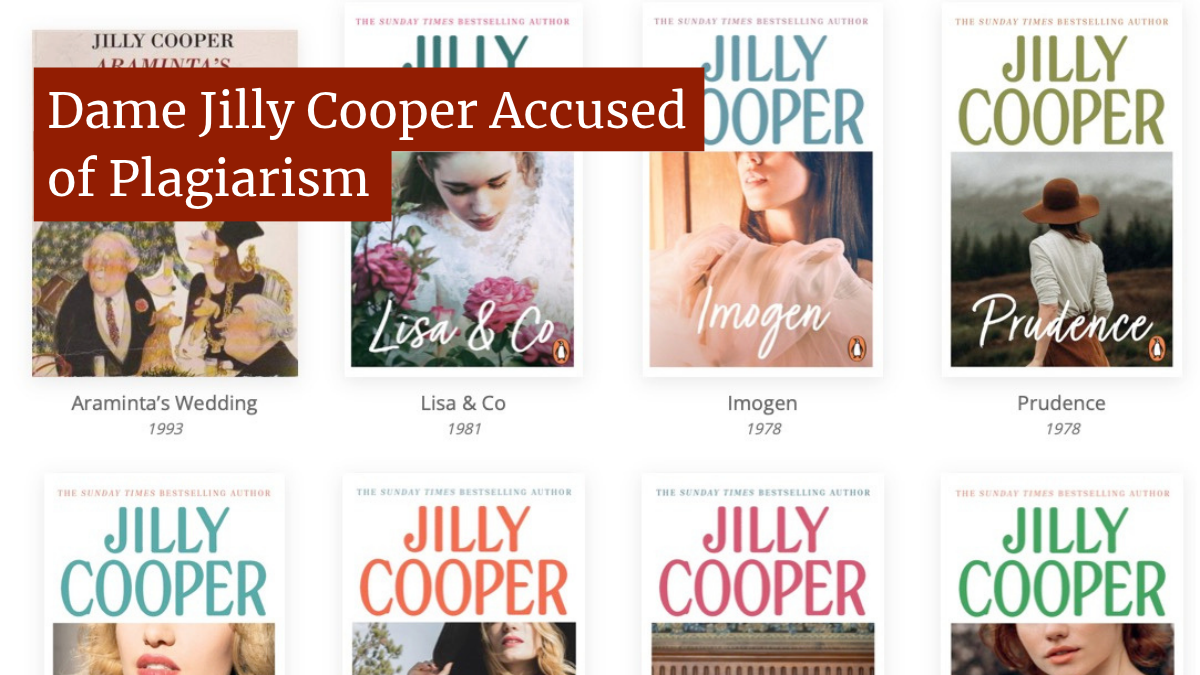

Dame Jilly Cooper had, by any metric, an amazingly successful literary career. She published nearly 50 different books across a variety of genres, sold over 11 million copies of her work in the UK alone, and her best-known works, the Rutshire Chronicles series, are currently being adapted into a TV series by Disney+ under the name Rivals.
Her career was capped when she was appointed a Dame Commander of the Order of the British Empire (DBE) in the 2024 New Year Honours.
However, now it appears that the full story of her career has not been written yet. Though she passed away in October 2025, Cooper’s work is now being investigated for plagiarism in a new article by The Observer.
But this isn’t the first time that her work has come under scrutiny. In fact, she even acknowledged plagiarism decades ago but said that it was not intentional.
So why is this story making headlines now? Why is there renewed interest in plagiarism that took place nearly fifty years ago?
The answer, ultimately, has more to do with celebrity than it does with plagiarism.
The Story So Far
Dame Cooper’s career began where she worked as a journalist for various UK newspapers. Eventually, she became a columnist for The Sunday Times, where she wrote about her experiences as a young mother and wife.
She used her column and name as a platform to begin writing non-fiction books, the first of which was published in 1969. Five years later, she began publishing romance novels and, in 1985, she published the first book in the Rutshire Chronicles series.
Through all of her writing, Dame Cooper’s work was famous for mixing humor, drama, romance, and social commentary, in particular her criticisms of the modern feminist movement and upper-middle-class life.
However, her plagiarism story begins in 1976. According to The Observer, that was when journalist and author Auberon Waugh noticed “an amazing similarity” between Dame Cooper’s first novel, Emily (1975) and The Devil’s Cub by Georgette Heye, published in 1931. However, Waugh did not go into detail about the similarities, and little else was said about it.
Then in 1986, Private Eye, a satirical UK magazine, compared two of Cooper’s novels, Emily (1975) and Bella (1976), to the 1958 novel The Dud Avocado by Elaine Dundy. In October 1993, Dame Cooper acknowledged the plagiarism but claimed that it was not intentional and that “she had made notes on the novel and accidentally mixed them up with her own writing.” Little else came of the story.
The Observer’s new allegations focus on her 1978 novel, Prudence. According to the article, the book has significant overlaps with The Serial by Cyra McFadden, published originally between 1975 and 1976 as a serial, and The Franchise Affair, a novel published in 1948 by Josephine Tey.
According to the article, The Observer found 35 examples of plagiarism from The Serial alone. However, the publication only shared 15 examples from that list. The paper also cited additional examples of plagiarism from The Franchise Affair but only provided limited details.
The article ended by saying that, “A complete examination of Cooper’s works using AI technology to detect plagiarism is likely to require her estate to waive copyright permissions.” Neither Dame Cooper’s agent nor her publisher had any comment on the story.
Understanding the Issues
Since I can only examine the 15 examples included in the article, it’s difficult to say how severe or problematic the issues are. That said, the examples provided do appear to be very damning. Though the examples are almost all short phrases, they include unique phrasing that is unlikely to have been independently created.
This is bolstered by the fact that Dame Cooper acknowledged that she had read The Serial, even if she did not give it credit or indicate that she had referenced it in her work. It seems almost certain that she did copy‑paste and then edit the text involved.
Based on that, it’s easy to see why McFadden’s daughter and heir, Caroline, said that she is exploring legal options. However, it’s difficult to say, based on the information that’s publicly available, whether this rises to the level of copyright infringement. Short phrases and passages are generally not protected under copyright law, and the answer will likely come down to how similar the two works are more broadly.
But then comes the thorniest question. Though the previous allegations did not focus on this book, she had been previously accused of plagiarism twice and acknowledged the issue once. If these issues weren’t worth pursuing in 1976 or 1986, why would they be worth pursuing now?
The works involved are all around 50 years old. None of the allegations have impacted her best‑known work, The Rutshire Chronicles series.
I also disagree with The Observer’s assertion that it would require a waiver of copyright permissions to examine the works. There are several ways that they, or anyone else, could examine the works without fear of copyright infringement. The problem is that such an investigation would take a great deal of time and resources.
Dame Cooper passed away over a year ago. The books involved are roughly half a century old. If it didn’t matter then, why would it matter now? Why should we check?
One reason is simple. It’s much easier to check for plagiarism. Setting aside The Observer’s claims that AI is the major breakthrough, the truth is that even standard plagiarism detection tools have only been around since roughly 2000. It’s simply much easier to compare works or detect copying today than it was in the ’70s or ’80s.
But other than a possible copyright infringement lawsuit, what would really come of doing such a check? Is anyone’s mind about Dame Cooper going to change? Probably not. If the two previous allegations didn’t shake anyone’s confidence in her, this one is much less likely to do so today, simply because she is far more entrenched as a literary figure.
Bottom Line
When looking at citation standards and norms, a question always has to be asked. Is the primary focus of the genre the originality of the work or the quality of the work?
As originality becomes more important, plagiarism becomes a more serious issue, and citation standards become tighter. As the focus on quality rises, the opposite is true.
Historically, fictional novels have had a reputation for being very focused on originality. There have been many cases where audiences turned on an author due to plagiarism concerns. But those were almost always active authors with recent works.
Dame Cooper’s legacy may get some reexamination, but I highly doubt that this will greatly impact her place in the UK literary world. This is especially true considering the new life her work has been given by the Disney+ series.
I wouldn’t go as far as to say that she is immune to plagiarism. If significantly more issues were found, in particular with her Rutshire Chronicles series, it could be more damaging. But this is the third time that others have raised concerns about her romance novels. If it didn’t matter then, why would it matter now?
One of the most telling aspects of this story is that the defense of Dame Cooper’s work has already started. Even as more UK and Irish publications have picked up the story, The Independent published a piece asking readers to not “let one mistake overshadow Jilly Cooper’s achievements.”
But was it just one mistake? The answer is obviously no since there have been prior allegations. However, we have no way to know if there are even more issues.
But how much does the plagiarism in her work really matter? The audience will be the ultimate arbiter of that question, and I don’t think that it is likely to judge her harshly.
In the end, her legacy is almost certainly secure. Barring some major revelation, her place in the literary world will remain safe.
Want to Reuse or Republish this Content?
If you want to feature this article in your site, classroom or elsewhere, just let us know! We usually grant permission within 24 hours.