
In 2005, I launched two major projects. The first was Plagiarism Today, the site you’re reading this on right now. The second was Bernie Baxter’s Traveling Sideshow, a home haunted attraction I run with my partner, Crystal. Both projects are still going on to this day.
In many ways, the two projects are polar opposites to one another. Plagiarism Today is a digital‑first project that grew to become my full‑time job. Bernie Baxter is an almost purely meatspace project that is completely an avocation.
But that’s what I love about haunting. It’s a creative outlet that built with lumber, paint, and actors. Despite all the walkthrough videos on the internet, there really is no way to experience a haunted house digitally. It’s an analog experience that truly does not have a digital equivalent. Haunts are a safe place to unplug and simply live in a truly unique moment.
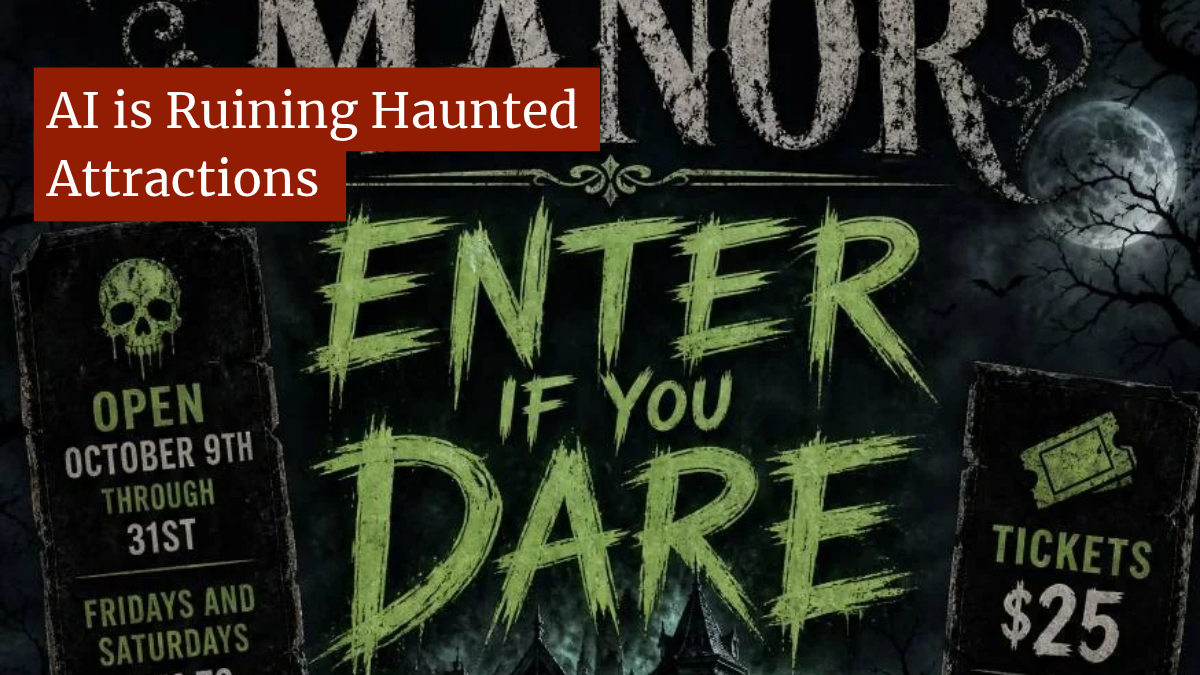
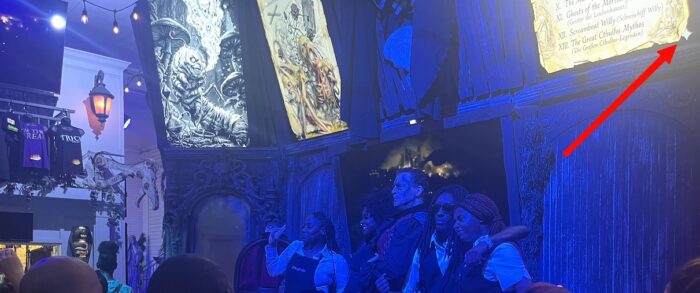
So, imagine my disappointment when I walked up to my first haunted attraction of the year and was immediately greeted by low‑quality AI art. One of the images was so bad that it even included the Gemini diamond in the lower‑right corner of the page.

It shouldn’t really come as a surprise. In an age of AI menus and AI event flyers, why wouldn’t haunts use AI to generate their work? Why would haunted attractions be immune to the same pressures and temptations that other businesses face?
But somehow the betrayal feels even worse.
It’s not just because of the love I have for the craft of haunting. It’s because of what haunting has meant to me over the decades and why it’s an important part of my life.
The AI Invasion Into Haunting

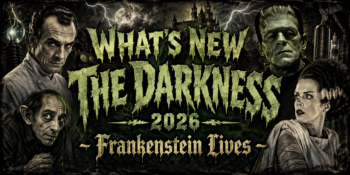
In many ways, the AI invasion into haunting is similar to how it has invaded other businesses. The most visible and noticeable use is generating AI flyers, posters and other marketing materials. The pushback against those flyers has been growing for years and many businesses have been going the other direction, back to hand-drawn promotional materials.
This might be easier to understand if it were just small haunted attractions and home haunts doing it. But that is not the case. Last year, Kennywood found itself in the middle of a controversy over its use of AI art to promote its new haunted attraction. Similarly, The Darkness in St. Louis has also faced heavy backlash over its use of AI in promotional materials.
However, AI art is especially dangerous for haunted attractions. For haunts, promotional materials are also meant to be indicative of what the experience will be like. AI art can, and often does, give a very misleading impression of what the haunted house will be like.
But it’s not just the promotional materials. AI art has also seeped into the actual haunted houses themselves. AtmosFX, one of the largest providers of digital projections to the haunt industry, has admitted to using AI to create some of their characters. Haunts, like the one I went to, have also used AI to generate props and other items that are part of the attraction itself.
Finally, many haunts have been accused of selling AI-generated merchandise. That includes Knott’s Berry Farm (also Knott’s Scary Farm), which sold merchandise that they admitted to being at least partially generated by AI that featured a racist caricature. Fans of Queen Mary Dark Harbor have also complained about the use of AI in the development of their merchandise. Even Disney has been accused of selling AI-generated merchandise in a Haunted Mansion-themed store.
In short, AI is finding its way into every aspect of the haunted house experience. From the promotional materials to the attractions themselves to the merchandise booth afterward.
And I believe that haunting is worse for that. But that’s not to say that there aren’t ways technology can be used to improve the haunted house experience.
How Technology Can Improve Haunting
Despite its image of being an old‑fashioned industry, the haunted attraction industry is actually very technically savvy overall. Arduinos, Raspberry Pis and other microcontrollers have been used for decades to control prop activation, lighting, sound and other elements.
Haunts also make regular use of LCD screens, projectors and other digital displays as part of their attractions. Tech is also used behind the scenes for everything from designing the attraction to operating it. This is not an industry that has a history of shunning technology and is now racing to embrace AI.
The industry is making use of non-generative AI tools to improve those non‑customer‑facing aspects of the attraction. This includes using AI to time props, sounds, etc. Some have also begun to use such tools in the design phase as a tool to ensure that the haunt meets all the safety and accessibility requirements.
However, other haunts have used AI to draft backstories and character bibles for their actors to use. While this isn’t precisely customer‑facing, it does mean that the human actors are being instructed by AI rather than the other way around.
To be clear, I understand this temptation. Haunted attractions are often run by a handful of people who need to have a broad range of skills. Building, painting, decorating, acting, writing, graphic design, sound engineering, safety management, etc., are all skills haunts need; very few people will be able to do it all. The temptation to let AI backfill your shortcomings is understandable. But art is often most interesting when creators have to work around their limitations.
Nowhere is that more true than haunting. Haunters are constantly fighting against various limitations, including skill, money, time and other resources. That’s a big part of what makes each experience unique. By turning to AI to backfill any gaps, every experience begins to look and feel the same.
Bottom Line
When I go to a new restaurant and see an AI-generated menu, I’m disappointed. When I see an AI-generated flyer for an event, I’m annoyed and much less likely to go.
But with haunting, the betrayal feels different. Not only is this a field I’ve been involved in for decades, but the whole reason I love it is its creativity and the fact that it is a wholly physical experience. I love things like watching a haunter turn three empty soda bottles, a piece of PVC, and a rotating motor into a working prop.
Haunting is a unique form of artistic expression. It pushes you to find ways around your limitations. Best of all, it’s got a great community that shares ideas and helps each other improve. With all that, using AI feels like a surrender. It feels like they aren’t trying. While that can be said about any use of generative AI, especially for public‑facing materials, it’s especially true here.
The good news is that most haunts seem to be keeping AI out of the haunt itself. The obvious exception to that is the new haunt “Terrors from the Antique Mall,” which is put on by an AI company. Most haunts have been content to use AI for their promotional materials and their merchandise (with some using AI-generated props and art).
While that is somewhat positive, it does mean that the entire haunted attraction experience is bookended by AI. Literally the first and last things customers will see are AI-generated.
If this industry is going to survive, let alone thrive, it needs to be a unique experience. The quickest way to kill that is to be like everyone else. The most surefire way to do that is by using AI on public‑facing work.
If any industry should be celebrating originality and pushing to stand out in a sea of sameness, it’s the haunted house industry.
Want to Reuse or Republish this Content?
If you want to feature this article in your site, classroom or elsewhere, just let us know! We usually grant permission within 24 hours.