
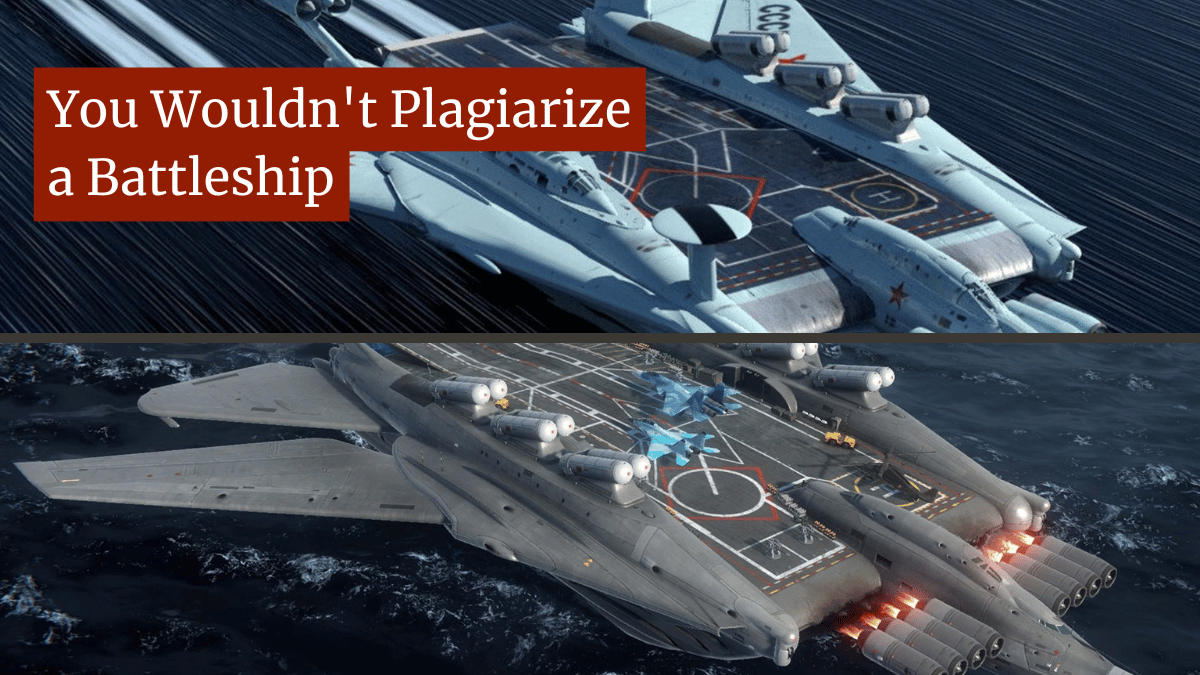
Alex Jay Brady is a 3D concept artist who has worked both in the film and video game industries. In 2014, they published the design of a futuristic battleship/aircraft carrier named the “Atomic Ekranoplan,” which itself was loosely based on the Russian Lun-class ekranoplan, which was used in the 1970s and 1980s.
However, Brady recently learned that the design in question was used in the ArtStorm video game Modern Warships. There, the ship was dubbed the RF Bartini A-2000-7 and, according to IGN, would have required either $50-$100 in random spins or $500-700 to purchase outright.
Taking to BlueSky, Brady explained they had not given permission for the game to use their design nor had they been paid for the use. However, Brady also did acknowledge the changes that ArtStorm had made to the model, saying, “They did a beautiful job on the model and nailed every nonsensical detail to a far higher fidelity than I ever did!”
I did NOT give ArtStorm Games permission to use my design in #ModernWarships but I have to admit they did a beautiful job on the model and nailed every nonsensical detail to far higher fidelity than I ever did!
— Alex Jay Brady (@alexjaybrady.bsky.social) October 4, 2026 at 9:21 PM
[image or embed]
ArtStorm, for their part, apologized for the use and reached out directly to Brady to discuss the issue. They said that the design “was used as a reference without proper clearance” and that the elements were added to the game “as a roundabout piece of contract work.”
But while the story is largely over for ArtStorm, it turned out not to be over for Brady. According to another post, Brady learned that the same model had been used, much more directly, in a game titled Mobile Warships.
LMAO its been brught to my attention ANOTHER team ALSO stole my design and added it to their completely seperate game wtfffff
— Alex Jay Brady (@alexjaybrady.bsky.social) October 5, 2026 at 6:21 AM
[image or embed]
It is unclear what, if anything, Brady plans to do regarding this second use.
All in all, it has to be a very frustrating situation for Brady, who said that they are already struggling financially and could use support from these developers.
So how did this happen, and what can designers like Brady do to protect their work?
An Ongoing Problem
To be clear, ArtStorm is not the first developer to face these kinds of issues. The major video game developer Bungie has had four separate accusations of plagiarism. Each time, they reached out to the original creators to reach an amicable solution.
Other developers have also struggled here as well. Activision was accused of plagiarizing a character design and Capcom was accused of stealing images to create two of their games.
In short, there are countless examples of video game developers doing exactly what ArtStorm did. And they are all likely for the same reason: The way video games are made.
Though there are definitely some exceptions, most video games are not made by a single person or even a single company. Even large developers, such as Bungie and Activision, don’t make or create every game engine, asset, sound effect, model, etc. in-house.
Even large companies purchase assets from other sources. This is a generally accepted practice in the video game industry. The exception being when developers fail to modify the assets enough to make the game original. Then it becomes known as an “asset flip.”
However, with so many hands involved in the creation of a single game, it’s easy to see how these kinds of issues can arise. All it takes is one bad contractor or one bad purchase of an asset to create a major problem. We saw this with the developers behind the game Crime Scene Cleaner, President Studio. They were falsely accused of using AI in their game development, when the image in question was purchased from a third party.
This problem isn’t limited to just video games. Wizards of the Coast, the makers of Magic: The Gathering and Dungeons & Dragons, have faced many allegations of art plagiarism, most of it centered around contracted artists.
Simply put, once projects reach a certain scale, it becomes difficult to ensure that every piece that goes into it is original, not AI-generated and is not too similar to previous works. This puts pressure back on the original creators to prevent their work from being used, which is grossly unfair, but also the reality of the situation.
What Can Artists Do?
For artists, the advice hasn’t changed much over the past 25 years, be careful what you post online.
Whether you’re posting artwork, 3D models, photographs or anything else, it’s important to remember that anything you post online can and likely will be copied and shared. Limiting the resolution of your images and videos can help a great deal, as can using visible watermarks.
Granted, those techniques are less effective in the age of generative AI. One can use AI to easily remove watermarks or to upscale images. However, if one is already using generative AI, they can also simply generate the content whole cloth.
Someone who is simply searching for an easy image or model isn’t likely to use a low resolution or watermarked image, especially if there are other options available. While the onus shouldn’t be on the artist to protect their work, the grim reality is that there is no practical alternative.
If Bungie, Wizards of the Coast and Activision either can’t or won’t prevent these kinds of issues, then it is up to the artists to step in and be proactive about protecting their work. It’s a defeatist attitude, but it is based on the reality we have seen over the past few years.
But, even within that defeatist attitude, Brady’s story is especially frustrating. ArtStorm didn’t use the model as some background asset. They used it as an asset that can be directly or indirectly purchased in the game. In short, they were selling it and for a high price at that.
While they did make significant changes to the model, you can still plainly see the similarities between the two works, none of which were found in the original Russian design.
I would hope that, if a video game developer were going to be careful about any of their assets, it would be the ones that they are selling. That is where the harm is greatest for all involved.
Bottom Line
Even though I obviously want to know more about how this happened and where the breakdown was on ArtStorm’s end, I do have to applaud them for taking the issue seriously and reaching out to Brady.They owned up to their mistake, apologized and are working to fix the issue.
However, I fear that this kind of happy ending may make video game developers a bit too complacent. It has been. much easier for them to ask for forgiveness after the fact than to set up the systems to ensure that they have permission before the publish.
That said, it’s also pretty amazing that these kinds of issues don’t happen more often than they do. Given the number of elements that go into even the most basic modern video game, there’s tons of opportunity for these kinds of issues.
Still, I would encourage artists to be more proactive and consider these kinds of cases before publishing. It’s much easier to prevent a problem than it is to fix it after the fact.
Likewise, I would encourage video game developers to not get complacent on this issue. So far, most developers have gotten lucky and the issues haven’t turned into major lawsuits. But it only takes one mistake for things to go south in ways that can end in years of legal battles.
So, while I am happy for both Brady and ArtStorm, I worry that the next time this story is told, it will have a very different ending.
Want to Reuse or Republish this Content?
If you want to feature this article in your site, classroom or elsewhere, just let us know! We usually grant permission within 24 hours.