
The Google Image Search Clipart Ad Blunder

By Jonathan Bailey • Dec 16th, 2009 • Category: Articles

google-images-logo

When I work with visual artists, one of the most common complaints that I hear is that too many people treat Google Image Search as a clip art or stock photography library, taking and using works without permission, assuming that it is ok.

Yesterday, I was beta testing the ImageExchange Firefox plugin (full report should be tomorrow) and part of it was entering a lot of queries into Google Images to see how well the system works.

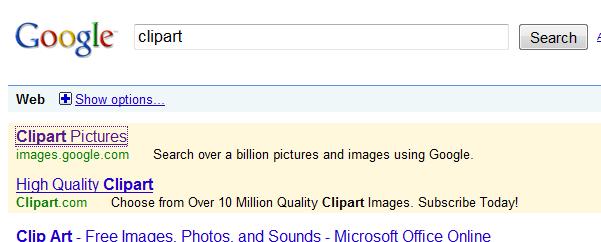
At one point I had an issue with trying to determine if “clipart” or “clip art” would produce more results so I punched both into Google’s regular search engine, below is the ad that came up.
cliparthuh

In short, Google was advertising its image search feature as a means to find “Clipart Pictures”, even above Clipart.com.

In Google’s defense, it appears to have been a one-time thing. I haven’t been able to replicate it today. Also, it is almost certainly an automatically-generated ad based on keywords. Still, the fact that Google could connect Google Image Search with clip art, even though it is made up of images from all over the Web, most of which they do not have the copyright in, is disconcerting.

Update 12/16: Even though I haven’t been able to replicate it today, artist Meredith Dillman was able to get it to work last night following my original tweet on the topic. It appears that it wasn’t just me.

Granted, the ImageExchange extension, which I am testing aims to make Google Images (as well as general Web browsing) useful for stock photo searches, by itself Google Image Search has no means to license images, only point to sites that can (such as iStockPhoto, etc.)

To be clear, I don’t think that Google thinks of its image search product as a clip art gallery and it seems that this was a mistake and one that has already been fixed. But I would also argue that Google hasn’t done a great deal to dispel the idea either. Other than a vague “Image may be subject to copyright” warning in the frame above the clicked link, there isn’t much notice that the images aren’t for reuse without permission, especially for a layperson.

To make matters even worse, their CC-licensed search, which might actually be useful for finding clip art and stock photos, is buried at the bottom of their “Advanced Options“.

While it isn’t Google’s responsibility to make sure that everyone who uses its image search does so properly, it would be nice to see Google make it easier and more effective for what is almost certainly one of its most commons uses. This would help both artists and those seeking to use art at the same time.

That and not advertising it as a source for clip art would also be good idea…

Share and Enjoy:
  • Twitter
  • Facebook
  • Digg
  • del.icio.us
  • Reddit
  • StumbleUpon
  • Slashdot
  • Tumblr
  • Fark

1 Star2 Stars3 Stars4 Stars5 Stars (No Ratings Yet)


Loading ... Loading ...

Short URL to this Post: http://copybyte.com/z/ka

Jonathan Bailey is The Webmaster and author of Plagiarism Today, which he founded in 2005 as a way to help Webmasters going through content theft problems get accurate information and stay up to date on the rapidly-changing field. He is also a consultant to Webmasters and companies to help them devise practical content protection strategies and develop good copyright policies.
Email this author | All posts by Jonathan Bailey

  • I'm surprised you didn't add that the way Google uses images breaks the DMCA. They use the whole image, instead of part of it (like text), and as you said, they say the image MAY be protected by copyright. By law for the last 50 years, everytime an image is created, the creator automatically has copyrighted it.

    I hope you have Fair Use explained somewhere on the site - almost no use of an image is Fair Use except perhaps works of art in a gallery or museum.

    Also, there is a Java script that breaks the frame - and the viewer goes directly to the website. (although this takes about half a second.)

    <script language="JavaScript" type="text/javascript">
    if (top.location != self.location) top.location.replace(self.location);
    </script>
  • Donna, this is one article on a site that covers this topic extensively. Jonathan has covered fair use extensively in other articles.

    (I do agree that Google Image Search has contributed greatly to image infringement.)
  • Robert
    When you first posted this, I was seeing Google Images for the "clip art" and "clipart" searches too. It was coming up with some regularity. Now, I get Bing all the time.

    If anyone thinks this is a coincidence or an accident, think again. Google is well-known for intervening manually in its search results when something embarrassing occurs. And whenever possible, they try to make their competition (or the person complaining) look stupid.

    It would be nice if they took some real action against copyright infringements instead of just shifting the focus or the blame around. Here's a prime example: Try searching for a CD or a DVD or a new movie or a book. How many times does Google suggest "torrent" or "rapidshare" or any of a host of ways of stealing intellectual property. EVERY TIME.

    In Google's view, the only intellectual property that is worth protecting is its own patents. They think everything should be available under fair use, and they use the safe harbor provisions of the DMCA to defend themselves. It's a huge loophole for companies like Google. Unfortunately, it's a necessary one, too, which makes it very difficult to challenge. Google knows this, and Google exploits it to the point where I feel that they often flaunt their invincibility in the faces of those who create content of any kind.

    If anyone thinks it will be any different once they get their hands on a bunch of copyright-protected, but out-of-print books, think again. Once Google turns those things loose, there's no getting them back, and authors are going to earn next to nothing for their efforts.
  • I wasn't able to duplicate your result, but something similar. I got an ad for Bing for Cartoon Clip Art (link goes to Bing with a search for Cartoon Clip Art without any notation of copyright/licenses). I can send you a screengrab if you want.
  • Please do, that'll be interesting to look at and very worrisome on that front as well. Thanks for the heads up!
  • What do you think stock photo agencies should do to deter Google image users from using the images for free? http://www.ImageEnvision.com/ added "no free use allowed" to their watermarks.
  • Sadly, that doesn't help too much when the image gets bought and then used on another site and picked up in Google there. That image will not have the watermark.

    The watermark is a good step, especially since stock photo sites do seem to be ranking highly in Google Images, but it has to be weighed against whether the customers will be frustrated or confused by it and what actual good it will do.

    Watermarking is a good step, but Google will still have to do something as most instances of the image won't have it.
blog comments powered by Disqus