
My Response to Mark Helprin
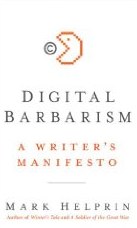
Earlier this week, Mark Helprin, the author of the book Digital Barbarians, posted a defense of his book on the National Review Online. Seeing as how I was among the sharp critics of the work, I felt it appropriate to respond.
Dear Mark Helprin,
I have to wonder what you would think of me if you met me. I’m a strong supporter of copyright. I operate a site called Plagiarism Today where I help small artists and Webmasters protect their creations and defend their works against plagiarists, spammers and others that would seek to misuse it. I also manage a company called CopyByte.com, which provides managed copyright solutions for small businesses.
However, I am also a member of what you would call the digerati. I blog, use wikis, have an iPhone and even place Creative Commons Licenses on my works. Though I believe copyright reform to be necessary, I also believe in the necessity of copyright very strongly and see reasonable reform as a way to rebalance the law to protect it for the future.
When I read your book, I felt I had no choice but to give it what can be politely called a scathing review. I didn’t like your book and I didn’t enjoy it and I don’t know of anyone who did. It’s that simple.
To be clear, it wasn’t your opinions that drove me away. I routinely enjoy books and other works I don’t agree with, your book just wasn’t one of them. I don’t agree with everything written by Lawrence Lessig, Bill Patry or even Ben Sheffner on his blog, but I read and enjoy of them. They are good writers with good arguments.
As I said in the closing of my review, “The novel-length copyright polemic is one that few authors can tackle. Helprin is not one of them. Though I think he is a very talented writer and may look up some of his other work, this is not the format for him.”
However, as a critic of your work I read with great interest your recent rebuttal to all of us. As I plowed through it, several things dawned on me that I feel should be put in plain English.
You Don’t Know Me
First, you say in your rebuttal that one of the critical responses to your book was that we, the critics, didn’t “understand” you. You may well be right about that. However, it is equally clear that you do not understand the groups you attack.
As I said in my review, you paint those who favor copyright reform with a combination of broad strokes and petty insults. In your view, those with CC licenses are raving anti-copyright lunatics Hell-bent on abolition, no matter what their actual views and intentions are. This alienates centrist figures such as myself and makes your arguments laughable to those further on the left.
Maybe we critics don’t understand you, but it definitely appears the feeling is mutual. However, we are not the ones writing a polemic about copyright and we are not the ones writing to convince an audience. The onus to both understand and be understood is on the author.
On that note, making yourself and your arguments understood is another failing of the book. You claim that your critics feel it “necessary to their physiology to think that I am for perpetual copyright,” and it is true many reviews made that claim. While you have stated repeatedly that you aren’t, you are also the one who has, both in the op-ed and the book, made favorable comparisons between intellectual property and physical property and based many of your arguments accordingly.
Doing so is a bit like saying you’re not in favor of longer prison sentences for inmates, but still wish that our system could be more like North Korea’s. It is a mixed message. However, how can we “digerati” hope to understand this message when even the headline writer at the New York Times missed it, giving your now-infamous op-ed the headline “A Great Idea Lives Forever. Shouldn’t Its Copyright?”
You also complain that a particularly insulting paragraph, quoted in your rebuttal, made it into nearly every review. I have to plead guilty as I used snippets from it as well. But the reason is apparent. When you read it, it leaps off of the page and becomes a “Holy Cow! Did he just say that?” moment. When I read that paragraph, I heard the sound of a thousand page corners being turned down in my head.
I understand well what it is like to have a mob show up at your door over a misunderstanding or a single quote in a long work. It’s frustrating, especially when you feel you have valid points buried within. But as writers we both have to take responsibility for what we produce. You penned the paragraph, you chose the words, the fact it became a lightning rod for criticism should shock no one, the least of all you.
The results were, to say the least, predictable and the fact that it distracted from your was a misstep on your part. In the bid to make clear, easy-to-understand arguments, the author has to take the lead.
Still, you are right, we don’t understand you and it seems clear you don’t understand us. However, this is not a failing of those who read your book and posted critical reviews, it is your fault. It is a failing both in research and in writing that you failed to clearly grasp your audience and clearly state your arguments to them without distractions.
Who’s Book is it Anyway?
This failure is highlighted in your rebuttal. You complain that, “Nearly every publication, left, right, and center, assigned the book, with digital in its title, to a resident digeratus, a member of the very tribe I provoke….”
This would seem, to me at least, to be the exact group you would want reviewing your book. The goal of a polemic is not to hear oneself talk or preach to the choir, but to convince the other side of your truth and make them agree with you. Anyone else reviewing your book would be a poor test of its effectiveness.
This raises the question of “Who was this book for?” Given that your rebuttal also slams “the corporate defenders of intellectual property” as people who “sit inertially in their towers and forfeit the more general debate,” it seems as if the book was written almost solely for Mark Helprin.
You found yourself alone in your arguments not because there aren’t a few points where you have some merit and a defendable position, but because you have worked to alienate everyone who might have come to your aid.
Bottom Line
In the end, I agree with the reviewers who feel that you do not know what you are talking about. I don’t say this because you mentioned Slurpees and Hip Hop though they predated the digital age or that you cited Mozart and Raphael, both of whom worked without copyright protection.
Instead, I say confidently you don’t know what you’re talking about because you claim, with your op-ed, you were, “In complete innocence that I was parachuting into a holy war.”
Mr. Helprin, your op-ed was published in 2007. The DMCA was passed in 1998, Napster was shut down in 2000, the Grokster ruling was in 2005. If you had performed as much as a Google search on the topic, you would have seen the dangerous waters you were treading into. It is clear you “parachuted” blind and now take offense that people claim you don’t know what you’re talking about.
But even if I can forgive your ignorance in 2007, you showed a similar kind of ignorance in your book, as if the backlash to your op-ed and two years of writing had not lead to one ounce of new research. You knew almost nothing about your opponents other than they used technology and, at times at least, had very poor grammar. Thus, you argued the wrong points and presented a case so out of step with both the times and the actual arguments that almost no one could take you seriously.
The problem with Digital Barbarians is simple. It is a bad book. Rather than blaming your audience and your reviewers, there comes a time where you have to take blame for your own mistakes.
There is room for a good pro-copyright polemic out there, but this is not it. I admire your attempt but, in the end, I think your book did more harm than good to the causes you support.
If you are able to take the criticisms to heart and learn from your mistakes, you may be produce a really great work in this area. But if you can’t, then there is no hope.
But then again, what do I know, according to you I’m just a Slurpee-sucking geek who seldom sees daylight (though technically I prefer Icees).
Sincerely,
Jonathan Bailey
Want to Reuse or Republish this Content?
If you want to feature this article in your site, classroom or elsewhere, just let us know! We usually grant permission within 24 hours.