Why I Don’t Celebrate The Thomas Ruling
 As I’ll be talking about on the Copyright 2.0 Show this weekend, it has not been a good week for the RIAA and other big copyright holders. However, the the biggest news, which everyone has been talking about, is the overturning of the RIAA’s $222,000 verdict against Jammie Thomas.
Though I think that this is great news for Thomas and I lamented the verdict when it was handed down last year, I’m not quite ready to celebrate its overturning yet either.
The problem is that this doesn’t bring an end to the case. Rather, it just sets it up for a retrial. Ms. Thomas’ life is still in a state of upheaval, she may still wind up owing money to the RIAA and the RIAA’s campaign against file sharing has not been stopped.
Nothing is resolved with this overturning, in fact, the conflicts are just extended. Even if the RIAA loses, it seems unlikely that they are going to abandon their campaign and, instead, will just come back with new tactics.
The simple truth is that this is not over, far from it, and might only lead to an even uglier chapter in the history of copyright law.
RIAA Evolution
 Whether you agree or disagree with the RIAA’s tactics, you have to admit that they have been incredibly effective. Though they might not have resulted in any decline of file sharing, they have racked up a win/loss record that would be enviable for just about any law firm.
Their methodology ensures that most of the people they target do not fight back. Fair or unfair, this keeps costs down while keeping the cash coming in.
The RIAA has made mistakes. It has sued minors, dead people and grandparents, but it has learned from those mistakes. In fact, if you look at those three stories, you’ll see they are all from 2003-2005.
The classic RIAA blunders, for the most part, are gone. However, getting around those issues involved taking other steps that raised other questions, such as hiring MediaDefender to help them. Sure, MediaDefender has had their own screwups, but the RIAA has managed to largely distance themselves from those mistakes and, to date, they have not seriously hurt their legal efforts, at least in the United States.
The RIAA, despite a repeated drumming for just reusing the same tactics tens of thousands of times, has actually been pretty good about adapting their techniques, getting around hurdles.
In that regard, if the Jammie Thomas ruling happens to be a crushing defeat for the RIAA, though Thomas’ long nightmare would finally be over, a new one could be brewing for the rest of us.
What’s Next?
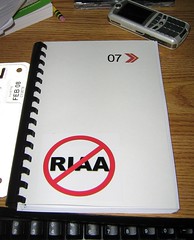  photo credit: frotzed2 photo credit: frotzed2 |
Let’s say for a moment that the RIAA loses this case outright. This seems possible enough now that making a work available on a file sharing network is no longer adequate to sue for copyright infringement.
If they either lose the case or drop it in defeat, are they going to simply stop suing people for copyright infringement? Absolutely not. They’ll continue suing, especially since 99% of all targeted individuals settle rather than fight, that means the majority of cases will still go down in the win column.
The worst it might do is embolden others to fight back. The hope many have is that enough people will fight the RIAA and win to make their campaign financially infeasible. A victory for Thomas would certainly embolden those who are debating fighting back.
But even if legal victory were certain, fighting back would be a poor personal decision without the aid of a pro bono attorney. The settlement cost of $3000 is less than the likely retainer for a major defense attorney. But even with free legal help, you would still be waiting in anxiety for years as the case played out rather than being done with it. This causes many to ask, how much is several years of tension and drama worth?
The RIAA knows all of this and that is why they’ve chosen their approach. Only the selfless, the wealthy or the foolish fight back. Those with mouths to feed and lives to live rarely do anything more than pay up.
But even those who do fight back are going to face an uphill battle. If, for example, “Making Available” is dead as an actual copyright infringement, which it may or may not be, the RIAA will do one of two things:
- Lobby: The RIAA has proved to be very effective at working the government. Though some of their clout may be waning, they could still easily lobby and get such claims inserted directly into the law. This would, almost certainly, have unintended side effects for legal use of copyright works.
- Improve Snooping Tactics: If it comes down that the RIAA needs to prove that files were downloaded, they might make the collection of such evidence a part of their standard procedure. This could mean more intrusive subpoenas and higher settlement costs for those accused.
In short, a defeat for the RIAA here will not mean and end of the war but, most likely, just another escalation. The war between file sharers and the record industry has been one of cat and mouse where the roles change frequently.
This ruling will not change that, at least not any time soon.
Fixing the Problem
The RIAA’s lawsuits will continue and the game will keep escalating until they find a business model that they feel can exploit peer to peer file sharing.
Granted, many individual artists have already begun to exploring such models with great success but the record labels are yet to see it that way. Some success on the individual artist scale does not mean that it will work on the larger one, at least from their perspective.
Until someone comes up with a way to turn free downloads into real cash, the RIAA is going to use every means available to stop it, including lawsuits. That will not change until either the labels are out of business, file sharing has been wiped out or the Internet has shifted in some other major way.
Sadly, I don’t see any good outcomes here, just a lot more fighting, bickering and name-calling.
Conclusions
As I said in my article after the initial ruling, I don’t see any heroes here. I don’t support people who share files illegally nor do I support the tactics of the RIAA.
What I worry about, however, is the consequences that this may have for other artists and other consumers. We are all affected by this fight, no matter what we do.
If you release your work under CC licenses and love your work being shared over file sharing networks, the tactics of the RIAA make it harder to enforce your right to attribution by causing people to treat any copyright enforcement, no matter how benign, with skepticism.
If you purchase your music legally, rampant file sharing is why much of it is wrapped in DRM and why you don’t own the tracks you buy.
If we’re going to reach a reasonable copyright regime, as I said in my first article and Professor Lessig said long before that, we need to declare war against war.
As long as we are fighting blindly, there can be no cooperation and with no cooperation comes no compromises.
The time has come to start talking, but I don’t think the Thomas ruling being overturned is going to jump start that process.
Want to Reuse or Republish this Content?
If you want to feature this article in your site, classroom or elsewhere, just let us know! We usually grant permission within 24 hours.