
My Experience with the Music Industry

By Jonathan Bailey • May 14th, 2008 • Category: Articles, Personal Experiences

Local H LogoYesterday I did something that I literally had not done in years, I bought a CD.

This isn’t to say that I haven’t bought music over the past few years, but all of those purchases have been online, either through the iTunes store or by purchasing MP3s straight from the band’s site. However, even then my purchases have been relatively few and far between.

However, yesterday was a special day for my wife and I. Local H came out with their first album in several years, entitled “Twelve Angry Months” and we were very eager to get our hands on it.

Furthermore, we wanted to buy the physical CD. Not only did we want the case and the liner notes, but we wanted it DRM free. While DRM music is fine if you are just going to listen to the tracks a few times, if something is going to be a part of your life, as the other albums have been, we want something that travels better.

So, after my wife got home at the end of the day, we headed out to grab a copy. What followed taught us a great deal about the struggles of the music industry and why I don’t buy that much music anymore.

Background

Admittedly, Local H is not a nationally-recognized name. From Zion, Illinois, they are much better known in the Chicago area than other parts of the country, including here in New Orleans.

That being said the have been around for well over a decade and have had several “hit” songs. Many people know their music without realizing that they were behind it.

The “As Good As Dead” album is typically very easy to find in store while others are usually dicier. Still, with a new release we figured that there would be no issue in tracking down a copy.

We were very wrong.

Getting the Album
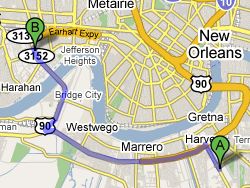
Google Maps of the DriveBefore we got into the car, we did some research and tried to locate an actual music store in the area. Not having been on such a run in several years, we had little idea where to begin, especially since Hurricane Katrina.

We jumped on the Internet and got names of stores and called them only to find that every single one was closed. It was disappointing, but we moved on to considering alternatives.

It was then that we remembered that Best Buy carried the band and decided to bite the bullet and head there to pick it up. This was in spite of the fact that Best Buy was not exactly along the beaten path for us to start with and is hardly our favorite place to go for anything.

However, after arriving and searching for the CD unsuccessfully, a very nice floor rep told us that they had sold out of the disk. At first we were happy that the CD was selling so well but then found out that they had only received a small number of CDs on the release date to “test how it sold” and that they “might get a larger order in next week.”

The rep then checked other stores in the area and found a copy of the disk at the Harahan store, which was across the river and across town from where we were. It would have taken at least 20 minutes to get there, probably more considering traffic was still bad.

Worried that we would drive over there to find the copy gone, we decided to chance it with stores closer to us.

We next hit a Circuit City and a Target, neither of which carried any of the band’s CDs. We debated stopping by Wal-Mart but broke into a debate about whether or not any copy we bought there would be censored. Though the CD hadn’t earned an “advisory” sticker, Local H is not exactly known as family-friendly either.

We passed on Wal-Mart on principle but did a quick check on our phones of Walmart.com, we found that they carried only two albums and both were “online only”.

During all of this driving, Crystal, using her phone, located an open CD shop on Bourbon St. She called only to find that they didn’t have the album in stock, however, they could easily order it and have it to us on Thursday.

We promised to call them back.

Frustrated and ready to give up, we decided to make the drive to Harahan. There, we finally found a copy of the CD buried in the actual Local H section, not in the new releases, and walked out with it.

We were fifteen dollars poorer and had spent over two hours trying to find it, but at least we had it and we had a long drive home with which we could listen to it.

A Better Understanding

The reason I am frustrated is because I did exactly what the music industry says it wants me to do. I didn’t fire up Bittorrent and download the CD illegally, I didn’t stream it off of Internet radio and I even avoided going the cheap route and downloading it off of iTunes. No, I paid full price for a brand new CD from a major retailer.

To thank me for my loyalty, the music industry made it almost impossible to buy their product. The problem isn’t Local H nor even their label, but a music sales system that virtually crushes any hope of variety.

At every store we visited, my wife and I could have easily snatched up a dozen copies of either the latest Madonna or Jordin Sparks album. While I am sure that these are great albums, they were languishing on the shelves while the product we wanted was nowhere to be seen.

If you’re not a fan of whatever the record labels are promoting that week, you’re forced into doing one of three things.

  1. Download the music illegally and not support the artist while risking being hauled into court.

  2. You can download a DRM-crippled copy of the album from any major online retailer and pray that the DRM doesn’t stop working.

  3. Spend hours of your life driving all over town in hopes of finding a copy and spending extra money for it.

The first option cheats the band and the second two cheat the customers. Though it doesn’t make it right, when you’re spending nearly 30 minutes in traffic heading to a store across town that might, just might, have a single copy of the CD you want, you begin to understand the temptation of Bittorrent.

In the time it took me to obtain a legitimate copy, I could have pirated the CD, listened to it twice and have written a short review. It would have been both legally and ethically wrong, but I would have had a lot more time in my evening for other things.

Why I Talk About This

The reason I talk about this is simple. The average reader of this site is a small copyright holder. We are bloggers, photographers, artists and musicians. We use the Web to distribute our works freely, or at least make them freely accessible.

Still, we have real copyright issues that need to be addressed. We have spammers that scrape our feeds and use our content to game the search engines. We have plagiarists using our works to pad their portfolios. We have eBayers that sell illegal prints from our freely-available photographs.

Every day small artists are ripped off in significant ways both on and offline and they turn to copyright law to protect them. However, there is a backlash against copyright law, in no small part due to the actions of the movie and music industries.

There are many good people who are calling for the abolition of copyright law not because they feel artists don’t deserve to be rewarded for their work, but because the current system feels broken and, in some cases, is being used to force customers into a business model that is inefficient and ineffective.

Even those who aren’t calling for the outright abolition of copyright law view it with a very wary eye. To many, the “C” inside of the circle might as well stand for any one of a number of four-letter words.

This makes it very difficult for those of us with with copyright issues that go beyond mere copying to protect our works. Hosts are unresponsive, readers are slow to assist and artists are scared to act when all they are trying to do is stop people from unfairly exploiting their work.

This is the climate that we operate in and the music industry is a large part of why it is so hostile against many of us.

Copyright is a tool and, like any tool, its inherent good or evil lies in its application. Sadly, the best known one use currently is as a stick to beat customers into following a business model that simply does not work.

Though many of the calls for the end of copyright are clear cases of throwing the baby out with the bath water, the receptiveness of the audience grows in lock step with the increase in frustration.

That should give all artists a reason to pause and think about how the RIAA and other major copyright holders could be destroying not just existing models, but future ones as well.

Conclusions

As artists who are interested in copyright, we have to keep our eye on the larger picture. Though it is easy to dismiss my afternoon yesterday is a strange person seeking out a CD from a relatively unknown band, the fact is that most music buyers have no interest in purchasing the new Madonna CD, or any other individual CD for that matter.

Everyone has their own taste in music and many people will have far more obscure preferences than me and my wife. This means that, every week when new releases come out, hundreds of thousands of people are forced into similar predicaments.

This isn’t about just one bad incident trying to find a CD any more than piracy is just about getting free music. This is about a much larger problem and how the music industry’s response to it is hurting all copyright holders.

Hopefully a solution will be found before the damage becomes irreversible.
localh-album-cover.jpgPersonal Note: Just to clarify, I am not trying to say anything bad about Local H or the album. In fact, quite the opposite is true. The album is great and well worth both the money and time. I am very glad that I have a physical, DRM-free copy of the CD as I plan to enjoy it for many years to come, as I have with the other albums.

If you are curious about the band you can check out their site or listen to samples of the album on their Myspace page. Specifically, listen to “24 Hour Break Up Session” and “Machine Shed Wrestling” as they are the previews off the new record. Also, if you don’t mind the DRM, you can buy it off of iTunes as well.

The problem is much larger with Local H and is with the music industry as a whole. However, as Local H proves, there is still some good music to be found, no matter how broken the system is.


Jonathan Bailey is The Webmaster and author of Plagiarism Today, which he founded in 2005 as a way to help Webmasters going through content theft problems get accurate information and stay up to date on the rapidly-changing field. He is also a consultant to Webmasters and companies to help them devise practical content protection strategies and develop good copyright policies.
Email this author | All posts by Jonathan Bailey

  • I don't understand why you say that copyright is used as a "stick to beat customers into following a business model that simply does not work." When I shop for music, I'm never forced to do anything. I am offered a lot of deals that I either accept or reject, but the salesperson never pulls out a stick and holds me up for my money. And likewise, I don't hold up the store or try to steal their property. Everything is voluntary, nobody is made to do anything against his or her will. We either do business or we don't.

    And I bet that's not exactly what you meant, but I think some parts of your post suggest that somehow people don't have a choice or they are somehow a victim of the way music is sold today. The truth is, it has never been easier to find, listen, and buy music than it is right now. Legally, too, and without DRM. I just did a search on Amazon, and the music you were looking for is available as a DRM-free, 256 kbps MP3 download. And if you want the CD and liner, you can order the CD online and get it shipped to you in a day or two. So let's be honest: 1.) You weren't driving from store to store just to get the music; you were picking one option (out of many other options) that would get you the physical CD in your hands the soonest, and 2.) customers have more than the three options you listed.

    If customers were only limited to your options, though, it still wouldn't justify stealing the music (not that you are saying that). Copyright is like a deed on a piece of intellectual property. When someone owns something, whether it's an apple, a car, or a song, they get to decide what to do with it. That includes the right to set up bad business models to sell it. It's their call what they charge and how they sell it, and as customers our only option is to accept or decline.
  • Jonathan,

    It's funny to read your post because Tower Records, which went bankrupt, was precisely that beautiful type of record store where you could browse hour after hour. They stocked everything even the most obscure records. But they are gone because piracy and file-sharing destroyed them. You can't blame everything on the labels. People who download music illegally have to accept responsibility for their actions. And one of those is that retail record stores are fast growing extinct. You can't find an obscure CD at retail now because it costs too much (too few units are sold) to make it economical. The bittorrents and illegal downloaders have forced retail record shops to be limited to just the mega-star offerings.
  • Darren: True, I did not meant that directly by any stretch. It was a metaphor and definitely not my finest. We now see why I am in journalism again and not doing poetry. It was an expression of frustration more than anything, not meant to be taken literal in any way, shape or form.

    Perhaps I write too literally these days.

    I'll be honest about Amazon and say that I didn't think of it. Hindsight being 20/20, I should have. However, I have to pass some of the buck on to my friends that have used Amazon and found the selection limited. It was a false assumption that they wouldn't have the CD, but an understandable one considering my father, who buys tons of music online (how sad is that when my father buys more than me?) gave Amazon a big thumbs down for having a wide selection.

    Still, I'll take the blame for that one and, to make amends, I am buying the "No Fun" EP from there. I have a copy somewhere but I lost it and didn't rip it before it disappeared, this beats buying a new copy.

    However, the flip side of the coin is that there is clearly an image and marketing issue here as well. It doesn't justify copyright infringement, but it might have saved me at least some of the rant.

    I guess the end point though was that the music industry has to share some of the blame for its own downfall. One problem I avoided was that I walked out with a 15 dollar cd, after walking past rows and rows of 5 dollar DVDs. For the price of one CD, I could have had three full movies.

    Maybe it isn't a surprise why the movie industry had a banner year in 2007 while the record labels sank like leaky boats.

    John: An interesting point. The Tower Records issue is a strange one but it is important to remember two things. One, a single record chain does not make a healthy ecosystem and two, the store did not mysteriously go dark after piracy started. The downfall of the standalone music store did not happen in a vacuum.

    The downfall of such stores was as much the fault of big box retailers, such as Best Buy, beating them on price and convenience. Did the pirates have a hand and should they bear at least some of the blame? Sure. But the record labels also encouraged an ecosystem where big box stores could easily undercut their specialized competitors and run them into the ground. It was in the name of short-term gains but has cost us in the form of selection and variety. Now the retailers are backing off from music as sales slump and there's no one to stand by them in the bricks and mortar world.

    The Tower music story is sad but the causes are complex. But the ecosystem didn't die with them, they simply died after the environment they thrived in disappeared.

    Just my thoughts...
  • Jonathan, just a quick follow-up to your follow-up...

    Record distributors and labels didn't make special deals with Big Box stores at the expense of Tower Records. Tower was a major player - it was its own big box if you will. Yes, big box stores priced CDs as loss leaders but Tower's prices were always good and competitive. Big Box didn't kill Tower. You can argue that Amazon contributed to Tower's demise - that I think is accurate but the primary reason Tower is no more is that the CD itself has a value close to zero in today's market and the reason that is is because file sharing and torrents have reduced it to that.

    It's a shame because a whole generation of kids will now grow up without having any major music acts of their own. This is the cultural fallout of file sharing. The music business is going to be about small regional acts with a small radius of attraction. This generation will not have its own Bruce Springsteen in other words. It's not cost effective to blow an act up to a national level. The only place doing that is American Idol - that's the only place an act can gain national notoriety. Problem is the music on American Idol has no edge and really no musical interest. It's more like 15 minutes of national notoriety that's totally driven by non-musical factors.

    (The movie industry had a banner year in 2007 but they are scared sh*tless by file sharing. They know they are next. It's already starting to effect their bottom line).
  • John: I agree that the record labels didn't give any special deals to the big box stores, but the deal structure they had in place didn't adequately reward musical variety and that paved the way for stores like Best Buy to use CDs as a negative or near-negative margin item that could be subsidized by overpriced... well... anything else.

    I would agree that the value of a CD is dropping fast, to the vanishing point perhaps, but I think there's plenty of blame for that to go around. The labels missed many opportunities and could have at least prolonged the current crisis by a good while if they had recognized the signs of trouble earlier and tried a different. However, I have to admit, it is very easy to criticize in hindsight so I won't say too much more there.

    Suffice to say though that the music industry was crumbling long before piracy reached levels that drastically impacted the bottom line. Napster, for all of its legend was nowhere near as widely used as current technologies. However, the industry was already undergoing slowing growth at that point.

    I do, however, agree about the problems this creates for the culture. It is a tragedy. I don't see any new acts coming up to become nationwide phenomena. Most of the successful acts on the national stage that I read about are acts that were already doing well ten or more years ago.

    Regarding the movie industry. They are scared and with good reason. But they have been a bit smarter. They have gotten decent legal alternatives out ahead of the curve and already have a user experience that pirates can't match, the movie theater. They have some buffer and can fare better than the record labels. But if they keep releasing junk sequels I can't make any promises...

    Seriously, with the new Indy movie I think they are out of childhood memories of mine to sell out. Well, save for the Thundercats movie in production...

    That is another rant though.

    To summarize. I agree that the pirates have some of the blame but I think there is plenty to go around. Some people always have and always will pirate music and movies, the tipping point is when ordinary users start to do it...
  • Some of the blame? It seems that pirates should have the blame. If pirates didn't pirate, there would be no piracy. The problem is not a business model, it's an individual who infringes on another person's property. That's illegal, no matter what the victim did prior to the crime.

    I understand why people point at the music companies, but I think they're making the mistake of blaming the victim. As a quick example, imagine if I emptied my bank account, dumped the cash into a wheelbarrow, and then walked down the bad part of town singing the "Money, Money, Money" song. Sure, I'm putting myself in a bad situation by not protecting myself, but if somebody grabs some of my cash and runs away they've still committed the same crime as if they had grabbed my wallet out of my back pocket. Music companies aren't acting nearly as irresponsibly as my wheelbarrow o' cash example, but they're treated as if they're the primary cause of piracy.

    I've only been listening to the podcast and reading your writing for a few months, so I'm sorry if this is a bad question... but I want to ask it: Do you come down on groups like the Pirate Bay as hard as you do on the RIAA?

    As for your three options, the error wasn't missing the Amazon website, it was creating a list that didn't include all of your viable options. When I read your options I immediately thought "Or, 4.) you can buy the music DRM-free from an online store that sells it. Emusic, Amazon, or Napster perhaps?" Then I checked Amazon, and sure enough it was there. I think if you wanted to make amends for skipping over that option, you'd do more than buy an album from Amazon. Wordpress has an edit button, and you can still add in that fourth option to correct the original error.
  • Darren: The way I look at the problem is this. The record industry is something like a patient in a hospital, slowly dying. It is easy to say that the patient is dying of cancer, or whatever disease you want to use here, and walk away. However, the truth is much more complicated.

    If the patient is dying of something (piracy), what caused it and what can we do to prevent it in the future. Some of it can not be controlled (human nature and bad people), some of it is environmental (how the product is consumed made it ripe for piracy) and some of it was based on actions taken by the patient (not setting up legal alternatives quickly enough).

    Also, it's not safe to say that, if we magically cured the disease that they would be in good health. The record industry has a lot of potential ailments eating at it right now and there is no guarantee that they would be "all better" if it weren't for the piracy issue.

    I'm not trying to blame the victim any more than I would blame a victim a serious ailment. I'm just acknowledging that these types of situations have complicated causes and many different factors.

    The truth is that the music industry could have done more to prevent this problem, but failed to do so. Would it have stopped or even slowed the process? Hard to say, impossible to say actually. But if you're looking to tell others what they can do to avoid a similar fate, you need to look honestly at everything that went wrong.

    A one-dimensional view of the problem solves nothing and, frankly, I think that BOTH the RIAA and The Pirate Bay are guilty of that same sin.

    Which brings me to the next question, I admit that we're hard on the RIAA on the show but don't mistake the humor and silly banter for political opinion. Granted, you're not going to win any friends anywhere by suing single mothers for nearly a quarter of a million dollars. Such rulings haven't helped their cause and could create new limits on the amount of damages other copyright holders can claim later due to public outcry.

    However, I'm no friend of The Pirate Bay and I don't want anyone to think I am. I've been hard on them in the past too reminding everyone that they don't want to do away with the middle man, they want to replace him. There is a big difference. Still, I admit, I go where the jokes take me and the old comedic principle of jab at those in power seems to apply.

    Perhaps I am a bit unfair but I do try to be equally hard on both. I certainly have no love for either side at the moment, though the record industry has at least been making an effort.

    As for the fourth option, I think you have a point. I do need to add it and will. Still, as an option, it has flaws too, considering how limited many of the DRM-free catalogs are. Also, I did actually check emusic (they had an ad in my Netflix) but the registration requirements and confusing plans scared me off. I couldn't even search without an account.

    Amazon's system is clearly superior and much more worth the attention.
  • What sin is both the RIAA and the Pirate Bay guilty of? I know the Pirate Bay commits copyright infringement, but what about the RIAA?
  • Darren: The sin I see is that both sides are looking at a very complicated issue with a very one-dimensional tone. They both have colored this fight with hard lines, looking at it as a fight between good and evil. This has enabled both of them to pursue their interests and ignore the consequences to others.

    As I see it, there are no heroes here and neither side has our best interest in heart, just their own. There's nothing inherently evil about that, it's called rational self-interest, but I have to be a realist and see that the situation is much more complex than either side paints it to be. The record labels are not evil, The Pirate Bay is not a freedom fighter, the record labels are not wholly innocent in the situation and The Pirate Bay is about more than getting free stuff.

    They see things as black and white, I try to see the shades of gray. I'm not perfect, but I at least try.
blog comments powered by Disqus