
Google’s Shell Games

By Jonathan Bailey • Nov 16th, 2007 • Category: Articles, DMCA, Legal Issues, Punditry

Anyone who is a regular reader to this site knows that, in order to get Adsense removed from a scraper or plagiarist’s page, you are required to file a DMCA notice.

Adsense has its own DMCA policy and follows it very strictly. Though results can be obtained through that means, few bloggers actually use it.

Not only is the process unnecessarily complicated and time consuming, but a great deal of confusion is being spread about the nature of their policy.

However, the cause of the misunderstandings are very easy spot. If you follow Google’s abuse process, the confusion is very apparent as Google itself says never mentions its DMCA process when filing a complaint. Instead, it intentionally allows visitors to finish the entire process, certain the matter is in good hands, before letting them know the truth hours or days later.

It isn’t that these bloggers didn’t do their research, just that they were misled by a company who’s motto is supposed to be “Don’t Be Evil”.

Adsense Abuse 101

In theory, reporting Adsense violations is as simple as a few clicks of the mouse.

When you see a site breaking any of Adsene’s rules, you are supposed to first click their “Ads By Google” link at the top or bottom of one of the ad blocks. You are then taken to a page that tries and sells you space on the site or get you to sign your own site up.

However, at the bottom there is a link reads “Send Google your thoughts on the site or the ads you just saw”. If you click that link, a form appears below asking you what you thought of the ads. Below that is a link to report a violation. Click that link and a subform appears asking you to choice between a violation with the ads or the site itself.

If you choose the Web site, you get a question with the options below:
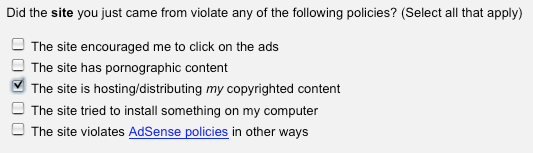
The third option reads “The site is hosting/distributing my copyrighted content” (emphasis in original) and seems to be perfect for reporting scrapers and spammers. If you hit submit from there, you get a thank you page and a promise to look into the matter.

Then nothing happens.

If you provided your email address, which is entirely optional in the form, you get an email some time later telling you that Google can not process your complaint without a DMCA notice. It then links to the Adsense DMCA policy (found above) and offers little else.

In the meantime you’ve lost hours, possibly days worth of time waiting for a response from Google and now have to start all over again.

Frustrating, yes, but entirely avoidable.

A Double Standard

Even if we discard the facts that Adsense is not protected under the DMCA and that Google’s DMCA policy is likely illegal in and of itself, there are several problems with this method of handling things.

The biggest is that Google knows that they can not and will not act on such complaints without a proper DMCA notice. They wrote the policy and they stand by it, for better or worse. Yet they keep that option available, even though it only leads to confusion.

Of course, the presence of that option would not be so bad if Google would actually notify submitters of the requirement to file the DMCA before they left the page.

Strangely, Google actually does exactly this one of their other sites, YouTube. If you use the “Flag” feature at YouTube to report a video for copyright infringement.
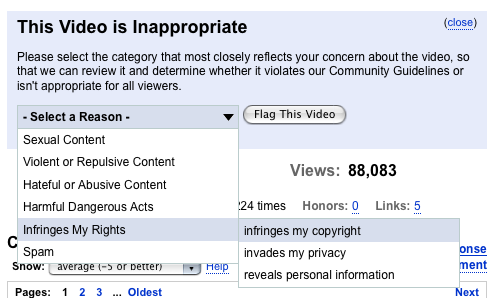
You are then given an error message directly you to their help center, which provides instructions for properly reporting the clip.
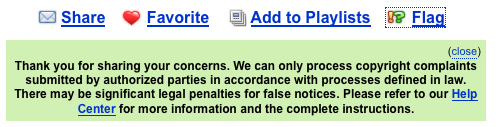
It is not a perfect system, but it prevents Webmasters from wasting days waiting for a response when one simply isn’t coming.

Bad Behavior

Questions about why Google does this is entirely up for debate. The most obvious reason, however, is that Google has much less motivation to be cooperative with Adsense than YouTube. Adsense is Google’s main money maker, is not technically protected under the DMCA and is not the subject of a billion dollar lawsuit.

But no matter what the reason is, this is just another artificial hurdle to Google’s already obstructionist DMCA policy. Google already mandates you send a physical signature, though the law clearly states that it is not necessary, refuses to accept email notices and often takes weeks to respond to a perfectly legitimate notice filed using their own policy.

Google could probably fix this problem within the space of a few hours but, for whatever reason, it has not been a priority for them. Instead, there are countless confused bloggers who believe that Google simply doesn’t respond to complaints about scraping doesn’t care.

The result is not only a damaged reputation for Google, but that thousands of spam blogs continue to thrive because content owners were thwarted in reporting the problem. They either never got the email requesting the DMCA notice, likely because they didn’t fill out their email as it was optional, or had simply moved on in the days that had passed.

The side effect of that is, of course, that Google gets to keep making money on the spam blogs. Considering they provide the hosting, promotion and revenue stream with their Blogspot, search and Adsense products respectively, Google seems to be a spammer’s best friend. Sadly, this “do the absolute minimum” policy when dealing with scraping seems to be a mere extension of that.

Even worse, it doesn’t seem to be getting any better in the near future.

Conclusions

Google is a company like any other, with responsibilities to share holders and employees. The bottom line for a corporation is, quite simply, the bottom line. Money doesn’t have an ethical or political stance and companies know that.

We should not expect companies like Google go act quickly on something that is not in their best interest. Instead, we should make it in their best interest to act by voting with our dollars. Doing anything else will have no effect.

The quicker we realize that, the quicker we can start to see some real change from Google in these and other areas.

Even though no company is perfect, a company should at least attempt to live up to is motto. Otherwise, it should expect its customers to demand better and then seek it out elsewhere.

Share and Enjoy:
  • Twitter
  • Facebook
  • Digg
  • del.icio.us
  • Reddit
  • StumbleUpon
  • Slashdot
  • Tumblr
  • Fark

1 Star2 Stars3 Stars4 Stars5 Stars (No Ratings Yet)


Loading ... Loading ...

Short URL to this Post: http://copybyte.com/z/1f

Jonathan Bailey is The Webmaster and author of Plagiarism Today, which he founded in 2005 as a way to help Webmasters going through content theft problems get accurate information and stay up to date on the rapidly-changing field. He is also a consultant to Webmasters and companies to help them devise practical content protection strategies and develop good copyright policies.
Email this author | All posts by Jonathan Bailey

  • Recliners: I think there is indeed a very strong sentiment against Google right now. One of the big problems though is the lack of a better competitor. Microsoft is viewed as being even worse, Yahoo! doesn't seem to return accurate results on may queries and Mahalo is years away from being viable.

    Who wants to found a new search engine?

    Maria: I've noticed similar issues with FeedBurner since the transition as well. I used to promote them openly on this site but I have not done so since the transition. I've been debating leaving them but know that would likely cost me many of my readers.

    The answer to your second question is that Google is paranoid, wanting to stop everyone from making money from them that isn't paying their cut. That is sure how it seems.
  • A little side note here...

    I recently visited the support forums for FeedBurner, which was purchased by Google within the past year or so. In the old days, the forums were full of helpful information. Today, the response to someone else with the same problem I have was basically, this is a .htaccess problem, not a FeedBurner problem. We won't help.

    A similar (but not exactly the same) problem involving .htaccess for FeedBurner redirects had been tackled throughly by the FeedBurner staff in 2005, before the company was swallowed by Google.

    What do I read from this? Once Google takes over a company, support is optional.

    And I'm sure everyone is aware of how Google allegedly dropped the Page Rank of Pay Per Post bloggers to 0? While I don't agree with Pay Per Post blogging, I'm also wondering why Google is so anxious to go after PPP bloggers but not the sploggers who are infringing copyrights -- BREAKING THE LAW -- every day.
  • Seems to me that Google is way too bothered with their bottom line and only their bottom line right now! They are being all big brother with bloggers banning paid links and coming down on text link ads, while at the same time not much bothered with the very people they should be working toward protecting. Methinks there is a very strong bugged-with-Google sentiment all across the internet right now. NETIZENS OF THE WORLD UNITE??!!
  • Andy: Thank you for the compliments and for the add! Greatly appreciated! I didn't talk about how U.S.-centric their Adsense policy is and I probably should have. Sending a fax or a postal mail is bad enough if you live in the country, it'd be ten time worse if you lived across an ocean.

    There is a workaround and a way to send an email using a PDF with a scanned signature, but it is a pain to say the least. That, and I don't know the email for Adsense, just for Google and Blogspot.

    Still, one could try the other account amac at google dot com.

    RS: As true as that is, one thing I've learned from watching the financial markets is that it is all quarter to quarter. When a company is in a growth cycle like Google, they tend to obsess over keeping the growth going and making next quarter's results better than the last.

    That leads to some stupid decisions if one asks me.

    I'm sure if Google did what was actually in the shareholder's best interest, the shareholders would bail on them as the stocks slid in the short run.

    People are fickle that way.

    Thanks for the compliments!
  • Another well written article though I would like to take issue on one matter. It is not sufficient for any corporation to act in the best interest of their share holders and worry only about the bottom line. In this day and age, that is very short sighted and as you have pointed out, people will vote with their dollars and it will make a difference. There is something called morals and another called business ethics. Is Google listening?
  • I've also added you into my blogroll as I think your site makes a valuable contribution to making people knowledgeable about an important subject. Keep up the good work my friend! x
  • Jonathan, this is both an excellently-written article and absolutely spot on. As you already know, I wrote about my experience this week with Google AdSense on my own blog - not meaning ads on my blog, which I removed ages ago because they aren't worth carrying, but from the perspective of my being a complainant about splogs nicking my content. Google AdSense has a totally US-centric perspective despite being used across the globe, and does absolutely nothing in real terms to help people whose content is being stolen.

    I was shocked by the email I received. It was as big a waste of bandwidth as any junk mail.

    Again, a truly great piece of writing about a topic that really needs bloggers to start highlighting the world over. I've held the view for quite some time now that genuine bloggers should vote with their mice and click-click until the AdSense ads are gone from their blogs.

    If all of us stopped carrying their ads, maybe then and only then would AdSense stop being so damned lazy, unethical and greedy. x
  • Maria: I can't add much to that other than to say thanks and that I agree completely.

    But even if they have won this round, they won't win in the end. You can't make a profit by sabotaging your money maker. This is a short-term strategy at best that will implode at some point.

    Lets hope it doesn't take the whole of the Web with it.
  • I agree entirely with your assessment of the situation at Google regarding sploggers. As you know, it bothers me to no end that I have to spend many frustrating hours to get Google to act on any of the copyright infringement caused by someone splogging my content. I'm almost ashamed to say that Google and it's partners, the sploggers, have won this round. I simply don't have the time or the energy to stay on top of this.

    90% of the slog-built sites out there are clearly recognizable as splogs due to their automated gathering of content. Google should simply put a "three strikes and you're out" policy in place -- three complaints about a site in a rolling 30-day period should be enough to get the AdSense accounts revoked. This should be simple enough to automate, with a human doing the final check before clicking the revoke button.

    Google is doing the Internet community a disservice by taking this stance. It's enabling -- no, encouraging -- splogging activities. And there's no value to a splog site.
blog comments powered by Disqus